Why Finding the Right Commercial Studio Space Matters for Your Business

Commercial studio space for rent is a specialized type of commercial property designed for creative work, production, and business operations. Whether you’re a photographer, artist, musician, woodworker, or small business owner, finding the right studio space can be the difference between struggling in a cramped garage and thriving in a professional environment.
Quick Guide to Commercial Studio Space Types:
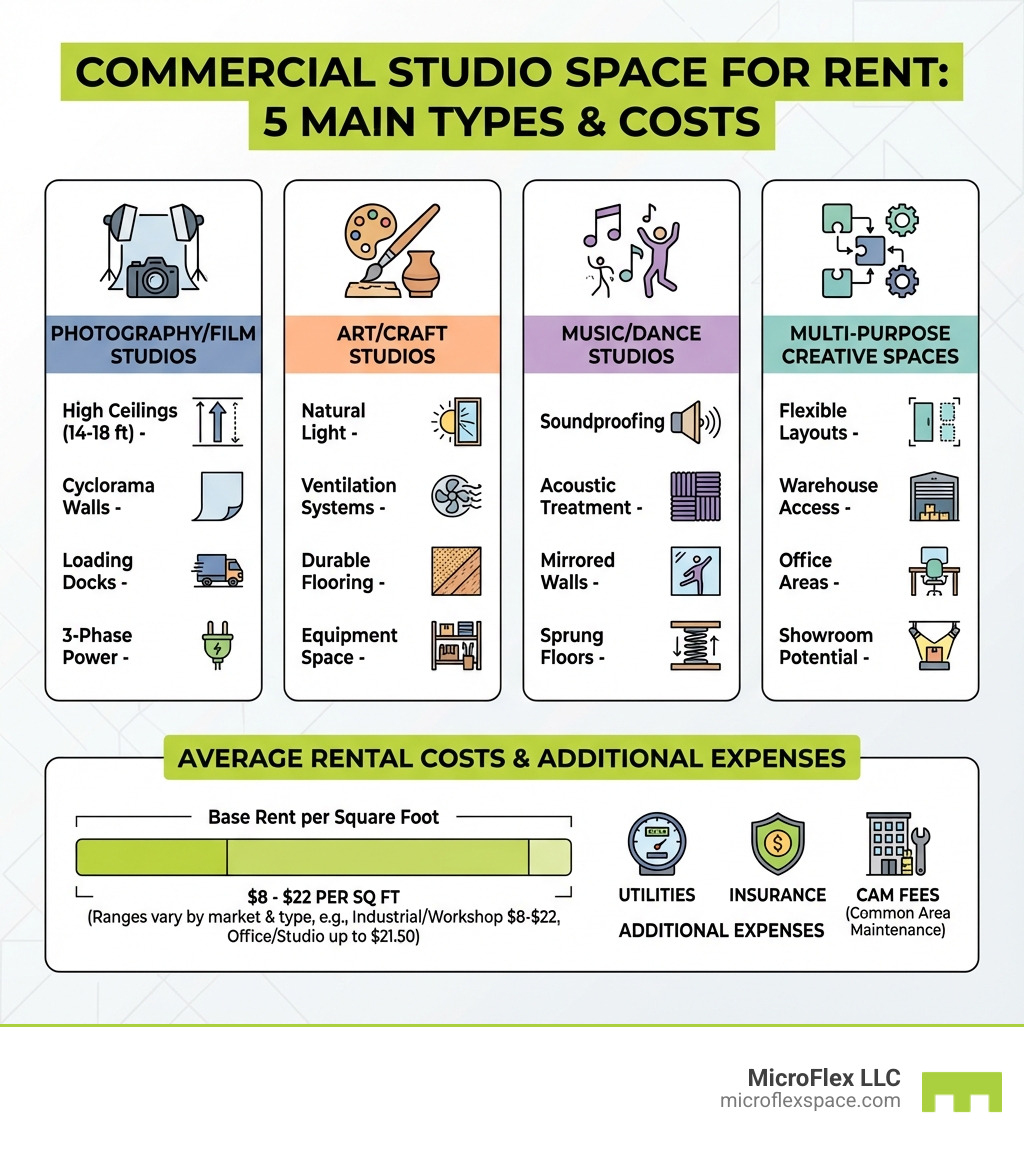
- Photography & Film Studios – High ceilings, cyclorama walls, loading docks, 3-phase power
- Art & Craft Studios – Natural light, ventilation, durable floors, equipment space
- Music & Dance Studios – Soundproofing, acoustic treatment, mirrored walls, sprung floors
- Multi-Purpose Creative Spaces – Flexible layouts, warehouse access, office areas, showroom potential
Average Rental Costs:
- Office/Studio Space: $21.50 per sq ft (varies by market)
- Industrial/Workshop Space: $8-$22 per sq ft
- Total costs typically include base rent plus utilities, insurance, and maintenance (CAM)
The challenge most creators and small business owners face isn’t just finding space—it’s finding space that doesn’t lock them into rigid, long-term commitments that stifle growth. Traditional commercial leases often force businesses into single-purpose layouts with inflexible terms, making it hard to adapt as your needs evolve.
I’m Chase Carroll, and over 12+ years in real estate development and small business advisory, I’ve helped countless entrepreneurs steer the complexities of commercial studio space for rent, with a focus on flexible solutions that support growth rather than restrict it. My work developing MicroFlex spaces came directly from seeing this gap in the market.
Decoding the Different Types of Commercial Studio Spaces
When we talk about a commercial studio space for rent, we’re often picturing a blank canvas, ready for our creative vision. But just like artists have different mediums, businesses have diverse needs. Understanding the various types of studio spaces available is the first step in finding your perfect match.

Photography & Film Studios: These spaces are built for capturing magic. We look for high ceilings to accommodate lighting rigs and backdrops, robust power access for equipment, and often loading docks for easy transport of props and gear. Cyclorama walls (curved backgrounds) are a common feature, creating a seamless visual field. For film production, sound stages may also be necessary, offering controlled acoustic environments. Whether you’re shooting portraits, product photography, or independent films, a specialized space can make all the difference. Check out our insights on Microflex Space for Film and Photography Studios.
Art & Craft Studios: For painters, sculptors, ceramists, and artisans, the studio is a sanctuary. Natural light is often prized, as is good ventilation for working with paints, chemicals, or dust. Durable flooring is essential to withstand spills and heavy equipment, and ample space for workbenches, storage, and display areas is key. If you’re into furniture restoration or woodworking, a dedicated Furniture Restoration Studio or a Woodworking Shop Rental will require specific considerations like dust collection systems and heavy-duty power outlets.
Music & Dance Studios: These studios demand highly specific features. Soundproofing is paramount for musicians to prevent sound leakage and ensure optimal recording conditions. Acoustic treatments help control reverb and improve sound quality within the space. For dancers, sprung floors are crucial for impact absorption and injury prevention, while mirrored walls are indispensable for practice and choreography.
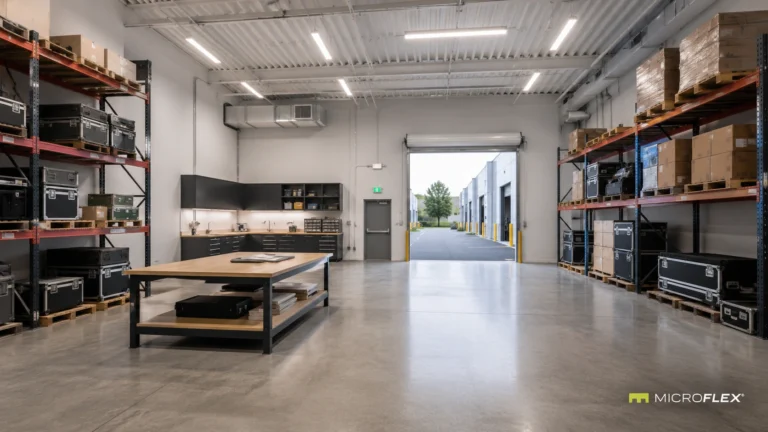
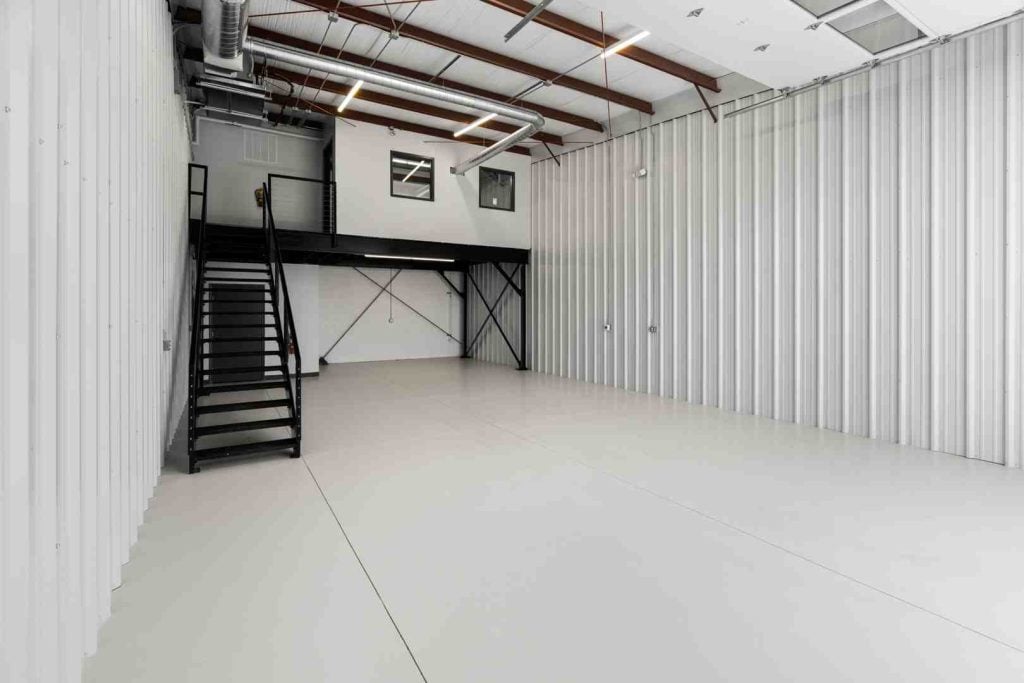
Multi-Purpose Creative Spaces: This is where flexibility truly shines! Many modern businesses and creators don’t fit neatly into one category. They might need a space that functions as a photography studio one day, a workshop the next, and a showroom for clients on another. These spaces often combine elements like warehouse access for storage and logistics, a dedicated office area for administrative tasks, and an open layout suitable for various creative endeavors. This adaptability is key for businesses looking for a Commercial Workshop for Rent or a versatile environment. Our Creative Workspace Complete Guide dives deeper into these adaptable solutions.
Key Factors When Choosing a Commercial Studio Space for Rent
Choosing the right commercial studio space for rent is a bit like picking the perfect outfit—it needs to fit well, look good, and function for its intended purpose. There are several critical factors we always advise our clients to consider to ensure they’re making a smart investment in their creative future.
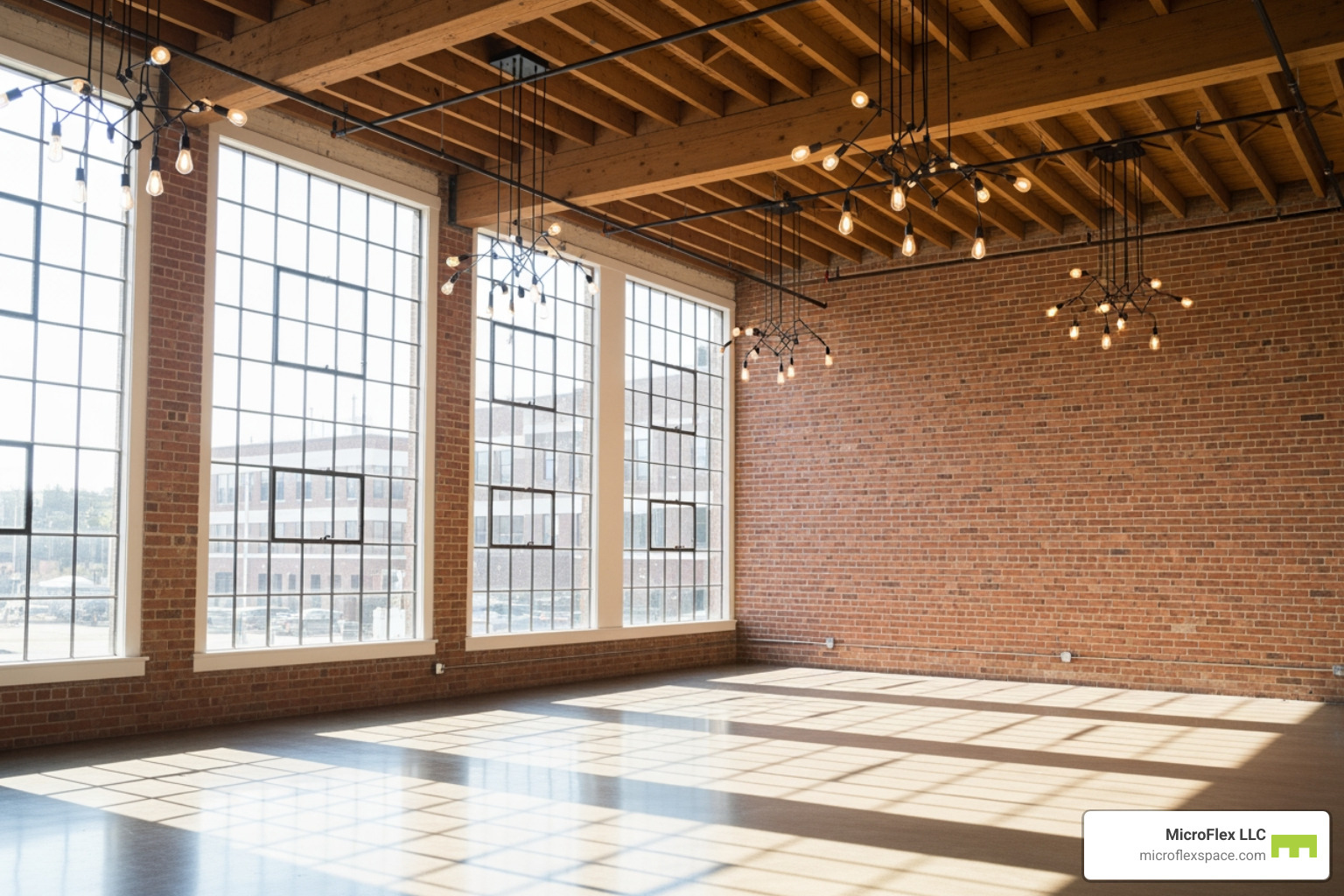
Essential Amenities: The devil, as they say, is in the details, and for a studio, amenities are paramount. High ceilings, often ranging from 14′ to 18′, are a game-changer for photographers, filmmakers, and those needing vertical storage or large-scale projects. Grade-level overhead doors simplify loading and unloading heavy equipment or large art pieces. Robust 3-phase power is often a non-negotiable for industrial machinery, advanced lighting, or audio equipment. Efficient HVAC systems are crucial for comfort and protecting sensitive materials. Finally, 24/7 access ensures you can work whenever inspiration strikes, without being constrained by traditional business hours.
The Impact of Location: Where your studio is located can significantly impact your business. For many, client accessibility is key, meaning easy access from major roads or proximity to public transport. The neighborhood synergy can also foster a thriving creative community, offering opportunities for collaboration and networking. We see this in our own locations in Auburn Opelika, Birmingham Irondale, Huntsville, and Birmingham Hoover, where vibrant communities support diverse businesses. However, location also affects pricing and zoning laws, which dictate what activities are permitted. Understanding these local regulations is critical. A prime location might mean higher costs, but it can also bring increased visibility and opportunity, contributing to a thriving creative community.
Sizing Your Space: How much space do you really need? While traditional office space often recommends 75-150 sq ft per person, studio needs can vary wildly. A sculptor might need more open floor space, while a podcaster needs a smaller, acoustically treated room. We encourage thinking about layout flexibility—can the space be easily reconfigured as your needs change? Scalability for growth is also vital. You don’t want to outgrow your space in six months. Solutions like Small Warehouse Storage can offer immediate relief, but ideally, your primary studio should have room to breathe and expand.
The Financial and Legal Side of Leasing a Studio
Navigating the financial and legal landscape of a commercial studio space for rent can feel daunting, but it doesn’t have to be. Understanding the typical costs and contractual considerations will empower us to make informed decisions and secure a lease that supports our business growth.
Pricing Models: When we look at rental costs, we usually encounter figures quoted as “per square foot per year.” For instance, in our Alabama markets, office space averages about $21.50 per sq ft, while industrial space can range around $8 per sq ft. These are base rents. However, we must also account for additional costs. These often include Common Area Maintenance (CAM) fees, which cover the upkeep of shared spaces, utilities (electricity, water, gas, internet), and sometimes property taxes and insurance, depending on the lease type.
Lease Agreements: This is where the legal jargon comes in, but don’t fret! The type of lease agreement dictates who pays for what. We’ll dive into the main types below. Beyond that, we always advise looking for lease length flexibility. Can you get a short-term lease to test the waters, or is a longer commitment more beneficial for stability? Tenant improvement allowances (TIs) are funds provided by the landlord to customize the space, which can be a huge benefit. And don’t forget exit clauses—understanding how to terminate or transfer a lease prematurely can be a lifesaver if business needs unexpectedly shift. Our Commercial Spaces Lease Guide 2025 offers a deep dive into these considerations.
Legal Due Diligence: Before signing on the dotted line, we need to ensure all our ducks are in a row. This includes understanding insurance requirements for our specific business activities, securing necessary business permits, and ensuring the space is ADA compliant, even if we don’t anticipate public access. These legal checks protect us and our clients.
Understanding Costs for a commercial studio space for rent
When we budget for a commercial studio space for rent, we break down the costs to avoid any surprises.
- Base rent: This is the core cost, typically calculated per square foot per year.
- Operating expenses: Often included in CAM fees, these cover property management, maintenance of common areas, landscaping, and sometimes property taxes and insurance.
- Security deposits: Usually equivalent to one to three months’ rent, held by the landlord as security.
- Build-out costs: If the space requires modifications to suit our needs (e.g., adding soundproofing, specialized wiring), these costs can be significant.
- Utilities: Electricity, water, gas, and internet are almost always extra and can fluctuate based on usage.
Key Contractual Considerations
The lease is our binding agreement, and understanding its nuances is paramount.
- Lease term: The duration of our agreement (e.g., 1 year, 3 years, 5 years). Flexible lease terms are a huge advantage, especially for growing businesses.
- Renewal options: What happens when the lease ends? Is there an option to renew, and at what terms?
- Subletting clauses: Can we rent out a portion of our space to another business if our needs change or we want to share costs?
- Use restrictions: Does the lease limit what we can do in the space? A photography studio might be fine, but a metalworking shop could be restricted.
- Maintenance responsibilities: Who is responsible for repairs and maintenance within our unit and in common areas?
| Lease Type | Tenant Responsibilities (Beyond Base Rent) |
|---|---|
| Gross Lease | Typically pays a single, all-inclusive rent amount. Landlord covers property taxes, insurance, and common area maintenance (CAM) costs. Tenant usually pays for their own utilities (electricity, internet). |
| Net Lease (NNN) | Pays base rent + a proportionate share of property taxes, property insurance, and common area maintenance (CAM). Tenant also pays for their own utilities. This is the most common commercial lease type and shifts significant operating costs to the tenant. |
| Modified Gross Lease | A hybrid of Gross and NNN. Tenant pays base rent + a portion of operating expenses (e.g., CAM, or utilities only). The specific allocation of expenses is negotiated. |
Rethinking the Studio: The Rise of Flexible, Multi-Use Spaces
The traditional notion of a studio space is evolving, and frankly, it’s about time! Many of us have faced the frustrations of trying to fit a square peg into a round hole, especially when our businesses are dynamic and ever-changing.
Traditional Studio Challenges: We’ve all heard the stories, or perhaps lived them ourselves: being locked into rigid, long-term commitments that don’t match our growth trajectory. Imagine signing a five-year lease for a photography studio, only to realize six months later that you also need a small workshop for prop building, or a dedicated area for client meetings. Traditional leases often come with single-purpose layouts, meaning significant—and costly—modifications if your needs pivot. The high overhead costs, from base rent to utilities and maintenance, can also be a heavy burden, especially for small businesses and startups.
The Flexible Advantage: This is where flexible solutions truly shine. We need spaces that offer adaptability for growth, allowing us to scale up or down without breaking the bank or our spirits. The cost-efficiency of a flexible lease means we only pay for what we need, when we need it, freeing up capital for other essential business investments. Think about the convenience of Short-Term Commercial Rentals when you’re just starting out or working on a temporary project. This approach aligns perfectly with our philosophy of providing Flexible Workspace Solutions.
Why MicroFlex Spaces are the Ideal Solution: At MicroFlex LLC, we saw these challenges and built a solution around them. Our spaces are designed to be adaptable multi-function units, combining warehouse, office, storage, and showroom features all in one seamless package. Whether you’re a burgeoning artist needing a dedicated painting space with storage for supplies, a videographer requiring a quiet editing suite with a small shooting area, or a small business owner who needs to juggle administrative tasks, product assembly, and client presentations, our units are purpose-built to adapt. We operate in Alabama, with locations in Auburn Opelika, Birmingham Irondale, Huntsville, and Birmingham Hoover, serving the diverse needs of our local business communities.
Benefits for Small Businesses: For small business owners, the advantages are clear. Our flexible spaces mean lower overhead costs, allowing you to invest more in your craft or services. This scalability is invaluable; as your business evolves, so can your space, without the burden of moving or significant lease renegotiations. We understand the unique needs of small businesses and offer solutions that support their journey. Learn more about our offerings for Commercial Space for Small Business and the power of Flexible Leasing Spaces.
How to Find and Secure Your Perfect Studio
Finding and securing the right commercial studio space for rent can be an exciting journey, but it requires a strategic approach. We’re here to guide you through the process, from initial search to signing the lease.
Where to Search: Online marketplaces are often our first port of call. Websites like LoopNet are powerful tools, boasting over 300,000 active listings and attracting more than 13 million monthly visitors. For over 30 years, LoopNet has been a trusted brand for commercial real estate, and their listings are even reported to lease or sell 14% faster. We also recommend leveraging commercial real estate brokers, especially those with local expertise in areas like Auburn Opelika, Birmingham Irondale, Huntsville, or Birmingham Hoover. They often have access to off-market listings and can negotiate on our behalf. Additionally, look for niche listing sites or local creative community forums that specifically cater to artists and creative professionals, as they might highlight spaces uniquely suited for studio work.
The Vetting Process: Once we’ve identified potential spaces, it’s time for some serious vetting. A Virtual Tour can be a great first filter, saving time by ruling out unsuitable options from the comfort of our current workspace. However, nothing beats in-person site visits. This allows us to get a true feel for the space, check the surrounding neighborhood, and assess critical infrastructure elements. We always advise asking key questions about power capacity, internet connectivity, HVAC quality, and access protocols. Don’t be shy—this is your future workspace!
Securing the Space: When we’ve found “the one,” the next steps involve a bit of formal negotiation. We typically start with a Letter of Intent (LOI), which outlines the proposed lease terms without being legally binding. This is where we can negotiate on rent, lease length, tenant improvement allowances, and other critical details. Once the LOI is agreed upon, we move to lease negotiation, working through the detailed commercial lease agreement. Finally, we finalize the contract, ensuring all our agreed-upon terms are accurately reflected.
Vetting a potential commercial studio space for rent
To ensure we’re making the best decision, we use a comprehensive checklist when vetting any potential commercial studio space for rent:
- Power capacity: Does it have sufficient amperage and voltage (e.g., 3-phase power) for our equipment?
- Internet connectivity: What are the available providers and speeds? Is fiber optic an option?
- HVAC quality: Is the heating and cooling system efficient and reliable? This impacts comfort and material preservation.
- Security features: Are there alarms, cameras, secure access points, or on-site security personnel?
- Parking and loading access: Is there ample parking for clients and staff? Are loading docks or ground-level doors available for deliveries and equipment?
Why MicroFlex is the Best Choice for Your Studio Space
When it comes to finding a commercial studio space for rent that truly caters to the diverse and dynamic needs of modern creators and small businesses, we believe MicroFlex stands out as the premier solution, especially here in Alabama.
Purpose-built for creators and small businesses: We didn’t just build generic commercial units; we designed MicroFlex spaces with you in mind. Our units are crafted to adapt seamlessly to your needs, whether you’re a photographer needing a clean, well-lit area, a woodworker requiring robust power and ventilation, an artist desiring ample space for creation and storage, or a small e-commerce business combining office work with inventory management and shipping. Each unit offers the versatility to function as a studio, workshop, office, or showroom, providing the perfect environment for your unique craft or service.
Flexible lease terms: We understand that business needs can change faster than the weather. That’s why we offer flexible lease terms, allowing you to scale up or down as your business evolves. No more being tied into rigid, multi-year commitments that stifle growth or burden you with unnecessary costs. This adaptability is a cornerstone of our philosophy, ensuring that your space supports your journey, not hinders it.
All-in-one solution: Imagine having your photography studio, editing suite, prop storage, and client meeting area all under one roof. With MicroFlex, you get the benefits of a dedicated warehouse for storage and light production, a comfortable office for administrative tasks, and a versatile creative space—all within a single, modern unit. This integrated approach simplifies logistics, reduces commuting between different locations, and optimizes your operational efficiency.
Supportive community: We believe that creativity thrives in connection. By choosing MicroFlex, you’re not just renting a space; you’re joining a vibrant network of like-minded entrepreneurs and creators. Our facilities in Auburn Opelika, Birmingham Irondale, Huntsville, and Birmingham Hoover foster a sense of community, offering opportunities for collaboration, networking, and mutual support within a thriving business environment. We’re proud to be a part of the local business ecosystem in Alabama, and we strive to create an atmosphere where innovation flourishes.
Explore MicroFlex Spaces for your next chapter. We invite you to find how our adaptable, all-in-one solutions can be the catalyst for your business’s growth and creative success. Your perfect commercial studio space for rent is waiting.
Frequently Asked Questions about Studio Rentals
How much does it cost to rent a commercial studio space?
Costs vary significantly based on location, size, and amenities. Prices are typically quoted per square foot per year. For example, in Alabama, office space averages about $21.50 per sq ft, while industrial space can range around $8 per sq ft. Expect to budget for base rent plus additional costs for utilities, insurance, and common area maintenance (CAM) fees. Always get a clear breakdown of all expenses before committing.
What should I look for in a studio space?
Prioritize features that match your specific creative needs. For photographers and filmmakers, high ceilings, robust power, and loading docks are essential. Artists might prioritize natural light and good ventilation. Musicians will need soundproofing and acoustic treatments. For all types of studios, consider lease flexibility, a convenient location, and scalability to accommodate future growth. Don’t forget practical elements like HVAC quality, internet connectivity, and security features.
What is the difference between a studio and a workshop?
A studio is often geared towards artistry and content creation, such as photography, painting, or music production, focusing on aesthetics, lighting, or acoustics. A commercial workshop, on the other hand, is typically for fabrication, assembly, and hands-on building, requiring features like heavy-duty power, durable flooring, and space for machinery. However, modern flexible spaces, like those we offer at MicroFlex, often blur these lines, providing environments that can comfortably accommodate both creative and hands-on activities within the same versatile unit.
Conclusion: Your Next Chapter Starts in the Right Space
Finding the right commercial studio space for rent is a critical step in turning your creative passion into a thriving business. By carefully defining your needs, understanding the financial and legal considerations, and prioritizing flexibility, you can secure a space that not only supports your work but also fuels your growth. The era of rigid, single-purpose commercial leases is fading, making way for adaptable, multi-functional solutions that truly empower entrepreneurs and creators.
When you’re ready to find a space that adapts to your vision, offers flexible terms, and provides an all-in-one solution for your warehouse, office, and creative needs, explore a solution built for the modern creator.
Find your ideal Creative Workspace for Rent.