When Your Warehouse Is Full and Sales Have Slowed Down
Excess inventory storage is one of the most common — and costly — challenges small business owners face. Here’s a quick breakdown of your best options:
| Situation | Best Approach |
|---|---|
| Overflow during peak season | Flexible short-term storage space |
| Slow-moving stock | Discounts, bundles, or liquidation |
| Obsolete or unsellable goods | Donation or write-off |
| Ongoing overstock issues | Demand forecasting + WMS software |
| Need space fast, no long-term lease | Flexible business storage units |
Too much inventory sounds like a good problem to have. It isn’t.
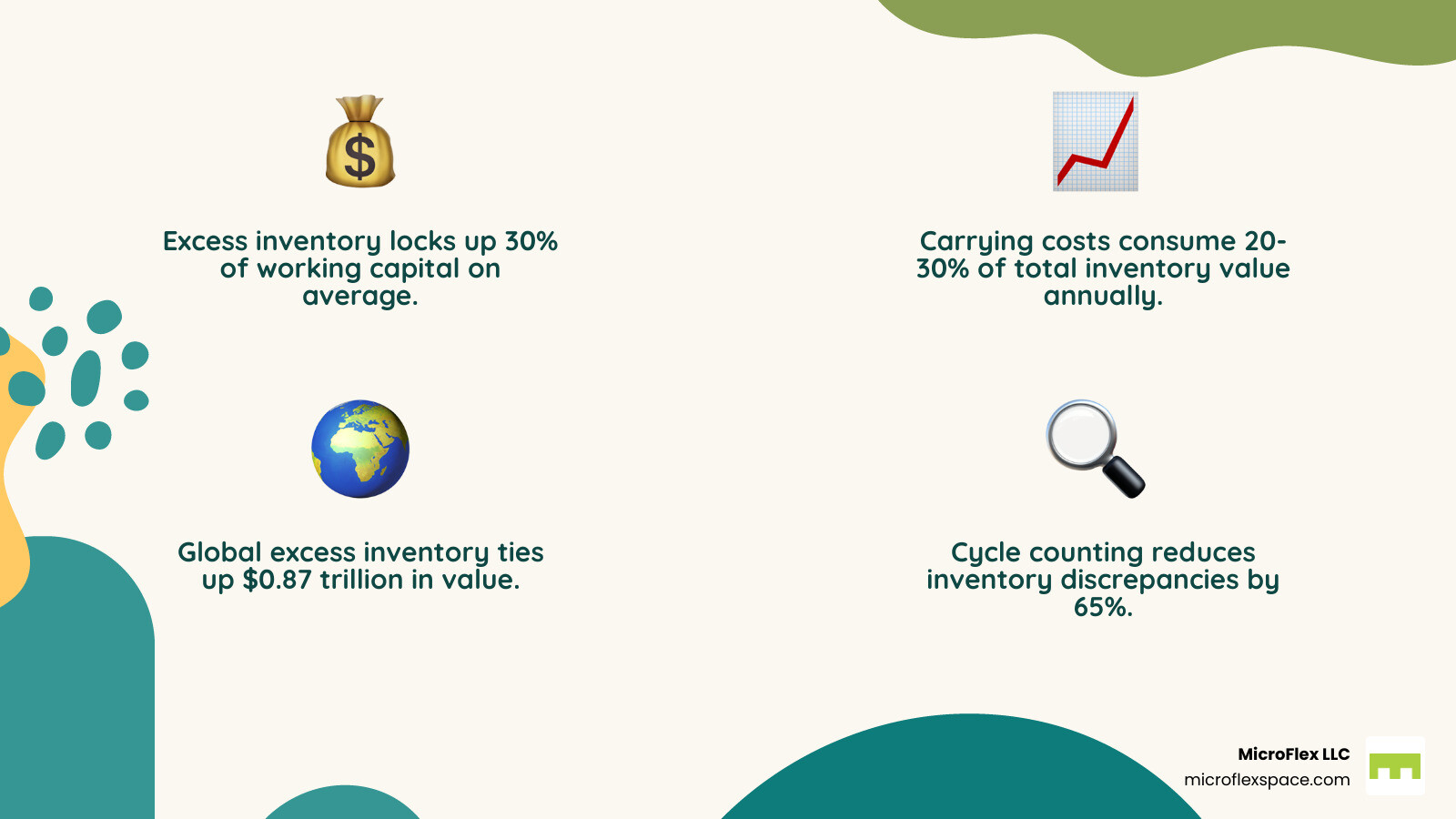
When stock piles up faster than it sells, it ties up your cash, eats your storage space, and quietly drains your profits. Research shows excess inventory can lock up 30% of your working capital — and carrying costs alone can run 20–30% of your total inventory value every year.
For small business owners, that’s not just an inconvenience. It can slow growth, limit flexibility, and leave you scrambling for space at the worst possible time.
The cause is usually straightforward: a demand forecast that missed the mark, a supply chain disruption, or a seasonal rush that didn’t materialize the way you expected. The COVID-19 pandemic is a vivid example — retailers stocked up heavily on products, only to watch demand collapse, leaving warehouses packed with goods nobody was buying.
The good news? There are smart, flexible ways to handle the overflow — without locking yourself into a long-term warehouse lease or selling off stock at a loss.
I’m Chase Carroll, a real estate developer and small business advisor with 12+ years of experience building and optimizing spaces where businesses operate — including excess inventory storage solutions through MicroFlex developments across Alabama. In the sections below, I’ll walk you through the real costs of surplus stock and the practical strategies that actually work.
Key excess inventory storage vocabulary:
Understanding Excess Inventory vs. Safety Stock
To manage your warehouse effectively, we first need to draw a line between “good” extra stock and “bad” extra stock. In logistics, words matter.
Safety stock is a strategic choice. It is the “just-in-case” buffer you keep on hand to protect against supply chain hiccups or sudden spikes in demand. Think of it like a spare tire; you hope you don’t need it, but you’re glad it’s there.
Excess inventory, on the other hand, is a surplus that exceeds both your immediate demand and your planned safety stock. This usually happens when products are over-ordered, over-produced, or when sales forecasts simply fail to align with reality. If left unmanaged, this surplus can lead to the obsolescence of items, where products become unsellable because they are out of style, expired, or replaced by newer technology.
The key to keeping your business healthy is maintaining a high inventory turnover ratio. This metric tells you how many times you’ve sold and replaced your stock during a specific period. A low ratio is a red flag that you’re paying for excess inventory storage for items that aren’t moving.
At MicroFlex, we see many businesses in Irondale and Huntsville using our excess-inventory-solutions/ to bridge the gap while they recalibrate their demand forecasting. Having access to short-term-storage/ allows you to keep your main operations lean while you figure out the best way to move that surplus.
The High Cost of Excess Inventory Storage
It is a common misconception that once you’ve paid for a product, the spending stops. In reality, the meter is always running. Holding onto surplus stock creates a massive financial drag on your business through “carrying costs.”

Carrying Costs and the “Hidden” Drain
Carrying costs include more than just the rent for the space. They encompass:
- Storage Taxes and Insurance: The more value you have sitting on shelves, the higher your premiums.
- Depreciation: Many items lose value the longer they sit.
- Opportunity Cost: This is perhaps the most painful. Every dollar tied up in a box of slow-moving widgets is a dollar you cannot spend on marketing, new equipment, or hiring talent.
The Bullwhip Effect
We often see local Alabama businesses caught in a massive bullwhip effect. This happens when small changes in consumer demand cause retailers to over-order, which causes wholesalers to over-order even more, and so on. By the time the “wave” hits the warehouse, you’re drowning in inventory that the market no longer wants.
Beyond the finances, there is an environmental cost. Extra stock means extra packaging waste and increased carbon emissions from unnecessary transportation. If you find yourself in this position, our short-term-warehouse-storage-guide/ can help you organize the chaos. For smaller batches, short-term-self-storage/ might be the quick fix you need to get your primary workspace back in order.
Strategic Solutions for Managing Surplus Stock
When you realize you have too much “stuff,” you have to act fast. The longer it sits, the less it’s worth. Here is how we recommend our tenants in Hoover and Auburn handle the overflow:
| Strategy | Pros | Cons |
|---|---|---|
| Liquidation | Immediate cash flow, clears space fast. | You’ll likely sell at a significant loss. |
| Donation | Tax benefits, supports community, eco-friendly. | No immediate cash inflow. |
| Strategic Storage | Keeps value for future sales, avoids fire sales. | Requires ongoing storage costs. |
Flash Sales and Bundling
One of the best ways to buy surplus stock back from your own warehouse is to incentivize your customers. Flash sales (lasting 2–24 hours) create urgency. Alternatively, try bundling slow-moving items with your best-sellers. It’s a great way to “delight” your customers with a freebie or a discount while clearing your shelves.
Value Recovery
If the products are still in good shape, consider selling your surplus inventory to specialized liquidators. Partnerships with companies like ClearCycle can help move bulk items quickly. If the items are unsellable, don’t just throw them away. Services like giveNkind can help you donate the goods to a worthy cause, which often provides a nice tax write-off during tax season.
While you are executing these sales, you might need a dedicated area to sort, repackage, and ship these items. This is where short-term-commercial-storage/ becomes a lifesaver, providing a “staging area” so your regular fulfillment doesn’t get interrupted by the liquidation process.
Why Flexible Business Space is the Best Alternative
If you’ve ever looked for warehouse space in the Birmingham or Huntsville areas, you know the struggle. Traditional commercial leases are often rigid, requiring 3-to-5-year commitments and massive square footage that you might not need year-round.
MicroFlex LLC was built to solve this exact problem. We offer adaptable, multi-function spaces that combine the best of a warehouse, office, and showroom. We are the best alternative for managing excess inventory storage because we don’t believe in “one size fits all.”
The MicroFlex Advantage:
- Flexibility: Our lease terms are designed for modern businesses that scale up and down. You aren’t locked into a giant warehouse when your stock levels return to normal.
- Multi-Functionality: You can use your space to store inventory, but also as a showroom to sell it or an office to manage the logistics.
- Strategic Alabama Locations: We have state-of-the-art facilities exactly where you need them:
- Birmingham-Irondale
- Birmingham-Hoover
- Auburn-Opelika
- Huntsville (Madison, AL)
Whether you are looking for warehouse-storage-near-me/ or a more specialized small-warehouse-storage/, our units provide the security and professional environment your business deserves. We even offer mini-warehouse-storage-big-solutions-for-small-spaces/ for those who just need a bit of extra room without the industrial-sized price tag.
Frequently Asked Questions about Surplus Stock
How does technology help prevent excess inventory storage?
Technology is your best defense against the “inventory glut.” Modern Warehouse Management Systems (WMS) and inventory management software provide real-time visibility into your stock levels.
- Predictive Analytics: These tools use historical data to forecast demand more accurately, helping you avoid over-ordering in the first place.
- Automated Reorder Points: Instead of guessing, the system tells you exactly when to buy more based on actual sales velocity.
- Improved Accuracy: Up-to-the-minute tracking has been shown to improve picking accuracy to 99%, reducing the “ghost inventory” that often leads to accidental double-ordering.
Utilizing mini-warehouse-storage/ combined with a solid WMS allows you to run a “Just-In-Time” (JIT) model, keeping your footprint small and your costs low. For more on how to set this up, check out our mini-warehouse-rent-ultimate-guide/.
What are the primary causes of excess inventory storage?
The “why” behind surplus stock usually falls into a few categories:
- Inaccurate Forecasting: Relying on gut feelings instead of data.
- Over-ordering for Discounts: Buying in bulk to save on the per-unit price, only to realize the excess inventory storage costs ate all those savings.
- Seasonal Shifts: Ordering heavy for a summer rush that gets rained out.
- Supply Chain Disruptions: Ordering from multiple suppliers to ensure someone delivers, then ending up with shipments from everyone at once.
If you’re stuck with the results of these issues, a short-term-storage-unit-rental/ can give you the breathing room to clear the backlog.
How does flexible business storage support value recovery from surplus inventory?
When you are trying to recover value from surplus, you need space to work. You can’t efficiently bundle products or prep items for a secondary market if you’re tripping over boxes in a cramped hallway.
Flexible short-term-business-storage/ at MicroFlex allows you to create a dedicated “liquidation zone.” Here, your team can:
- Sort and inspect items for quality control.
- Kitting and bundling slow-movers with popular items.
- Process returns to manufacturers (which typically allow for about 10% of inventory to be returned).
- Host “warehouse sales” or showroom events to sell directly to the local Alabama community.
Conclusion
Managing excess inventory storage doesn’t have to be a nightmare that keeps you up at night. By understanding the difference between safety stock and surplus, utilizing technology to forecast demand, and acting quickly to liquidate slow-moving items, you can protect your cash flow and keep your business growing.
At MicroFlex, we are dedicated to providing the Alabama business community with the space they need to succeed. Whether you’re in Irondale, Hoover, Auburn, or Huntsville, we offer the scalability and operational efficiency that traditional warehouses just can’t match.
Don’t let surplus stock sit in your way. Take control of your inventory, reclaim your working capital, and give your business the room it needs to thrive. If you’re curious about the logistics of moving in, take a look at our guide on short-term-storage-costs/ to see how flexible space fits into your budget.