An equipment rental business does more than store equipment between customer jobs.
Every item moves through a cycle. Equipment leaves for a customer, returns to the operating base, moves through check-in and preparation, returns to available inventory, and eventually gets assigned to another rental.
As inventory grows, those stages begin competing for the same floor space.
A small-bay flex unit can support that cycle by giving equipment storage, turnaround, customer-order staging, and dispatch defined roles within one operating base.
A practical rental workflow looks like this:
return → check in → prepare → store → reserve → stage → dispatch
Rental Inventory Has Different Statuses
One of the main differences between an equipment-rental operation and passive storage is that inventory is constantly changing status.
One item may be available. Another may already be reserved. Another may have just returned. A fourth may be grouped with accessories and staged for departure.
If all of those items occupy the same general area, the operator has to rely heavily on memory, software, or paperwork to understand what is actually ready.
The physical layout can make those distinctions clearer.
Returned Equipment Needs a Defined Landing Point
Equipment coming back from a customer should have a temporary destination before it returns to normal inventory.
A return area gives the operator a place to confirm the item, accessories, and rental record before the equipment moves to its next stage.
This area does not need to consume a large part of the unit.
Its purpose is simply to keep returned equipment from immediately becoming mixed with equipment that is already ready for another rental.
Create a Clear Equipment Turnaround Flow
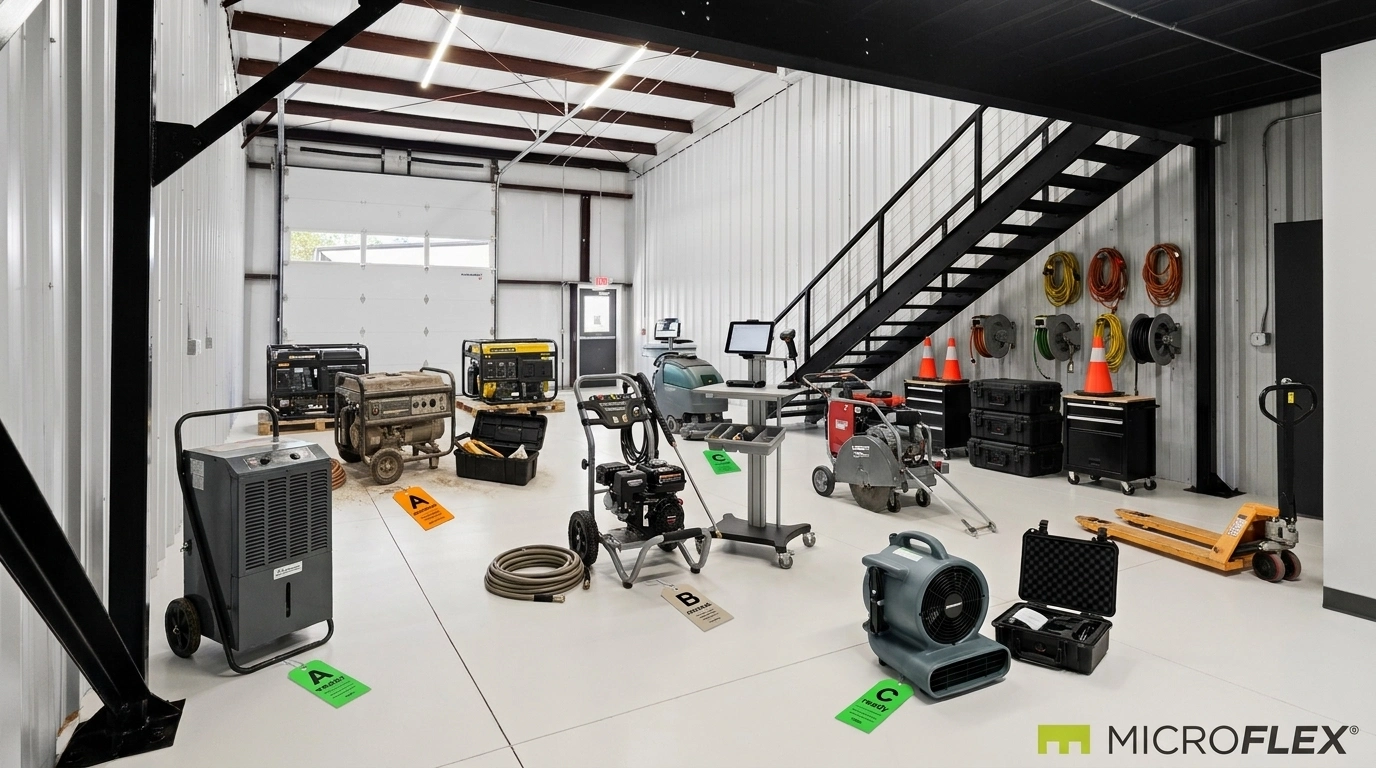
After check-in, equipment can move through the business’s normal preparation process before returning to available inventory.
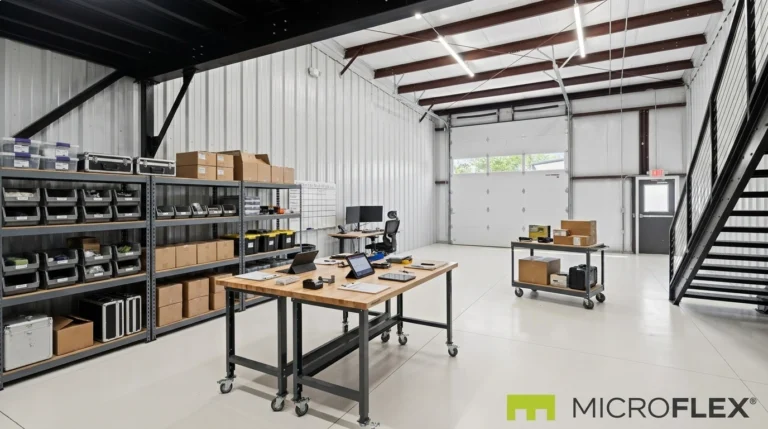
A compact turnaround area may include a work surface, computer terminal, rental documentation, accessory trays, and equipment waiting to be reassigned.
The objective is not to create a repair facility.
It is to make equipment status visible.
The workflow becomes easier to understand when returned equipment, equipment being processed, and equipment ready for another customer do not occupy the same position.
Organize Inventory Around Frequency of Use
Not every rental item moves at the same frequency.
Frequently requested equipment can remain closer to the active staging and dispatch area.
Lower-frequency inventory can occupy secondary positions deeper inside the unit.
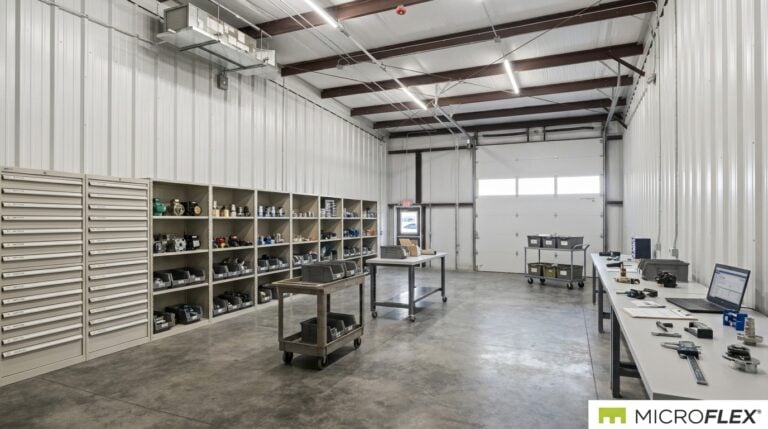
Accessories such as hoses, cables, attachments, cases, controls, and reels can remain organized with the equipment families they support.
The goal is not maximum inventory density.
It is reducing the amount of unnecessary movement required to prepare each customer rental.
Separate Available Equipment From Reserved Equipment
An item can be physically inside the unit without being available.
Once equipment has been assigned to an upcoming rental, moving it into a defined reservation or staging zone makes that change visible.
This becomes more useful when several upcoming customer jobs overlap.
Available inventory can remain organized while separate rental packages begin forming elsewhere on the floor.
Build Customer Orders Before They Reach the Door
A rental order may include more than one piece of equipment.
The primary machine may also require cables, hoses, attachments, transport cases, stands, or other accessories.
Those components can be grouped as a complete customer load before departure.
A rolling platform, cart, or defined staging position gives the operator somewhere to assemble the order as one package.
That changes the process from gathering equipment during vehicle loading to preparing the complete rental before it reaches the dispatch area.
The Roll-Up Door Becomes Part of Dispatch
At purpose-built MicroFlex® locations, units include drive-up roll-up access.
For a compatible equipment-rental business, that can connect interior staging directly with vehicle loadout.
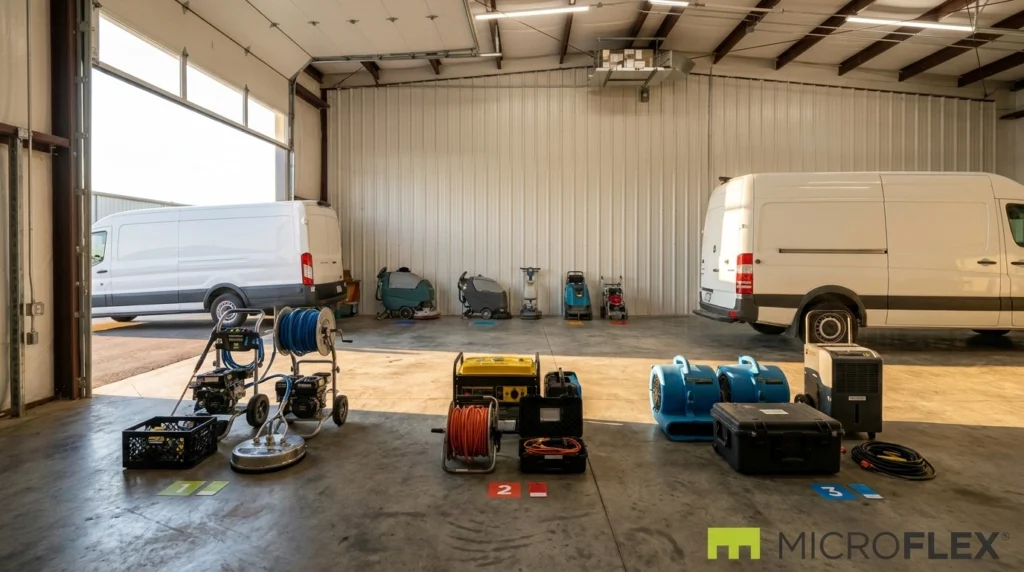
Carts, compact equipment, cases, and prepared rental packages can move toward the vehicle area through a direct path.
The area near the roll-up door works best as temporary staging rather than permanent inventory storage.
Otherwise, receiving, returned equipment, and outgoing rentals begin competing for the same section of floor.
Open Floor Area Has a Job
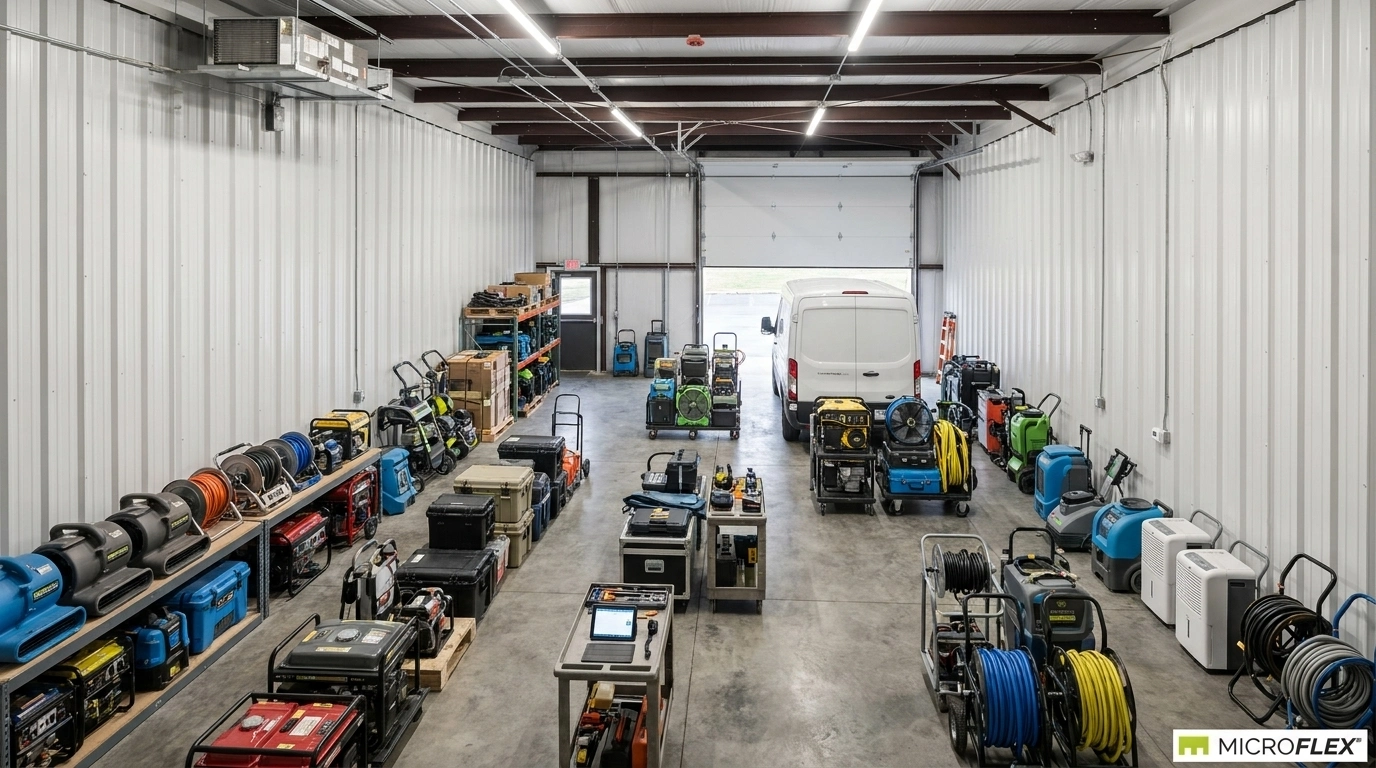
Rental inventory should not consume every square foot of the unit.
The business still needs room to move carts, separate returned equipment, assemble customer-specific loads, and reposition inventory as the schedule changes.
That does not mean most of the unit should remain empty.
It means part of the floor should stay available for active operations rather than becoming permanent storage.
For an established rental business, the balance is between substantial usable inventory and enough circulation space to keep that inventory moving.
Administrative Work Is Part of the Rental Cycle
Equipment movement is only one side of the operation.
Reservations, customer communication, scheduling, inventory records, purchasing, quoting, and billing all create desk-based work.
MicroFlex offers pre-built configurations that can separate some administrative activity from the primary operating floor.
FLEX is the open-bay base configuration.
FLEX+ includes an enclosed rear office.
FLEX Premium includes a mezzanine.
FLEX Ultimate includes a full mezzanine with premium finish.
Configuration availability varies by location and unit.
See
the MicroFlex configurations
for the full product breakdown.
What a Small-Bay Rental Operation Can Look Like
Purpose-built MicroFlex locations typically offer units of approximately 1,000 to 1,250 square feet, with standard bay dimensions of 25 by 40 or 25 by 50 feet.
Within that footprint, a compatible equipment-rental business can organize several connected functions without dividing the entire floor into permanent rooms.
One area can hold available equipment.
Another can contain returned inventory.
A compact station can support check-in and preparation.
Customer-specific rental groups can form closer to dispatch.
The center can support circulation and temporary staging.
The exact layout depends on the type, quantity, and dimensions of the equipment being handled.
The Space Still Has to Match the Equipment
Equipment rental covers a broad range of businesses.
A small-bay flex unit is not intended for every rental category or every related business activity.
Large machinery, specialized servicing, unusual utility requirements, regulated materials, or other operational requirements may need a different environment.
The proposed equipment, business activity, customer traffic, and operating requirements should be discussed with the leasing team for the specific property and unit.
MicroFlex for Equipment Rental Operations
Purpose-built MicroFlex units include a drive-up roll-up door, private restroom, HVAC, and LED lighting.
MicroFlex leases are offered on a one-year modified gross basis.
For a compatible compact equipment-rental operation, the space can support a repeatable cycle:
return → check in → prepare → store → reserve → stage → dispatch
The value comes from giving those stages defined places while keeping the equipment moving through the operation.
A Note About Auburn-Opelika
MicroFlex Auburn-Opelika is a rebranded property rather than a purpose-built MicroFlex development.
Units there do not begin at 1,000 square feet, climate control varies by unit, and mezzanine configurations are not available.
The property includes drive-up roll-up doors and private restrooms.
Current unit size, features, compatibility, and availability should be confirmed with the leasing team for the specific unit.
Build the Operation Around Equipment Turnaround
An equipment rental business does not stop operating when an item returns.
The return starts the next operating cycle.
Equipment moves from the customer back through check-in, preparation, inventory, reservation, staging, and another dispatch.
When those stages have defined roles, the unit becomes more than equipment storage.
It becomes the operating base connecting one rental to the next.
Review the
current MicroFlex locations
and contact the leasing team for current configurations, unit availability, and compatibility with the proposed operation.
Disclosure
This article is published by Founders Investment Properties, LLC, owner and operator of MicroFlex®. Content is provided for general informational and educational purposes only. Nothing in this article constitutes legal advice, tax advice, financial advice, investment advice, insurance advice, real estate brokerage advice, or any other form of professional advice. Readers should consult their own attorneys, accountants, tax professionals, insurance brokers, and licensed real estate professionals before making decisions based on the topics discussed.
MicroFlex® is a registered trademark of Founders Investment Properties, LLC. Photos may be representative and may not reflect a specific location. Product configurations, features, lease terms, pricing, and availability are subject to change. Current information is available at microflexspace.com or by contacting the leasing team directly.