Why Adaptable Business Solutions Are Essential in Today’s Market
Adaptable business solutions are flexible approaches that help businesses quickly adjust their operations, technology, and physical spaces to meet changing market demands. These solutions enable companies to pivot strategies, scale efficiently, and maintain a competitive advantage without being locked into rigid systems.
Key components of adaptable business solutions include:
- Flexible processes – Lean methodologies and streamlined workflows that can evolve with business needs
- Scalable technology – Custom systems and cloud-based tools that grow with your company
- Agile workspaces – Multi-use facilities combining office, warehouse, and showroom functions
- Variable service models – Pay-as-you-go options for staffing, utilities, and specialized support
In today’s business environment, traditional models are failing. The world is undergoing constant change, and companies that can’t adapt risk falling behind more flexible competitors.
The evidence speaks for itself: businesses implementing adaptable solutions have achieved remarkable results, with some cutting operational costs by 50% while maintaining growth trajectories that outpace traditional approaches.
I’m Sam Zoldock, a commercial real estate investment professional. Since founding OWN Alabama in 2018, I’ve specialized in helping Alabama businesses find adaptable business solutions through flexible workspaces. My experience across diverse industries has shown me how the right mix of adaptable processes, technology, and physical space can transform a company’s ability to scale and react to market changes.
The Core Pillars of Business Adaptability
Building a truly adaptable business isn’t about a dusty backup plan; it’s about creating a foundation that can bend without breaking when the unexpected happens, like a tree that sways in the wind rather than snapping.
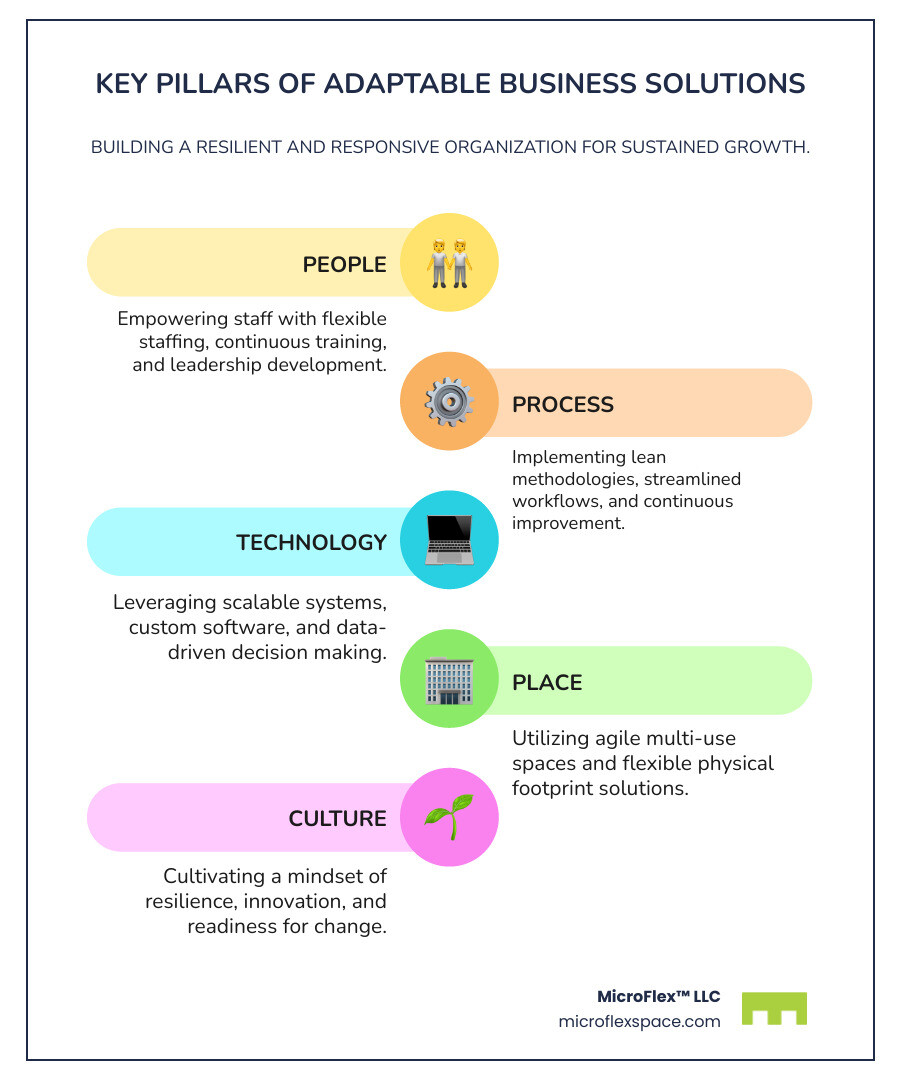
The most successful businesses today are built on four core pillars that enable true adaptability: People, Process, Technology, and Place. When these elements work together harmoniously, they create an organization that doesn’t just survive change—it thrives on it.

Real adaptability goes beyond simply reacting. It’s about building your business to actively seek out new opportunities while staying protected from risks. This means creating a continuous cycle where process improvement, technology integration, and flexible staffing all work together, supported by a physical space that can grow and change with your needs.
You can explore more about these strategies through various Business Process Management Resources and learn about Dynamic Workplace Solutions that bring these concepts to life.
Streamlining Operations with Lean Processes
The backbone of most adaptable business solutions is Lean Thinking and Business Process Management (BPM). These approaches focus on doing things smarter, not harder, to get more done with less waste without cutting corners on quality.
Companies that master this approach often use Lean Six Sigma, a systematic way to solve problems using real data instead of guesswork. They map workflows to spot bottlenecks and inefficiencies, much like finding traffic jams on a commute and building better routes.
The experts who guide businesses through these changes are often GE-certified Master Black Belts with years of experience. Their training programs consistently earn student ratings of 9.73 out of 10, proving the approach’s value.
The results speak for themselves. Organizations that accept these process optimization strategies have cut their operational costs by as much as 50%. This isn’t just theory; it’s proven results from over 100 organizations ranging from $10 million to $80 billion in sales. Whether you’re in manufacturing, healthcare, or professional services, these solutions can help.
Business Process Management systems focus on making your operations more goal-oriented and agile. They help teams manage time better, avoid wasteful activities, and boost productivity. By collecting data automatically, BPM makes it easier for managers to make smart, cost-effective decisions based on accurate information.
Leveraging Flexible Technology and Custom Systems
Technology is a strategic weapon for adaptability, but generic, one-size-fits-all software often creates more problems than it solves. Instead of using technology efficiently, you end up twisting your operations to fit the software’s limitations.
Customized business solutions flip this equation. They’re designed with clarity and simplicity, built specifically for your unique business needs.
Whether you need a specialized CRM system, an ERP solution, or custom applications, the key is flexibility and scalability. Unlike expensive, complicated systems from big corporations, customized solutions let you pay only for what you need.
The benefits are impressive: cost savings because you’re not paying for unused features, perfect compatibility with your processes, easy upgrades, unlimited users without extra fees, better security, device flexibility, and simple backup solutions.
This custom approach doesn’t just save money—it drives growth by providing a strategic plan that identifies new opportunities. For smaller businesses, exploring Small Business Office Solutions that integrate flexible tech can be transformative. Understanding broader platforms like Microsoft Dynamics can also provide valuable insights into scalable technology.
Optimizing Your Physical Footprint for Agility
While discussions on adaptable business solutions often focus on process and technology, physical space is a critical, yet overlooked, component. A rigid, traditional setup can become a bottleneck, holding back growth and flexibility.
This is why MicroFlex™ LLC exists. We’ve seen businesses struggle with mismatched spaces—a warehouse across town from the office creating coordination headaches, or long-term leases for unneeded space draining cash.
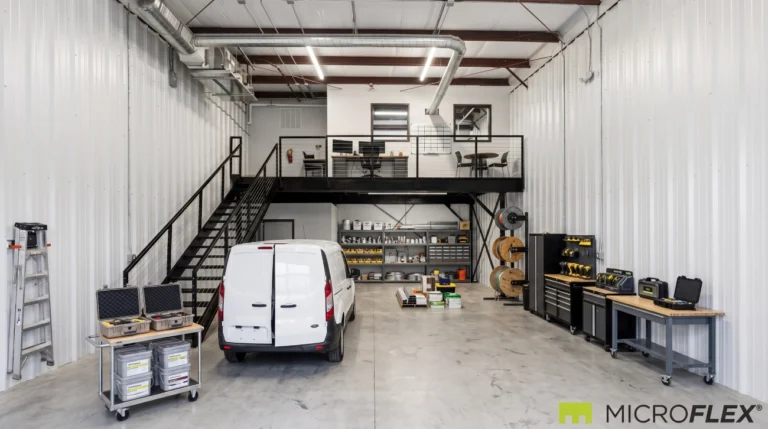
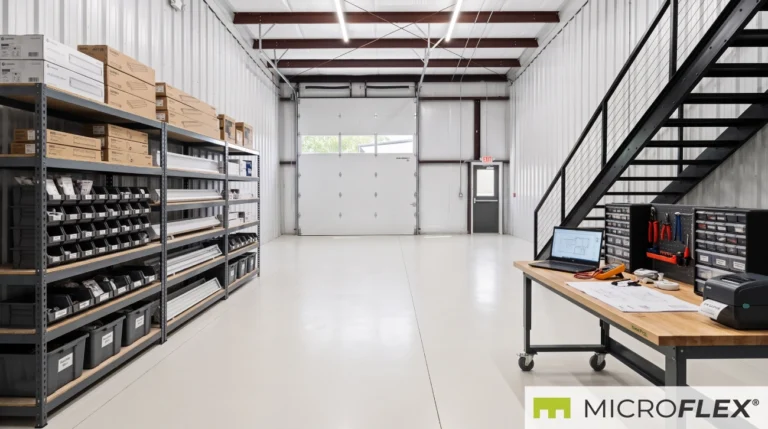
Our multi-function spaces are designed to evolve with your business. Picture this: light manufacturing happening right next to your administrative office, with a showroom to display your products, plus extra storage for fluctuating inventory. Everything’s under one roof, making your operations smooth and efficient.
What really sets us apart is our flexible lease terms and diverse configurations. Unlike traditional commercial leases that lock you in for years, we offer options that let you scale up when business is booming or scale down during slower periods. You’re not stuck paying for empty space or scrambling to find room when opportunities knock.
Whether you need a Micro Warehouse for e-commerce, Temporary Storage Solutions for busy seasons, or a full Commercial Warehouse for Lease with integrated office space, we provide the physical foundation for your agile business strategy. We have locations in key Alabama markets, including Auburn Opelika, Birmingham Irondale, Huntsville, and Birmingham Hoover, so your space can work for you.
Why Adaptable Business Solutions Are Crucial for Growth
Thriving in business means going beyond survival; it means getting stronger with every market challenge. Adaptable business solutions are no longer optional—they are the foundation that separates businesses that flourish from those that merely get by.

When your business can bend without breaking, you see consistent growth. Your customers notice and stick around because you can meet their changing needs. And when market opportunities pop up, you’re ready to grab them while others are still figuring out their next move.
This flexibility creates real value, leading to meaningful cost reductions and the breathing room needed for expansion. That’s where solutions like Business Expansion Space become game-changers, giving you room to grow without the usual growing pains.
Driving Efficiency and Slashing Operational Costs
Adaptable business solutions shine by dramatically cutting your expenses while making everything run smoother. This creates recurring savings that boost your bottom line.
Take your utility bills. Working with energy brokers can slash these costs significantly. All they usually need is your latest utility bill, and they handle the rest with no disruption to your operations.
The real magic happens with flexible staffing solutions like virtual assistants. Instead of hiring full-time employees with all the overhead costs—benefits, office space, equipment—you get skilled support exactly when you need it.
Virtual assistant services typically offer two models. Pay-as-you-go pricing lets you pay around £30 per hour for occasional tasks. For consistent help, monthly retainer packages give you better rates and predictable budgets, such as 10 hours monthly for £300, 20 hours for £600, or 30 hours for £800.
These services come with transparent time tracking and cover everything from email management to social media and research, all with complete confidentiality.
Cost savings extend beyond direct expenses. Smart HR management and workplace safety compliance prevent expensive legal problems. Expert guidance on employment law, HR systems, and safety protocols helps you avoid significant future costs.
The Strategic Advantage of Adaptable Business Solutions
When everyone else is playing catch-up, adaptable business solutions put you steps ahead. This isn’t about keeping pace with change—it’s about leading it and turning uncertainty into your competitive edge.
Think about what happens when you can pivot quickly. A new product opportunity emerges, and you’re already testing the market while others are tied up in rigid systems. A sudden demand spike hits, and your flexible setup lets you scale up production while competitors scramble for resources.
This agility is especially powerful with flexible real estate. A Short-Term Business Lease can open doors to new markets or temporary projects without long-term financial risk. You can test concepts, expand seasonally, or establish new footholds.
The real strategic advantage comes from controlling your customer experience. As one expert puts it, “The battle for consumers’ hearts and wallets is won and lost on experience.” When your business adapts quickly to customer needs, you’re not just meeting expectations—you’re setting new standards.
This means being ready to disrupt your own business model before outside forces do it for you.
Building a Resilient and Future-Ready Organization
The strongest businesses don’t just adapt to change—they improve because of it. Building this resilience starts with your people and extends through your entire organization.
Employee development and leadership training form the backbone of adaptability. Programs focusing on Lean Thinking, Six Sigma, and communication skills give your team the tools to handle what’s next. Real leadership provides purpose, direction, and motivation during uncertainty.
These training programs work, creating teams that can drive employee engagement, build stronger customer relationships, and improve your bottom line.
A truly adaptable organization also looks beyond its own walls. Supporting diverse talent, including veterans transitioning to business careers, brings unique perspectives and proven leadership skills into your company.
Your physical environment is also crucial for resilience. Modular Offices: A Complete Guide shows how configurable spaces can adapt to changing team sizes, new projects, or hybrid work. When your space can evolve with your needs, your entire organization becomes more flexible.
This combination of skilled people, smart processes, and adaptable spaces creates a business that doesn’t just survive change but thrives on it.
Implementing Your Strategy for Adaptability
Shifting to adaptable business solutions is a process, not an overnight change. Like a renovation, it requires knowing what you have, what you want to achieve, and who can help. With the right approach, this change is both manageable and rewarding.

Implementing adaptability requires a collaborative approach, careful project execution that doesn’t disrupt daily operations, and strong client relationships built on trust and clear communication.
When evaluating potential partners, ask key questions: How will you understand our unique needs? Can you show us relevant case studies? How do you measure success and ROI? What ongoing support do you provide? How do you ensure data security? What are your typical timelines and communication processes?
Assessing Your Unique Business Needs
Before improving, you must understand your current state. This assessment phase is essential for moving forward, revealing both challenges and opportunities for improvement.
Start with a current process analysis to examine how work flows through your organization. Where are the bottlenecks? Where are people spending too much time on tasks that could be streamlined? This isn’t about blame; it’s about identifying what’s holding your business back.
Next, conduct a thorough technology audit. Do your current systems communicate with each other? Can they grow with your business, or will they need replacement upon expansion? This step often reveals gaps between technology’s promise and its reality.
Don’t forget a comprehensive space utilization review. Are you making the most of every square foot? Could your setup adapt if your team grew or your business model pivoted?
Throughout this process, effective stakeholder management ensures everyone’s voice is heard. Your frontline employees often have the best insights into daily operations, while leadership provides strategic context.
Choosing the Right Partners and Methodologies
Finding the right partner for your adaptability journey is like choosing a good contractor. You need someone who listens, communicates clearly, and has a proven track record of success.
Vetting providers goes beyond checking references. Look for partners who take a consultative approach—they should want to understand your business deeply before proposing solutions. The best partners will document your requirements thoroughly to avoid surprises.
The importance of testimonials can’t be overstated. Real customer feedback reveals how a provider handles challenges and delivers on promises. Testimonials that mention direct access to decision-makers and technical teams often indicate a company that values relationships.
Seek out providers who offer industry-agnostic solutions. The principles of adaptability—lean processes, flexible technology, and agile spaces—apply across sectors. The right partner should create custom packages that fit your specific situation rather than forcing you into a predetermined mold.
For deeper insights, How Customized Business Solutions Transform Business? provides valuable perspectives on this transformative potential.
Your Guide to Finding Adaptable Business Solutions
When implementing adaptable business solutions, your physical space is the foundation that either supports or limits your flexibility. This is especially true for businesses managing inventory, client meetings, and administrative work under one roof.
Finding flexible leases means looking beyond traditional commercial real estate. The old model of locking into a single-purpose space for years doesn’t match how modern businesses operate. Instead, look for arrangements that allow you to combine office and storage in ways that fit your workflow.
For e-commerce businesses, this might mean having an office adjacent to inventory storage for easy order fulfillment. For service-based businesses, it could mean having meeting spaces that can double as training rooms.
Supporting e-commerce logistics requires spaces that can handle seasonal inventory flows while providing professional environments for team collaboration. The ability to scale storage up or down can significantly impact your bottom line.
Creating a hybrid work environment is now essential. This means having spaces that work for both in-person collaboration and remote work, with the flexibility to reconfigure as team needs change.
At MicroFlex™ LLC, we designed our spaces to address these challenges. Our multi-function facilities in key Alabama markets provide the physical infrastructure for true business adaptability. Whether you need space in Auburn Opelika, Birmingham Irondale, Huntsville, or Birmingham Hoover, you can explore all our Locations to find configurations that grow with your business.
Frequently Asked Questions about Adaptable Solutions
What industries benefit most from adaptable business solutions?
Adaptable business solutions benefit virtually any business, but industries with complex processes, changing demand, or tight regulations often see the fastest results.
Manufacturing companies love the flexibility to adjust production and optimize workflows. E-commerce businesses thrive with adaptable warehousing that scales with seasonal demand.
Logistics companies benefit from flexible space that handles varying shipment volumes. In social healthcare, these solutions streamline processes, automate stakeholder management, and ensure compliance.
Professional services firms use virtual assistants and flexible office arrangements to manage client loads efficiently without high overhead. Even retail businesses find that combining office and warehouse space lets them respond quickly to trends.
The key is matching the solution to your specific challenges, whether you’re a startup or an established enterprise.
What are the different types of flexible commercial leases?
Understanding lease types can save you thousands and provide crucial flexibility. Here are the main options.
The NNN Lease (Triple Net Lease) has a lower base rent, but you pay your share of property taxes, building insurance, and common area maintenance. It offers more control but requires budgeting for variable costs.
A Gross Lease bundles most costs into one flat payment, including base rent, taxes, insurance, and maintenance. You usually pay utilities separately, but it offers predictable monthly expenses.
The Full-Service Lease is the ultimate bundle, common in multi-tenant office buildings. Everything is rolled into one payment: base rent, utilities, taxes, insurance, and maintenance, making budgeting much easier.
At MicroFlex™ LLC, we focus on flexible arrangements that adapt to your business needs rather than forcing you into rigid traditional structures. The right lease depends on your cash flow and desired involvement in building operations.
How are virtual assistant (VA) services typically priced?
Virtual assistant pricing is straightforward and flexible, avoiding expensive long-term commitments.
The Pay-As-You-Go (PAYG) model is perfect for unpredictable needs. You pay an hourly rate (typically around £30/hour) for the exact time you use, with no minimums.
Retainer packages offer better value for consistent support. These packages provide a set number of hours monthly at discounted rates for budget predictability. Popular options include the Petite Perks Package (10 hours/month for £300), the Balance Bliss Package (20 hours for £600), and the Supreme Deluxe Deal (30 hours for £800).
Packages typically include briefing time and detailed time tracking. Most providers don’t allow unused hours to roll over, which encourages efficient planning.
VA services let you access skilled support when needed, without the overhead of full-time employees. You pay only for productive time on tasks like email, research, or social media management.
Conclusion: Thriving in an Ever-Changing World
The business landscape has shifted dramatically. Companies that recognize this will flourish. Adaptable business solutions are no longer a luxury—they are essential for staying relevant and profitable.
When you can quickly adjust processes, technology, and physical space, you don’t just survive the unexpected—you capitalize on it. You’re ready for a sudden surge in demand or a new market opportunity, allowing you to pivot faster than the competition.
The evidence is clear: companies using these flexible approaches are seeing 50% reductions in operational costs while maintaining strong growth. They’re building stronger customer relationships by responding quickly to changing needs. Most importantly, they’re creating organizations where employees want to work.
The physical space piece of this puzzle is crucial but often overlooked. Your office or warehouse shouldn’t constrain your growth—it should enable it. That’s why we created MicroFlex™ LLC. We understand that modern businesses need spaces that can evolve with them.
Our multi-function spaces bring together warehouse, office, storage, and showroom features under one roof. What truly sets us apart is our commitment to flexible lease terms. You aren’t locked into more space than you need during slow periods or left scrambling for room when business takes off.
Whether you’re an e-commerce startup, a growing manufacturer, or an established business testing a new market, our Birmingham-area locations provide the physical foundation for your adaptable strategy.
The time to build adaptability into your business is now. Markets will continue to change, and customer expectations will evolve. The businesses that thrive will be those that can roll with these changes instead of being overwhelmed by them.
Take that first step toward a more flexible, resilient future for your business. Your future self will thank you for making adaptability a priority today.