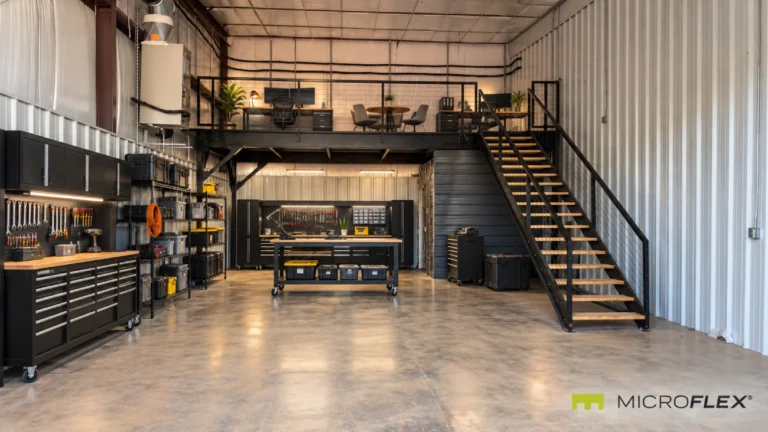
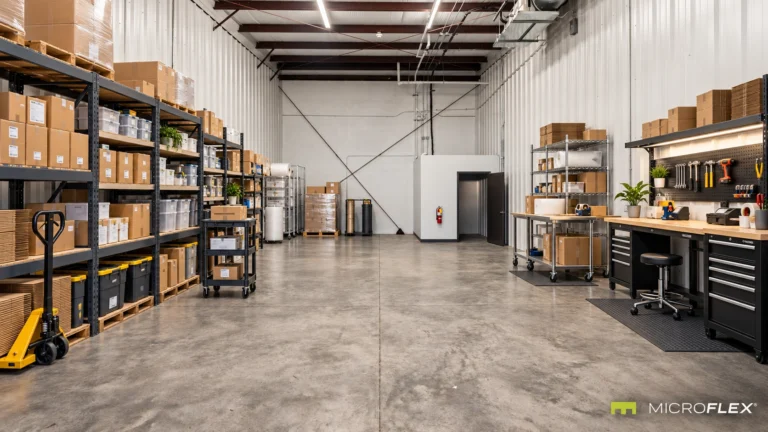
A flooring installer preparing materials for tomorrow’s job, a maintenance company organizing replacement parts, and a specialty supplier checking an order before delivery have different businesses, but they share the same physical problem.
Tools, materials, equipment, inventory, and job preparation need somewhere to come together.
That operating pattern is particularly relevant in Auburn-Opelika. The local economy combines manufacturing, construction, transportation, production, maintenance, university activity, and thousands of owner-operated businesses. Those sectors do not automatically create demand for flex space, but they do create a substantial base of companies whose work involves physical products, equipment, materials, or field operations.
For some of those businesses, the useful workspace is not a conventional office or a large warehouse. It is a private operating base where the physical side of the business can be organized around the working day.
Auburn-Opelika Has a Meaningful Physical-Operations Workforce
The composition of the local workforce helps explain why operational workspace matters in this market.
According to the U.S. Bureau of Labor Statistics, the Auburn-Opelika metropolitan area had approximately 83,700 nonfarm jobs in August 2026. Manufacturing accounted for approximately 7,600 jobs, trade, transportation, and utilities for approximately 13,100, and mining, logging, and construction for approximately 4,000.
Occupational data provides another view of the same economy.
Production occupations represented 9.4% of Auburn-Opelika employment in May 2025, compared with 5.5% nationally. Transportation and material-moving occupations represented 9.0% of local employment, while installation, maintenance, and repair represented 4.1%.
Construction and extraction represented another 3.6%.
These percentages are not a count of prospective MicroFlex tenants. Many people in those occupations work for larger employers that already have facilities.
What the data shows is a local economy where making, moving, installing, repairing, preparing, and handling physical products remains an important part of everyday business activity.
Manufacturing Is Part of the Market’s Economic Structure
Auburn’s business base extends well beyond the university.
The City of Auburn’s 2026 Community Profile reports that Auburn Technology Parks South, North, and West are home to 28 multinational manufacturing firms.
The products represented across those parks include automotive components, industrial systems, specialty plastics and packaging, construction components, medical products, logistics equipment, and aerospace components.
Large manufacturers themselves are not the target market for a small flex unit.
The more relevant effect occurs around them.
Manufacturing environments support networks of smaller suppliers, installers, repair companies, technical service providers, specialty distributors, maintenance contractors, and other businesses that may interact with larger operations without needing a large industrial facility of their own.
An equipment-service business may need parts, tools, a preparation bench, and room for field equipment.
A specialty supplier may need organized inventory and an efficient receiving and outbound process.
An installation contractor may need one reliable location where materials can be received and prepared before moving to customer sites.
The scale is smaller, but the operational requirement is real.
Opelika Adds Distribution, Construction, and Industrial Activity
Opelika adds another layer to the local physical-business economy.
The City of Opelika’s current major-employer data includes manufacturers involved in automotive components, food processing, wood products, plastics, and vitamins and supplements. Its larger non-manufacturing employers also include grocery distribution and construction companies.
This mix matters less because of any individual company and more because of the type of work occurring across the market.
Distribution creates movement of products and equipment.
Construction creates demand for trades and specialty installers.
Manufacturing creates demand for parts, maintenance, technical support, transportation, and supporting services.
Many businesses participating in that ecosystem operate at a much smaller scale than the companies they serve.
A Large Owner-Operator Base Sits Beneath the Major Employers
Lee County had approximately 3,377 employer establishments in 2023, according to the U.S. Census Bureau. Those establishments supported approximately 51,454 jobs.
The county also had approximately 13,249 nonemployer establishments.
Nonemployer establishments generally represent businesses without paid employees and include many sole proprietors and owner-operated companies.
Those 13,249 businesses are not 13,249 flex-space prospects. Most will never require dedicated operational space.
But the figure shows the size of the business population operating below the level of major employers.
For a business involving physical inventory, tools, materials, vehicles, equipment, or field work, growth can eventually create an operational constraint.
The tools are spread between vehicles.
Deliveries arrive wherever someone happens to be available.
Inventory begins taking over space intended for something else.
Preparing for the next job requires repeatedly loading, unloading, finding, and reorganizing the same materials.
At that point, the requirement may still be far below the scale of a traditional warehouse.
What the business needs is one organized operating base.
Flex Workspace Is Most Useful When It Solves a Workflow Problem
The useful question is not simply what industry the business belongs to.
The better question is what happens during a normal working day.
Trades and Installation Businesses
A flooring installer, electrician, HVAC contractor, painter, fencing company, or other field-based trade may leave the property every morning and still depend heavily on the space.
A typical workflow may involve:
receiving materials → organizing tools and supplies → preparing the next job → loading vehicles → returning equipment → resetting for the following day
The value of the unit is not simply how much material fits inside.
The value is whether frequently used equipment can be found, prepared, loaded, returned, and organized without repeatedly rebuilding the workflow.
For another example of this operating pattern, see
How Drive-Up Access Supports Daily Operations for Service Businesses
Specialty Parts and Equipment Distribution
Not every distributor operates a large warehouse.
A smaller specialty supplier may carry a relatively focused range of parts, components, or equipment but interact with that inventory constantly.
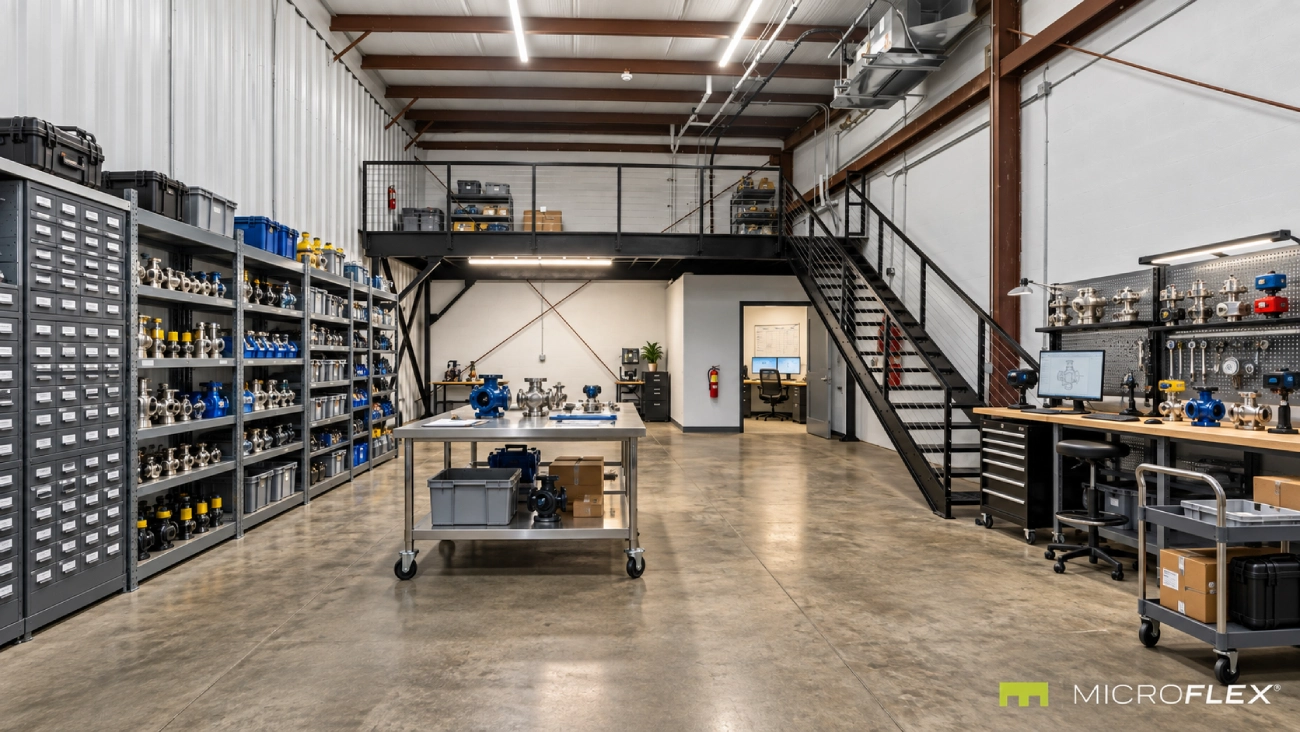
The workflow may require more organization than storage capacity.
Frequently handled components can remain accessible. Incoming products can be checked before entering inventory. Job-specific materials can be prepared on a rolling table or inspection bench. Completed orders can move toward a small outbound staging area.
In that type of business, the physical sequence may look like:
receiving → organized inventory → inspection → preparation → outbound delivery
The space supports the movement of the product rather than simply holding it.
Maintenance and Equipment-Service Businesses
A maintenance company may spend most of its billable hours somewhere else.
The unit still supports the work that happens between customer visits.
Replacement parts need organization. Portable equipment may require inspection or charging. Tools have to return to a known location. Consumable supplies need replenishment before the next job.
The business may also need a desk or administrative area for scheduling, quoting, ordering parts, and coordinating field work.
That mix of operational and administrative activity is different from passive storage.
Light Production, Kitting, and Product Preparation
Production occupations represent a relatively large share of Auburn-Opelika employment, and smaller businesses can have production workflows without operating full manufacturing facilities.
A permitted light operation might involve preparing components, assembling kits, labeling products, checking finished items, or preparing orders for shipment.
A useful layout separates those steps rather than allowing inventory and active work to compete for the same floor area.
For a deeper example, see
A Kitting and Light Assembly Workflow in a Small-Bay Unit
The University Economy Creates Additional Small-Business Activity
Auburn-Opelika is also shaped by Auburn University’s presence.
BLS data shows educational instruction and library occupations representing 11.5% of local employment in May 2025, compared with 5.9% nationally.
The significance for flex workspace is not that education itself requires small industrial units.
A large university economy supports many businesses around it.
Events, merchandise, graphics, equipment services, creative production, maintenance, landscaping, moving, specialty installation, and other services can involve substantial physical operations even when the customer-facing work happens somewhere else.
Signs, Graphics, and Event Displays
A sign, graphics, or event-display company illustrates that distinction.
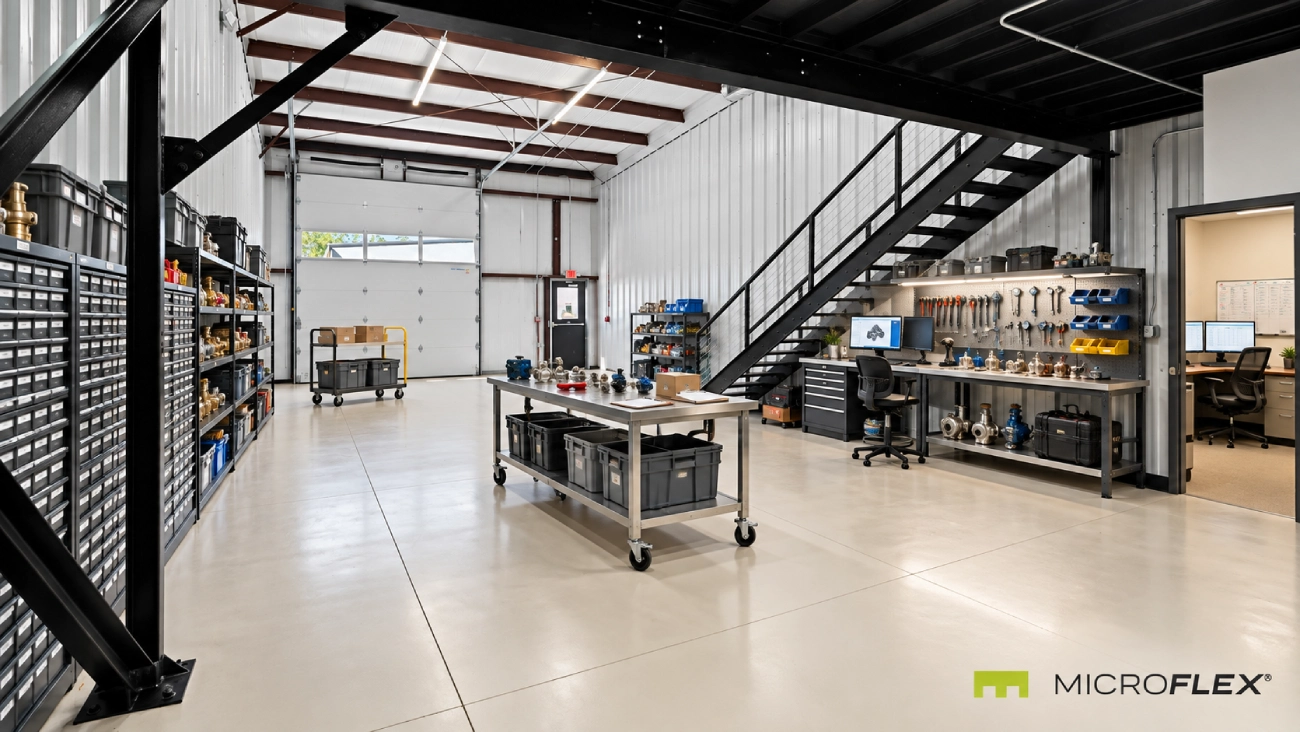
The finished product may be installed at a business, event, venue, or customer site, while the preparation happens back at the operating base.
Materials may enter as rolls, panels, frames, or reusable display systems.
Design work can happen at a computer workstation. Production and finishing occur at a dedicated table. Completed pieces need room for short-term staging before delivery.
The workflow becomes:
design → production → finishing → staging → delivery
This is visually and operationally very different from a contractor or parts distributor, but the underlying reason for needing the space is similar.
The business needs a private environment where physical work can be organized around what happens outside the unit.
Local Construction Activity Supports a Broader Trades Ecosystem
Lee County recorded 1,575 building permits in 2025, according to U.S. Census Bureau QuickFacts.
A permit count is not a measure of flex-space demand, and it should not be interpreted as one.
It does provide additional context for a market where residential and commercial construction activity continues to generate work for general contractors and specialty trades.
Electrical work, HVAC installation, painting, flooring, landscaping, fencing, millwork, and other trades tend to perform their revenue-generating work at project sites.
The operating base supports everything around that work.
Auburn-Opelika Is Different From Purpose-Built MicroFlex Locations
This distinction is important when discussing the MicroFlex® Auburn-Opelika property.
Auburn-Opelika is a rebranded property rather than a purpose-built MicroFlex location.
That means businesses should not assume that every feature or configuration available at a purpose-built MicroFlex property is available here.
At Auburn-Opelika:
- units include drive-up roll-up doors
- units include private restrooms
- climate control varies by individual unit
- mezzanine configurations are not available
- units do not begin at 1,000 square feet
MicroFlex uses one-year modified gross leases.
Current unit size, HVAC status, features, permitted use, and availability should be confirmed for the specific unit under consideration.
Drive-Up Access Can Become Part of the Workflow
For businesses that regularly move tools, supplies, products, or equipment, the roll-up door is more than an architectural feature.
It can become part of the operating sequence.
A contractor can move job materials between a vehicle and the working floor.
A parts supplier can receive or dispatch equipment without carrying it through an office environment.
A mobile service operator can return equipment, reset supplies, and prepare the vehicle for the next workday.
The important point is not simply that a vehicle can approach the unit.
It is that the path between transportation, storage, preparation, and outbound work can remain relatively direct.
A Useful Layout Does Not Fill Every Square Foot
One of the easiest ways to make a small operating unit less useful is to fill every available wall and floor area with stored items.
For many operators, open space is part of the workflow.
It allows materials to arrive temporarily without blocking permanent storage.
It gives mobile worktables somewhere to move.
It creates room to prepare equipment or organize a specific project.
It also helps separate items that are stored from items that are actively moving through the business.
A practical small-bay layout often uses the perimeter for relatively static functions while protecting the center for movement and temporary work.
The Real Demand Question Happens Inside the Business
Auburn-Opelika’s manufacturing base, production workforce, trade activity, construction environment, university economy, and owner-operated business population provide credible market context.
None of those statistics alone proves that a specific business needs flex space.
The decision happens at the operating level.
Has equipment become difficult to manage from vehicles?
Does inventory no longer have a consistent receiving and outbound path?
Are tools and materials stored in multiple places?
Is preparing for the next job consuming unnecessary time?
Does the business need active working space rather than passive storage?
When several of those conditions appear together, the company may need a more structured physical base without needing a large conventional industrial facility.
MicroFlex Auburn-Opelika as a Working Base
MicroFlex Auburn-Opelika
is located at 2900 Wyndham Industrial Dr in Opelika and serves the broader Auburn-Opelika market.
The property can support a range of approved contractor, trades, equipment, inventory, and other operational business uses, depending on the specific unit and proposed activity.
Because Auburn-Opelika differs from the purpose-built MicroFlex product, evaluating a unit should begin with the actual operation rather than assuming a particular configuration.
- What enters the unit?
- What stays there?
- What active work takes place inside?
- How frequently do tools, materials, or products move between the unit and vehicles?
- How much open floor area does the operation need?
- Does the specific available unit include climate control?
Once the workflow is clear, review the current
MicroFlex Auburn-Opelika location
and contact the leasing team to confirm current unit size, features, permitted use, and availability.
Sources
- U.S. Bureau of Labor Statistics, Auburn-Opelika, AL Economy at a Glance
, August 2026 data. - U.S. Bureau of Labor Statistics, Occupational Employment and Wages in Auburn-Opelika, AL
, May 2025 estimates published July 2026. - U.S. Census Bureau QuickFacts, Lee County, Alabama
. - City of Auburn, Community Profile 2026
. - City of Opelika, Largest Employers
.
Disclosure
This article is published by Founders Investment Properties, LLC, owner and operator of MicroFlex®. Content is provided for general informational and educational purposes only. Nothing in this article constitutes legal advice, tax advice, financial advice, investment advice, insurance advice, real estate brokerage advice, or any other form of professional advice. Readers should consult their own attorneys, accountants, tax professionals, insurance brokers, and licensed real estate professionals before making decisions based on the topics discussed.
MicroFlex® is a registered trademark of Founders Investment Properties, LLC. Photos may be representative and may not reflect a specific location. Product configurations, features, lease terms, pricing, and availability are subject to change. Current information is available at microflexspace.com or by contacting the leasing team directly.