Why Every HVAC Contractor Needs to Understand the Modern HVAC Parts Warehouse
An HVAC parts warehouse is a wholesale distribution facility that stocks heating, ventilation, and air conditioning equipment, replacement parts, and accessories — sold directly to contractors, property managers, businesses, and in many cases homeowners, often at prices below traditional retail.
Quick answer: What is an HVAC parts warehouse?
| Feature | What to Expect |
|---|---|
| Who can buy | Contractors, homeowners, property managers, businesses |
| Product range | Full systems, replacement parts, OEM components, IAQ products |
| Pricing model | Wholesale, often below retail; some require account registration |
| Fulfillment | Online shipping (2-5 business days) or local counter pickup |
| Support | Varies — some offer technical assistance and load calculations |
| Brands stocked | Goodman, Carrier, Trane, York, Mitsubishi, Daikin, and more |
The global HVAC equipment market was valued at approximately $120 billion in 2023 and is projected to reach $200 billion by 2030. That growth is reshaping how contractors and businesses source equipment — shifting away from single local suppliers toward a mix of online wholesalers, regional distributors, and specialty parts centers.
For HVAC contractors and business owners, knowing where to source parts is only half the equation. The other half is having the right operational setup — storage, staging, and workspace — to turn those parts into completed jobs efficiently.
I’m Chase Carroll, a real estate developer and small business transaction advisor with 12+ years of experience working with owner-operators across industries, including those who rely on an HVAC parts warehouse as a core part of their supply chain. That experience shapes how I think about the operational side of running an HVAC business, not just the procurement side. In the sections below, we’ll cover how modern HVAC distribution works, what to look for in a supplier, and how your physical workspace connects directly to how well you can move inventory and serve customers.
Operational Dynamics of a Modern HVAC Parts Warehouse
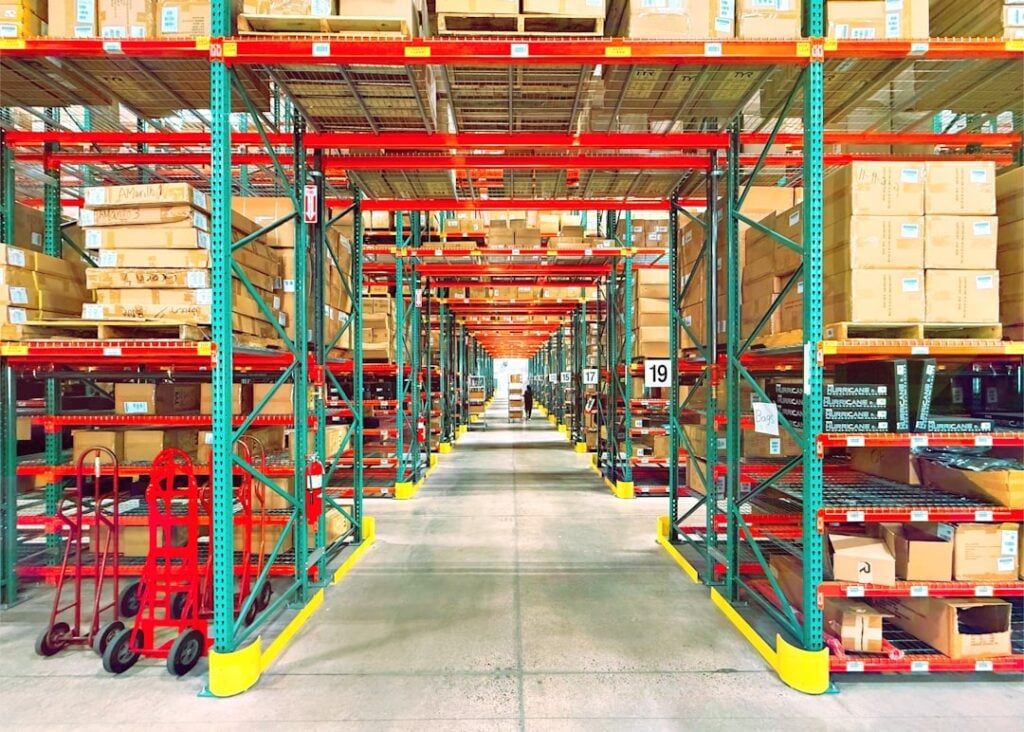
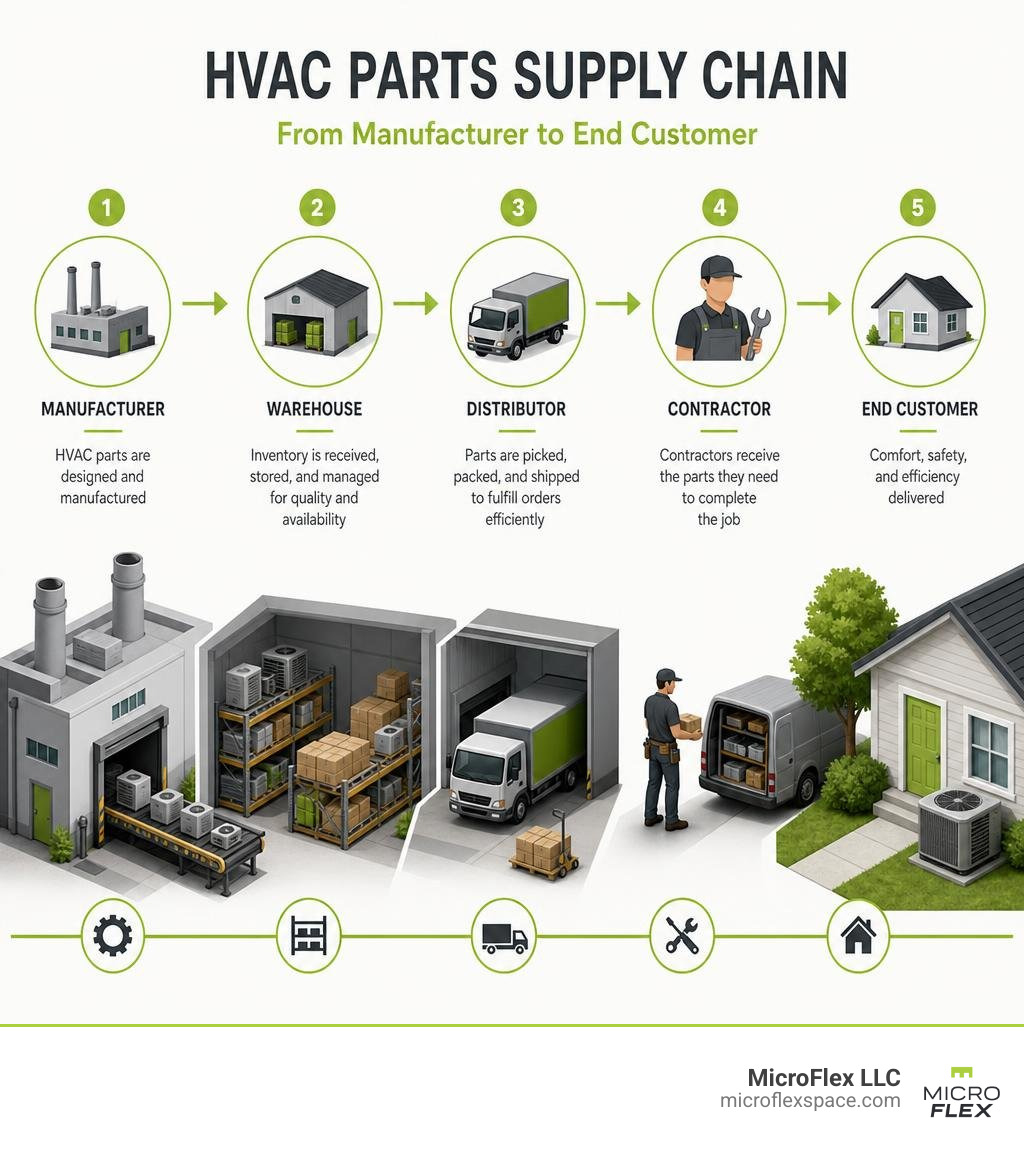
The daily operations of an HVAC parts warehouse rely on balancing inventory depth with fast order fulfillment. Unlike a standard retail hardware store, these facilities manage thousands of highly technical components. They stock everything from large commercial rooftop units to tiny low-pressure sensors and specialized electrical contacts.
For service technicians, sourcing authentic parts is critical to maintaining system warranties and performance. Wholesalers like the Carrier York Trane Parts | HVAC Repair Parts – HVAC Parts Center focus heavily on carrying genuine OEM parts. This ensures that contractors can find exact-match replacement components, such as discharge pressure transducers, oil level switches, or built-in oil filters for heavy-duty screw compressors.
Other distributors, such as Home | Glacier Supply Group and Total Parts USA , provide a mix of refrigeration equipment, run capacitors, and specialized tools. By maintaining direct relationships with manufacturers, these warehouses can hold vast inventories, reducing the time a contractor’s customer has to wait for a system repair.
Sourcing from Online Wholesalers vs. Traditional Local Suppliers
Contractors today have more options than ever when deciding where to buy equipment. Sourcing from online wholesalers offers several distinct advantages, alongside some trade-offs when compared to traditional brick-and-mortar local suppliers.
Online suppliers often maintain lower overhead costs, allowing them to offer highly competitive pricing structures on major equipment. Many online operations carry over 100,000 unique models and parts in their virtual catalogs. Wholesalers like WebReps B2B Wholesale HVAC-R | Online Home Distributor for B2B HVAC Customers combine this massive product access with commercial support, making it simple to source everything from high-wind hurricane-impact louvers to commercial ducting.
Similarly, online distributors like Wholesale HVAC Systems & Parts | National Air Warehouse offer nationwide distribution networks. They often provide free shipping on thousands of products, delivering complete split systems, packaged units, and air handlers directly to a shop or job site within two to five business days.
However, online sourcing lacks the immediate, face-to-face assistance that local suppliers provide. When a technician is on a service call in the middle of a summer heatwave, waiting two days for a capacitor is not an option. This is why local parts counters remain a vital part of a contractor’s supply chain.
Inventory Management in a Wholesale HVAC Parts Warehouse
Managing an HVAC parts warehouse requires sophisticated tracking systems to handle the sheer volume of hardware. A single warehouse might stock thousands of individual SKUs, including:
- Electrical components: Capacitors, contactors, relays, and variable frequency drives (VFDs).
- Air movement parts: Blower wheels, fan blades, and replacement motors.
- System hardware: Actuators, bearings, sensors, and valves.
To keep these items organized, wholesalers rely on digital inventory systems. Suppliers like HVAC Hardware Products Online | HVAC Hardware Products Supplier In USA | HVAC Parts Direct focus on keeping thousands of commercial-grade hardware parts in stock, ensuring that contractors can quickly search, verify compatibility, and order the exact pieces needed to complete a repair.
Local Distribution and Technical Support
Local distribution centers provide the physical touchpoint that online-only stores cannot replicate. Local counter service allows technicians to ask questions, verify parts compatibility in real time, and pick up materials instantly.
In Alabama, local wholesale networks are highly active. Contractors in the Birmingham metro area frequently rely on suppliers like Wholesale HVAC Distributor | Birmingham AL – JohnstoneSupply or the Birmingham, AL 35222 | Ferguson HVAC Supply Store for immediate inventory needs.
Further north, the Huntsville, AL 35806-3704 | Ferguson HVAC Supply Store and HVACR Parts – Huntsville AL – Johnstone Supply serve the Tennessee Valley. In East Alabama, local professionals utilize suppliers like the Wholesale HVAC Distributor | Opelika AL – JohnstoneSupply to keep their service trucks stocked. These local hubs act as an extension of a contractor’s own inventory, providing a safety net for urgent, same-day repairs.
Navigating Industry Standards and Specialized Equipment
The HVAC industry is undergoing rapid regulatory changes. Modern warehouses do more than just ship boxes; they help contractors navigate new energy efficiency standards and refrigerant transitions.
As of recently, the transition to low-GWP (Global Warming Potential) refrigerants is fully underway. Wholesalers must stock systems compatible with new refrigerants like R-32 and R-454B, which are replacing older standards like R-410A.
| Refrigerant | ASHRAE Safety Group | GWP (Global Warming Potential) | Common System Applications |
|---|---|---|---|
| R-32 | A2L (Mildly Flammable) | 675 | Ductless mini-splits, residential split systems |
| R-454B | A2L (Mildly Flammable) | 466 | Residential and commercial packaged units, split systems |
Adapting to SEER2 and New Refrigerants
The transition to SEER2 (Seasonal Energy Efficiency Ratio 2) standards has changed how systems are manufactured, tested, and rated. Modern HVAC parts warehouse distributors must ensure that the equipment they sell meets these updated, more stringent testing procedures.
These regulatory shifts require warehouses to educate their customers. Distributors must guide contractors on equipment compatibility, ensuring that new indoor coils are properly matched with new outdoor condensers under the SEER2 rating system. This prevents installation errors and ensures compliance with municipal building codes.
Sourcing Specialized Systems and IAQ Products
Beyond standard split systems, wholesale warehouses must support specialized markets. This includes ductless mini-splits, commercial water-source heat pumps, and mobile home heating and cooling systems.
Mobile home HVAC systems, for example, require specific configurations due to restricted space and unique duct designs. Wholesalers like Jakin Mobile Home Supply focus on these niche products, stocking specialized downflow furnaces and compact coil cabinets that meet HUD code requirements.
Additionally, Indoor Air Quality (IAQ) products have become standard inventory. Warehouses now stock high-efficiency MERV filters, whole-home humidifiers, and UV-C germicidal lamps designed to neutralize airborne pathogens within the ductwork.
Optimizing Inventory Storage for HVAC Contractors
For a growing HVAC business, relying entirely on a third-party HVAC parts warehouse for daily inventory can slow down operations. Successful contractors often set up their own localized staging areas to keep active jobs moving.
Managing your own parts storage allows your team to stage equipment for the next day’s installs, reducing early morning trips to the distributor. Contractors can find valuable operational strategies in our Microflex Spaces HVAC Ultimate Guide. Similar logistics strategies are also used by adjacent trades, as detailed in our guide on Microflex Space for Plumbing Businesses and our overview of Plumbing Parts Storage.
Staging Inventory in a Local HVAC Parts Warehouse
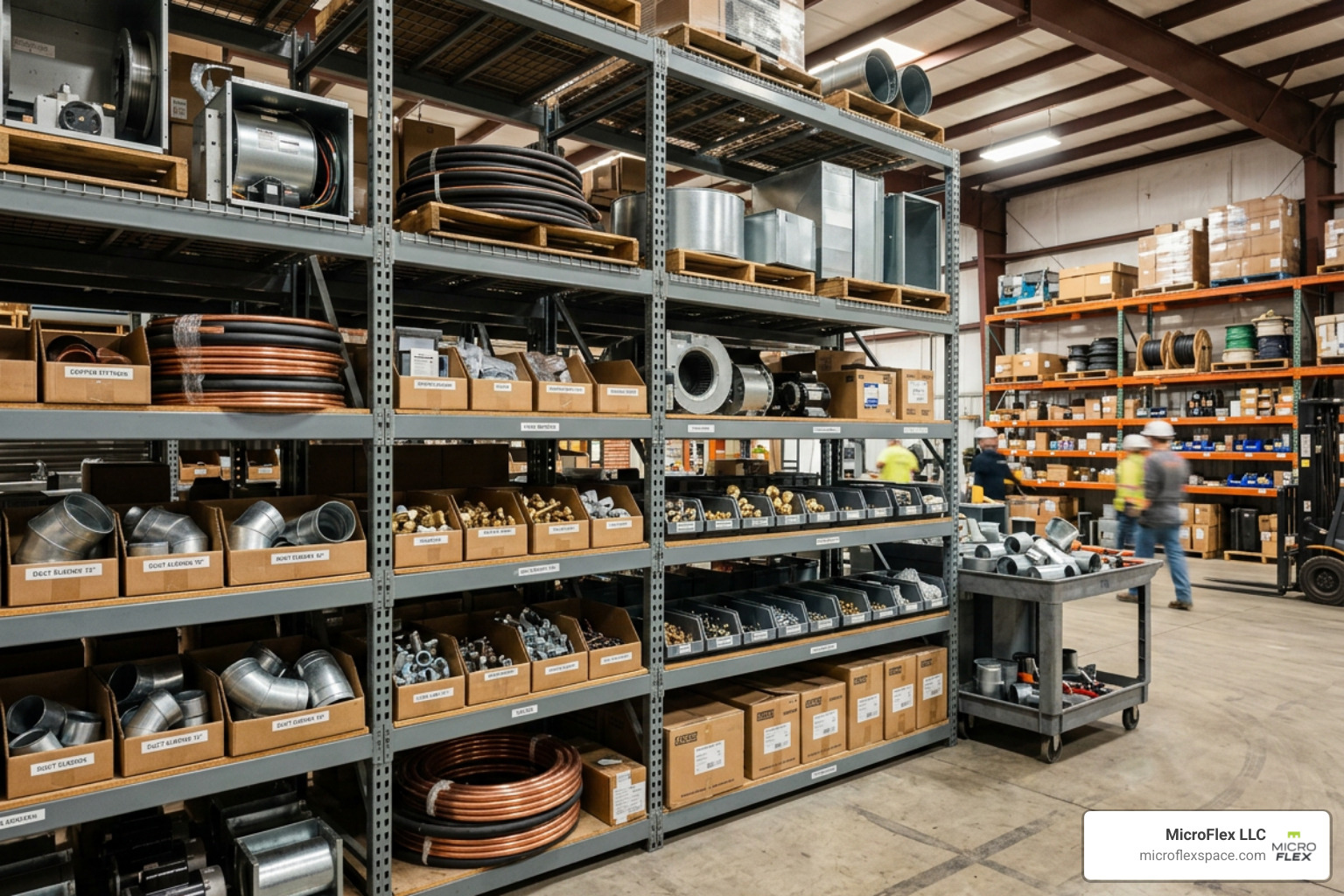
Setting up a centralized workshop or staging bay helps contractors organize bulk orders of ductwork, copper linesets, fittings, and units. Instead of dispatching technicians to a local distributor every morning, business owners can buy in bulk, store the materials locally, and have crews load their service vans directly from their own space.
To find a suitable location for organizing these materials, many local business owners search for Warehouse Storage Near Me or consult a Small Warehouse for Rent Guide to understand how to set up efficient shelving, pallet racking, and staging zones.
Utilizing Flex Space for HVAC Operations
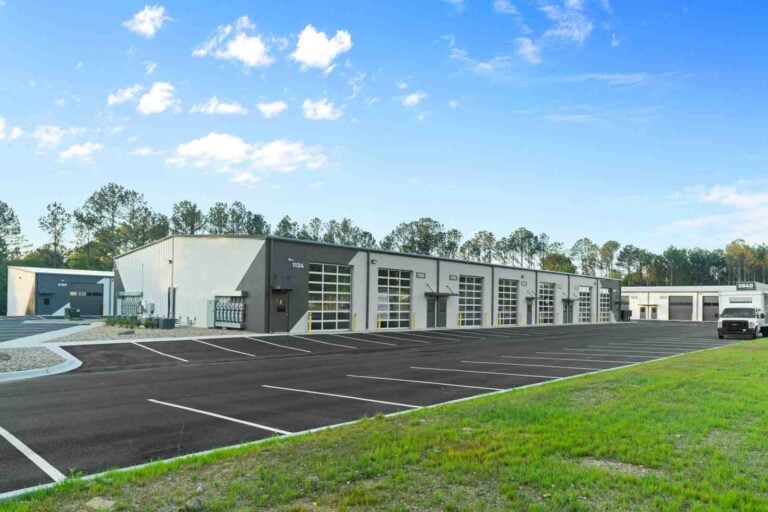
For contractors who need a professional footprint without the commitment of a massive industrial lease, purpose-built small-bay industrial space is an excellent fit. At MicroFlex® LLC, we offer adaptable multi-function spaces that combine warehouse, office, storage, and showroom features under a straightforward one-year modified gross lease.
Our spaces are designed with the practical needs of field-based teams in mind. We operate multiple locations in Alabama, including Irondale and Hoover (in the Birmingham metro area), Huntsville (Slaughter Rd. and South Memorial), and Auburn-Opelika.
Our purpose-built locations feature four distinct tiers tailored to different business sizes:
- FLEX: Our base tier, featuring an open bay, drive-up roll-up door, private restroom, climate control, and LED lighting.
- FLEX+: Includes all base features plus an enclosed rear office, ideal for contractors who need a dedicated desk for dispatching and invoicing.
- FLEX Premium: Adds a structural mezzanine to the base setup, expanding storage capacity for bulky equipment like air handlers and furnaces.
- FLEX Ultimate: Features a full mezzanine and a premium finish for businesses wanting a polished workspace.
For contractors operating in East Alabama, our Auburn-Opelika location is a rebranded facility. At this specific property, climate control varies by unit, mezzanines are not present, and units do not start at 1,000 square feet. However, these units do include drive-up doors and private restrooms, providing a highly functional setup for local field teams.
To see how local tradespeople utilize these spaces, read about how Discover Why HVAC Professionals in Auburn Alabama Thrive in Microflex Spaces. If you are evaluating your options, you can explore our resources on Warehouse Office Space for Rent, Flexible Industrial Space, Industrial Warehouses for Rent Near Me, and Beyond the Bays: A Comprehensive Guide to Renting Industrial Space.
Frequently Asked Questions about HVAC Parts Sourcing
Who can purchase from wholesale HVAC parts warehouses?
It depends on the distributor. Some wholesale warehouses sell exclusively to licensed HVAC contractors who hold proper EPA certifications (such as Section 608 certification for handling refrigerants). Other online retailers allow homeowners, property managers, and business owners to purchase equipment directly, though they typically advise that a licensed professional perform the installation to preserve the manufacturer’s warranty.
How do wholesalers handle warranties and returns?
Most wholesale distributors pass manufacturer warranties directly to the buyer. For equipment, these warranties often range from five years to lifetime coverage on specific components like heat exchangers, provided the system was installed by a licensed technician and registered within a specific timeframe. Returns on electrical parts or custom-ordered ductwork often carry restocking fees, while standard, unused parts in original packaging can typically be returned within 30 to 90 days.
What value-added services do HVAC distributors provide?
Many leading distributors offer services beyond parts sales. This includes performing residential and commercial load calculations (such as Manual J, Manual N, and Manual D duct design) to ensure systems are sized correctly for the space. Some B2B distributors also assist with energy code compliance calculations (such as COMCheck or RESCheck) to help contractors obtain necessary building permits.
Conclusion
Sourcing from a reliable HVAC parts warehouse is essential for maintaining a competitive, efficient heating and cooling business. Whether you rely on massive online catalogs for planned installations or local counters for urgent service calls, understanding how to navigate the modern wholesale supply chain is key to keeping your customers comfortable.
As you scale your contracting business, having a physical operations base is just as important as having a reliable parts supplier. A dedicated workspace allows you to stage equipment, store high-turnover parts, and manage administrative tasks in a professional environment.
At MicroFlex LLC, based in Birmingham, Alabama, we provide the physical infrastructure that helps local service businesses thrive. Our one-year modified gross leases offer the stability you need to grow your operations without unnecessary complexity. To learn more about our available configurations and locations, visit our MicroFlex Multi-Use Commercial Property page.
This article is published by Founders Investment Properties, LLC, owner and operator of MicroFlex®. Content is provided for general informational and educational purposes only. Nothing in this article constitutes legal advice, tax advice, financial advice, investment advice, insurance advice, real estate brokerage advice, or any other form of professional advice. Readers should consult their own attorneys, accountants, tax professionals, insurance brokers, and licensed real estate professionals before making decisions based on the topics discussed.
MicroFlex® is a registered trademark of Founders Investment Properties, LLC. Photos may be representative and may not reflect a specific location. Product configurations, features, lease terms, pricing, and availability are subject to change. Current information is available at microflexspace.com or by contacting the leasing team directly.
Tax considerations vary by jurisdiction, business structure, and individual circumstances. Consult a CPA or tax attorney before relying on any tax-related content in this article.
Legal and regulatory requirements vary by jurisdiction. Consult a licensed attorney in your state before relying on any legal or regulatory content in this article.
Insurance coverage requirements vary by activity, location, and business structure. Consult a licensed insurance broker before relying on any insurance-related content in this article.
Real estate transactions involve legal, financial, and regulatory complexity. Consult a licensed real estate professional in your state before making real estate decisions.