Why Every Minute Counts: The Hidden Cost of Disorganized Storage
Plumbing parts storage is essential for any plumbing professional or DIY enthusiast who wants to work efficiently and save money. The right storage solutions help you find parts quickly, prevent duplicate purchases, and maintain a professional appearance on job sites.
Key Plumbing Parts Storage Solutions:
- Compartment Organizers – Perfect for small fittings, washers, and O-rings
- Nipple Caddies – Hold plumbing nipples upright in dedicated compartments
- Slide Racks & Bins – Modular systems for shops and service vans
- Magnetic Tool Holders – Keep wrenches and tools accessible
- Clear Storage Containers – Enable quick visual identification
- Parts Organizer Towers – Vehicle-mountable, stackable units for DeWalt, Milwaukee, or Stanley bins
Storage Location Options:
- Service vehicle systems (van shelving, headboard mounts, floor-mounted racks)
- Workshop setups (pegboards, drawer cabinets, wall-mounted bins)
- Portable solutions (tackle boxes, tote trays, bucket caddies)
Every plumber knows the frustration of digging through a disorganized van while a customer waits. You search through multiple bins, unsure if you even brought the right fitting. That wasted time adds up quickly—both in lost billable hours and damaged professional reputation. Research shows that organized storage systems directly impact project efficiency, allowing faster job completion and accurate inventory management.
The solution isn’t complicated, but it does require a thoughtful approach. From small compartment boxes for fittings to vertical pipe racks for longer materials, the right storage system transforms chaos into a streamlined workflow.
I’m Chase Carroll, and my 12+ years building and advising small businesses have shown me how critical efficient plumbing parts storage is to operational success and profitability. Whether you’re optimizing a service van or designing a dedicated workshop space, the principles of smart organization remain the same.
Simple Plumbing parts storage glossary:
The Blueprint for Efficiency: Why Organized Storage Matters
Picture this: You walk into your van or workshop, and within seconds, you’ve grabbed exactly what you need. No digging, no guessing, no frustration. That’s the power of a well-designed plumbing parts storage system, and it’s not just about keeping things neat—it’s about changing how you work and how much you earn.
When you set up proper plumbing parts storage, you build a foundation for project efficiency. You’ll complete jobs faster, reduce waste by using what you buy, and simplify inventory management. There’s something else, too: professionalism. Whether you’re working out of a service van or a workshop space in Birmingham, Irondale, Huntsville, or Auburn Opelika, an organized setup tells customers you mean business. It shows you respect your craft, your tools, and their time, leading to customer satisfaction that keeps clients coming back. If you’re thinking about how to better organize your entire business operation, our guide on business rental solutions offers practical insights.
From Chaos to Cash: The Financial Benefits
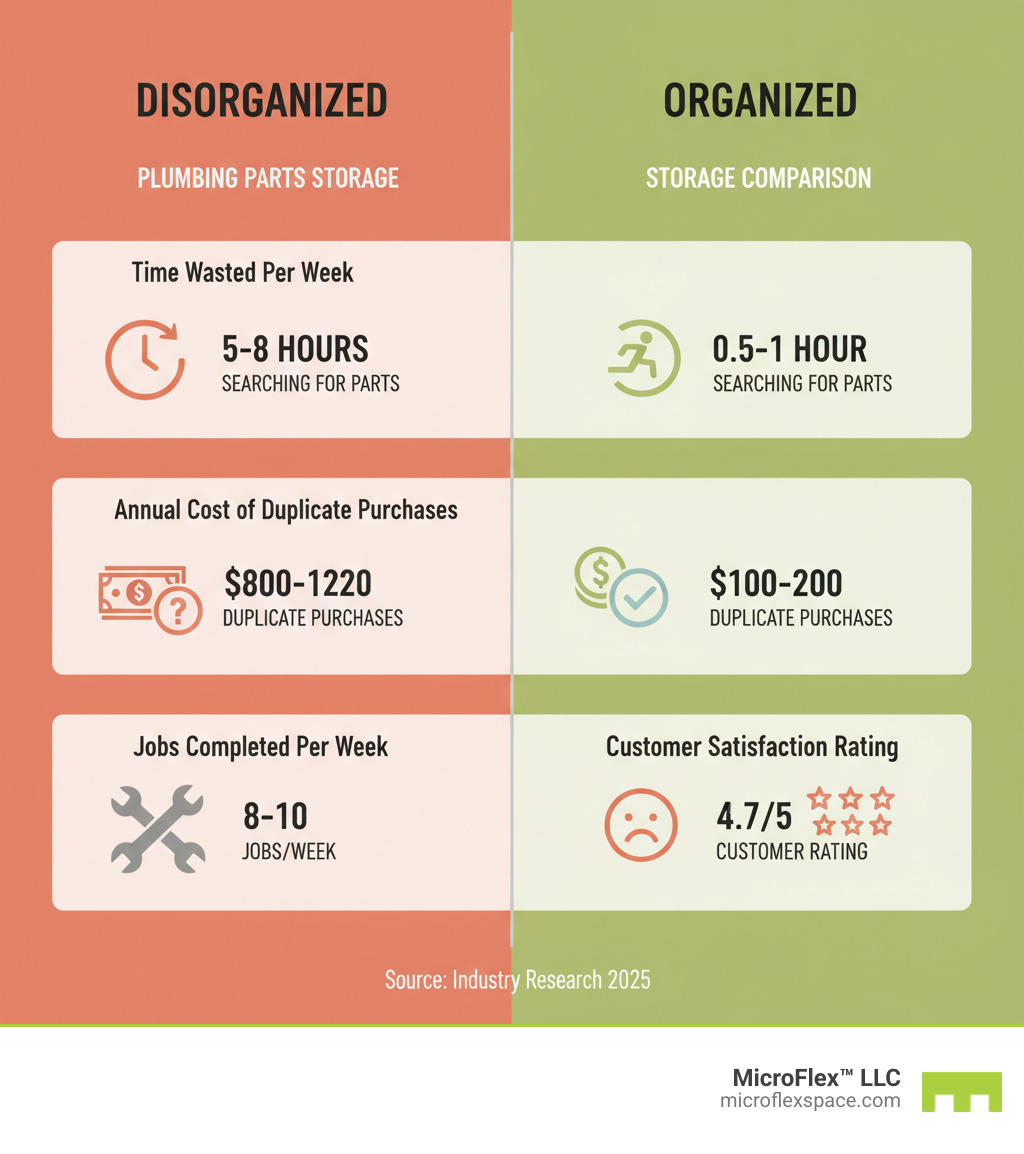
Disorganized storage isn’t just annoying—it’s expensive. Every minute you spend hunting for a part is money walking out the door.
Organized plumbing parts storage directly impacts your bottom line. Reduced duplicate purchases happen when you can see your inventory. You’ll spend less time searching for parts and more time on billable work. Accurate job costing becomes simple, and minimized part damage protects your investment. A major benefit is fewer trips to the supply house; knowing your stock prevents emergency runs mid-job, saving time, fuel, and momentum.
The financial impact adds up quickly, translating directly into increased productivity. For contractors looking to optimize their entire operation, the MicroFlex Space for Contractors Ultimate Guide explores additional strategies for business efficiency.
Building a Professional Reputation
Your reputation is the foundation of your business, and organization plays a bigger role than you might think.
When you arrive at a job with a clean workspace, customers notice. Quick part retrieval demonstrates competence. Instead of making a client wait while you dig through bins, you smoothly pull out what’s needed. This efficiency builds genuine client confidence. They believe you’ll handle their plumbing issues with the same care you give your equipment. That trust creates a positive impression that leads to repeat business and referrals.
In a competitive industry, that professional image can be the difference between a full schedule and scrambling for work. Organization is a marketing tool that works for you on every single job.
Mastering Your Mobile Workshop: The Ultimate Guide to Plumbing Parts Storage
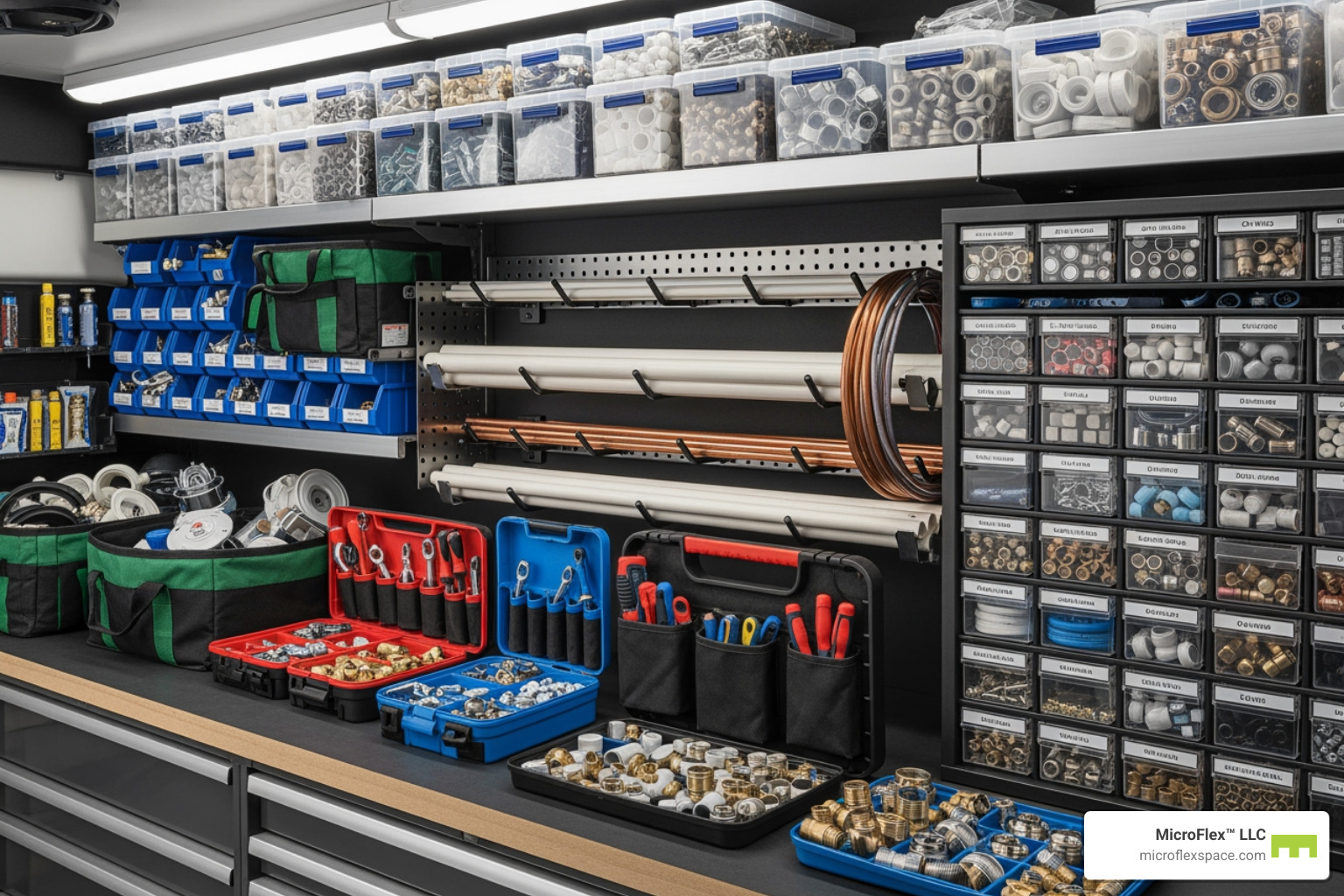
Not all storage solutions are created equal. The key to mastering plumbing parts storage is matching the right solution—from specialized bins to heavy-duty racks—to each component. The market offers a range of options in materials like polyethylene, polypropylene, and steel. The magic happens when we understand which solution works best for which situation, whether organizing a service van or setting up a workshop in Birmingham or Huntsville.
Small Parts, Big Solutions: Storing Fittings and Fixtures
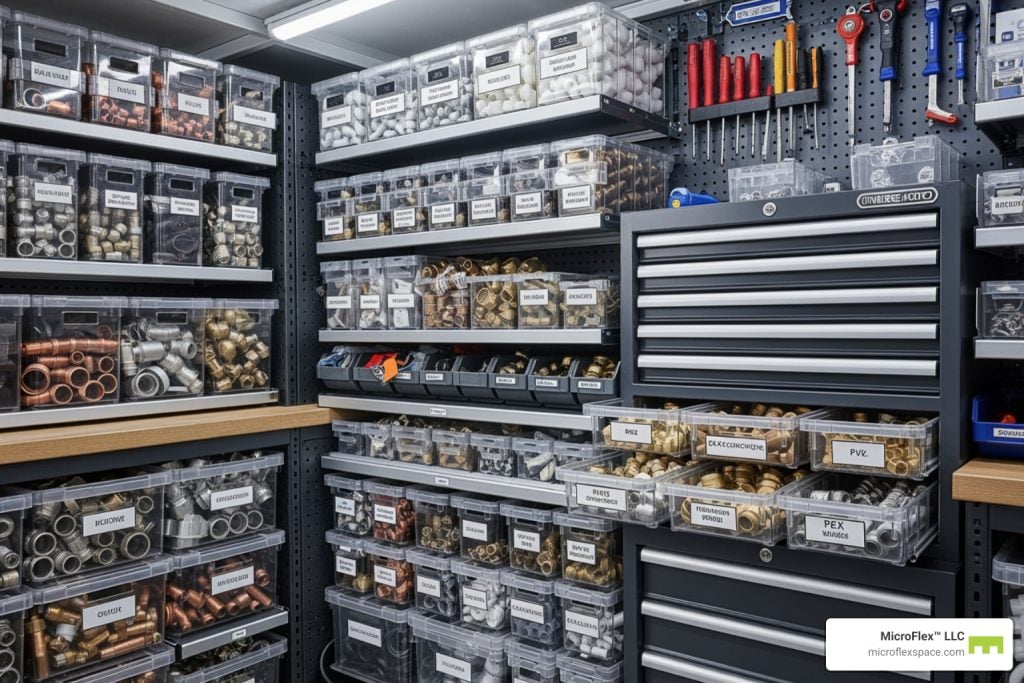
Small parts like washers, screws, O-rings, and nipples are essential but easily lost. Compartment organizers with adjustable dividers are lifesavers for creating custom spaces for different fittings. The value of clear containers can’t be overstated, saving minutes on every job by allowing visual identification. Tackle-box style cases offer portable, organized transport of frequently used parts.
For wall-mounted convenience, tip-out bins provide quick access in a workshop or van. Specialized Nipple caddies hold plumbing nipples upright, preventing them from rolling around. Fittings storage cases with removable boxes are another excellent, compact solution for shops and vans.
Taming the Tools and Taming the Tubes: Storing Larger Items
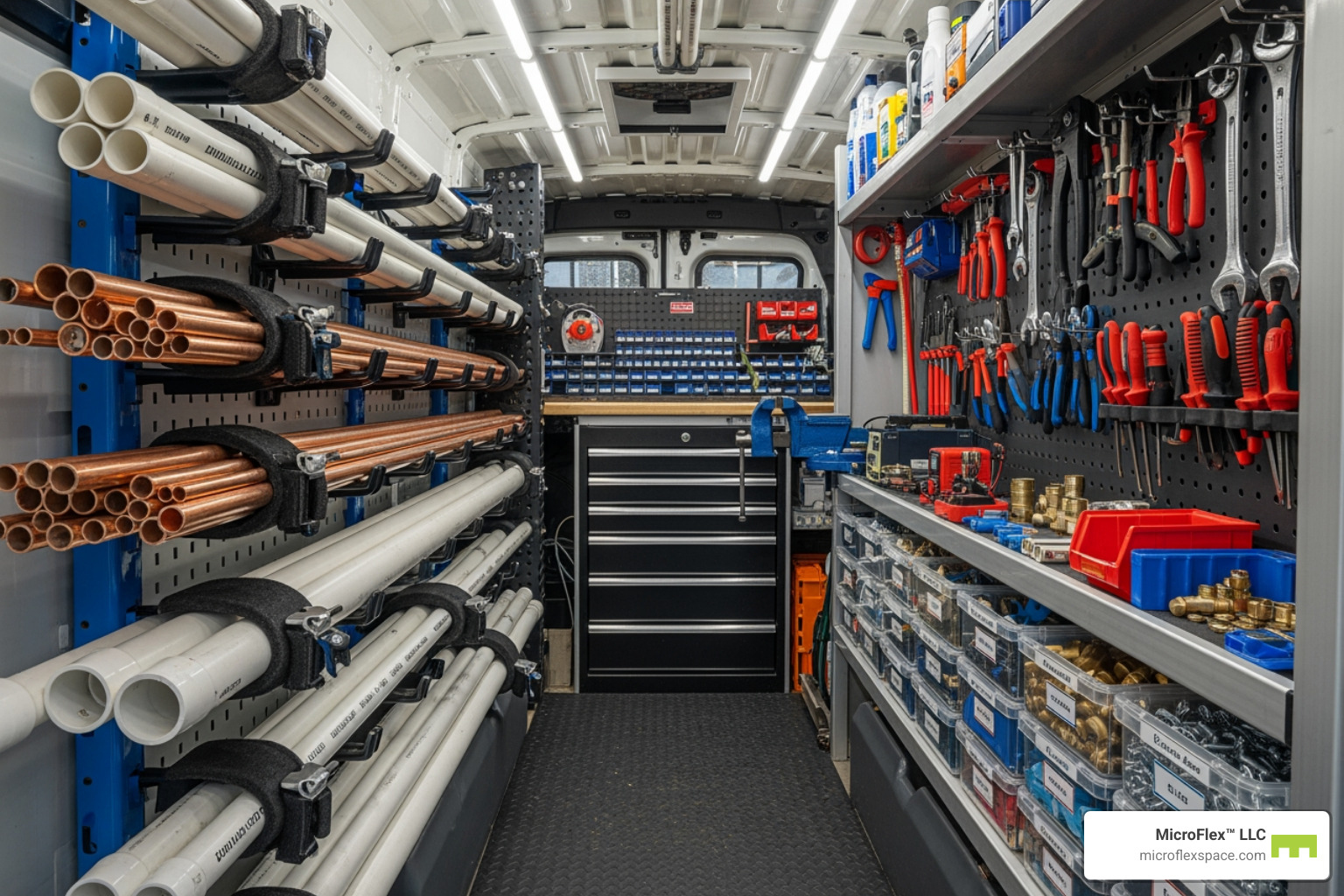
Larger items like pipes and tools require robust solutions that maximize space, especially in a service vehicle. Vertical storage is a game-changer for pipes, using racks on a van’s interior wall or ceiling to maximize floor space. In a workshop, vertical racks keep long materials accessible but out of the way. Custom shelving is perfect for irregularly shaped items like water heaters or pumps.
For tools, magnetic wrench racks and holders keep frequently used items organized and within arm’s reach. Tool chests provide secure storage in a workshop, protecting expensive equipment. Bucket caddies and tote trays bridge the gap, letting you carry essential tools and parts to the immediate work area. For businesses needing more space for bulk inventory, exploring small warehouse storage options can provide the necessary room.
Material Matters: Choosing Your Storage
The material of your plumbing parts storage impacts durability, cost, and performance. Plastic solutions (polyethylene or polypropylene) are rust-proof, lightweight, and affordable, making them ideal for service vehicles where weight and portability are key. Clear plastic also allows for instant visual identification. The trade-off is that plastic can become brittle in extreme cold and may not withstand the heaviest loads.
Metal storage, usually steel, offers superior durability for heavier loads and rigorous use. It’s an excellent choice for fixed workshop installations like drawer cabinets and tool chests. The downsides include added weight, higher cost, and susceptibility to rust if not treated. The best approach often uses both materials strategically: lightweight plastic for mobile solutions and robust metal for the workshop.
Organization in Action: Systems and Strategies
Here’s the truth about plumbing parts storage: buying the right containers is only half the journey. The real magic happens when we implement smart systems that transform those containers into a streamlined workflow. It’s like having a great toolbox but never organizing what goes inside—you’ve got potential, but you’re not using it.
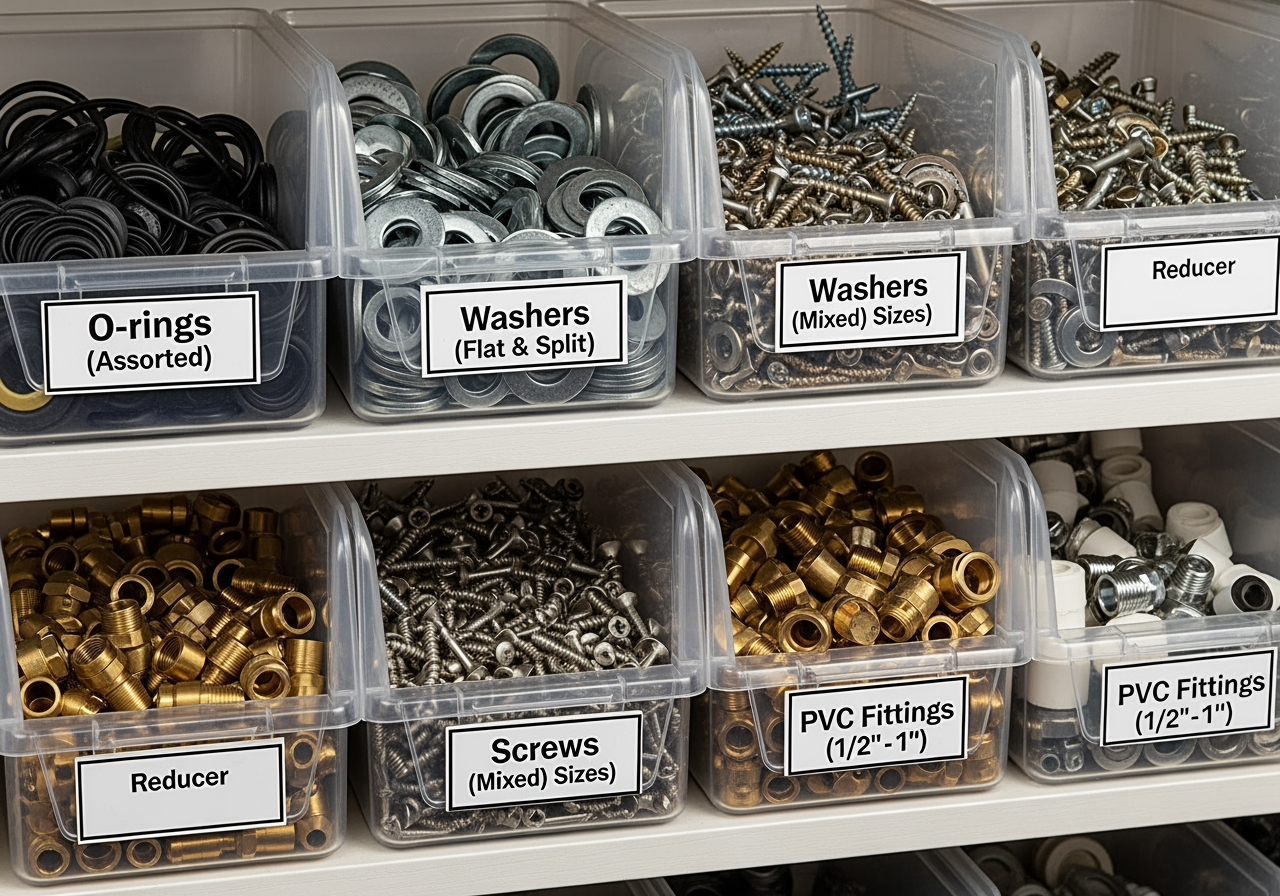
The foundation of any effective system starts with labeling. This isn’t optional, it’s essential. Whether we’re using clear bins or opaque boxes, every single container needs a clear, readable label. We can keep it simple with handwritten tags, get professional with a label maker, or even go high-tech with barcode systems for larger inventories. The key is making sure we can identify what’s inside at a glance—part type, size, and quantity if that matters.
Color-coding takes things a step further. Imagine assigning blue labels to all copper fittings and green to PVC components. When we’re racing against the clock on a job, that splash of color can guide us to the right bin instantly. It’s a small detail that makes a surprisingly big difference.
The way we group our inventory matters just as much as how we label it. Keeping all faucet repair kits together, all toilet components in another section, and drain parts in yet another creates logical zones in our storage. Within those zones, we can organize by size—all half-inch copper elbows together, all three-quarter-inch ones separate. This prevents the frustrating shuffle through mixed sizes when we need something specific.
For those of us running larger operations, especially from a dedicated workshop space in Huntsville or Auburn Opelika, inventory tracking becomes increasingly valuable. A simple spreadsheet or specialized app helps us monitor stock levels and know when it’s time to reorder. No more finding we’re out of a critical part halfway through a job.
Finally, we need to think about accessibility. The parts we reach for most often should be the easiest to grab—eye level in a workshop, front and center in a service van. Less frequently used items can live in those harder-to-reach spots. It’s common sense, but it’s amazing how much time this simple principle saves over the course of a day.
The See-Through Strategy: Using Clear Containers and Labels
There’s something almost magical about clear storage containers for plumbing parts storage. Walk up to our shelves or open our van doors, and we can immediately see what we have. No guessing, no opening five different boxes to find the right O-ring, no wasted motion. Just instant visual confirmation.
This see-through approach is particularly brilliant for small, similar-looking components. When we’re dealing with various washers, O-rings, or tiny screws, being able to spot the exact one we need through the container wall saves minutes on every single retrieval. Those minutes add up to hours over a week, and hours translate directly to more billable time and fewer frustrated customers.
The Container Store offers various clear storage boxes that work beautifully for this purpose, giving us that x-ray vision into our inventory. For those times when we do use opaque containers—maybe for heavier items or in situations where clear plastic isn’t practical—we double down on our labeling game. A comprehensive label becomes our guide, potentially including the part number, size, and even a small graphic or photo for instant recognition.
The smartest approach combines both strategies. Use clear containers wherever practical for that immediate visual feedback, and back everything up with detailed labels. This redundancy ensures our plumbing parts storage system works efficiently whether we’re working in bright daylight or the dim corner of a basement.
Customizing Your Space: Van vs. Workshop Setups
Here’s where plumbing parts storage gets personal—because a system that works perfectly in a spacious workshop might be a disaster in a compact service van, and vice versa. We need to match our storage strategy to our actual working environment.
Service vans present unique challenges. Space is tight, and everything needs to stay secure when we’re driving from Birmingham to Irondale or navigating Huntsville’s streets. That’s where vehicle-specific solutions shine. Part Organizer Towers designed for brands like DeWalt, Milwaukee, or Stanley maximize our carrying capacity with compact footprints—typically around 14 inches deep. These towers can mount under shelving, against the headboard, or directly to the floor, and they stack to take advantage of vertical space that might otherwise go unused.
Van shelving forms the backbone of mobile organization, providing the structure we need to keep bins and boxes from becoming projectiles during transit. Headboard mounts and floor mounts use often-overlooked areas, and removable compartment boxes let us grab exactly what we need and carry it straight to the work area without hauling our entire inventory inside.
Workshops offer different opportunities. With more space and no concerns about items shifting during transit, we can implement larger-scale solutions. Heavy-duty garage shelving accommodates bigger bins and bulkier equipment. Pegboards transform wall space into organized tool displays where everything is visible and within arm’s reach. Drawer cabinets protect items from dust while keeping them sorted and accessible. Vertical pipe racks store long materials efficiently without eating up valuable floor space.
For plumbing businesses ready to establish or expand their workshop presence, MicroFlex™ LLC provides adaptable commercial spaces throughout Alabama that can be configured to match specific storage needs. Whether we’re looking for a commercial workshop for rent or a small warehouse for rent Birmingham AL, having the right space makes all the difference in creating an organized, efficient operation.
Frequently Asked Questions about Plumbing Parts Organization
I get it—organization questions come up all the time, and they’re worth addressing because getting these details right can make or break your efficiency on the job.
How do I prevent small fittings from getting mixed up?
Here’s the truth: small fittings are sneaky little troublemakers. One moment you’ve got everything sorted, and the next, your elbows are mingling with your tees like it’s a fitting party you didn’t authorize.
The solution is actually pretty straightforward. Multi-compartment organizers with secure latches are your best friend here. The key word is “secure”—you don’t want those compartments popping open during transport. Look for cases that offer removable dividers so you can customize the compartment sizes. This flexibility means you can dedicate specific sections to different fitting types like elbows, tees, couplings, and adapters, adjusting the space based on how many of each you typically carry.
Clear plastic organizers are particularly brilliant because you can identify contents at a glance without opening anything. That said, even with clear containers, I always recommend labeling each compartment. It might seem redundant, but when you’re in a hurry or the lighting isn’t great, those labels save precious seconds. Think of it as foolproof insurance for your plumbing parts storage system.
What’s the best way to store various lengths of pipe in a service van?
Pipes are probably the most awkward items we deal with in plumbing parts storage. They’re long, they roll, they take up floor space, and they can get damaged if they’re bouncing around loose.
The smartest approach is vertical storage racks or dedicated pipe holders. These can be mounted to your van’s interior wall, ceiling, or along the sides. This vertical arrangement accomplishes several things at once: it maximizes your floor space (which is gold in a service van), keeps pipes from rolling around and getting dinged up, and makes it easy to see exactly what lengths you have available.
You can find commercially available pipe holders designed specifically for vans, or if you’re handy, custom-built solutions work great too. Some plumbers use external roof racks for very long pipes, but for everyday work, internal vertical storage is far more convenient and secure. Your pipes stay protected from the weather, and you’re not climbing on your roof every time you need a piece of PVC.
Should I choose plastic or metal storage bins?
This is one of those “it depends” questions, but I can help you figure out which direction makes sense for your situation.
Plastic bins—particularly those made from durable polyethylene or polypropylene—are lightweight, completely rust-proof, and usually easier on the wallet. These qualities make them perfect for service vans where every pound matters, especially if you’re loading and unloading frequently. Clear plastic options give you that instant visibility we talked about earlier, which is a huge time-saver. If you’re building portable job site kits that you’ll carry into homes or businesses, plastic is typically the way to go.
Metal bins, usually steel, are the heavy-duty champions. They’re more robust, can handle heavier loads, and stand up to serious impact without cracking. The trade-off is weight and potentially higher cost. They’re ideal for permanent workshop installations where you’re not moving them around much and where maximum durability matters more than portability.
Think about what you’re storing, how much it weighs, and whether the storage needs to move around. If you’re organizing your service van, go plastic. If you’re setting up shelving in a dedicated workshop space—perhaps in one of our commercial workshop locations—metal might be the better investment for long-term durability.
Beyond the Van: Scaling Your Storage for Business Growth
There comes a moment in every successful plumbing business when the service van just isn’t enough. Maybe you’re tripping over boxes in your garage, or you’ve started storing bulk purchases at home because there’s nowhere else to put them. If you’re nodding along, you’re experiencing the growing pains of success—and it’s time to think bigger about your plumbing parts storage strategy.
As our businesses expand, so does our inventory. What once fit neatly in a few compartment organizers now includes bulk purchases of copper fittings, stacks of PVC pipe, multiple water heaters, and specialized equipment that can’t just sit in a driveway. This growth is fantastic for our bottom line, but it demands a more sophisticated approach to inventory management and dedicated storage space.
The financial benefits of scaling up are significant. When we have the space to buy parts in bulk, we open up better pricing from suppliers. Those savings add up quickly across hundreds of fittings, fixtures, and materials. But here’s the catch: bulk purchasing only makes sense if we have somewhere to store everything properly. Without adequate space and organization, those bargain purchases become a disorganized nightmare that eats into the very savings we were trying to capture.
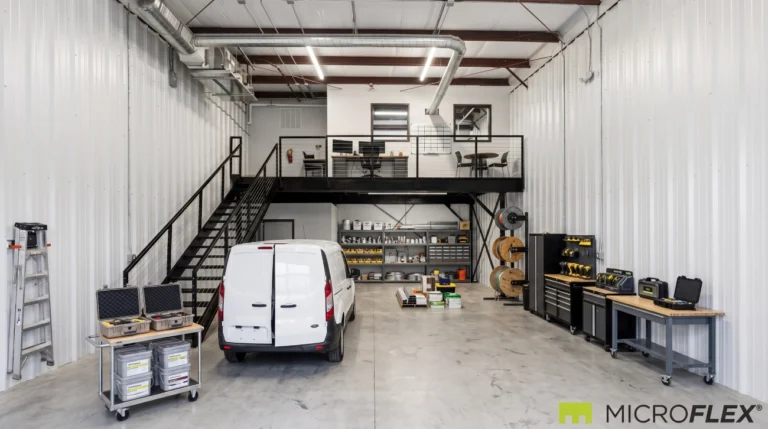
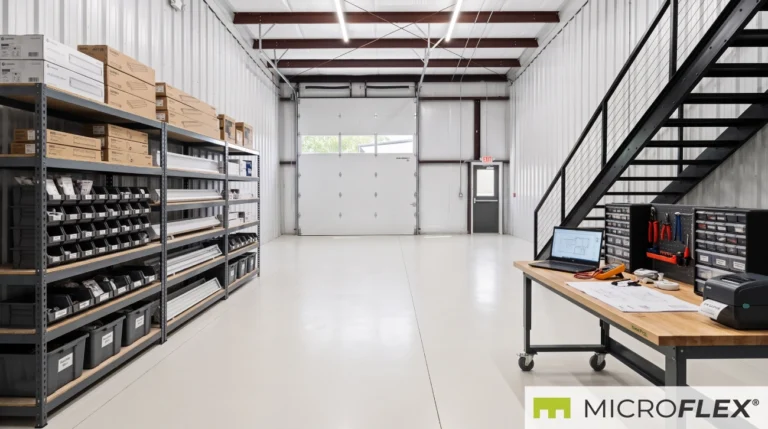
This is exactly where a dedicated storage space transforms our business operations. Instead of cramming everything into a garage or making do with scattered storage locations across town, a purpose-built space allows us to create a centralized hub for our entire operation. We’re talking about proper shelving for small parts, vertical racks for pipes, secure areas for expensive equipment, and even room for a small office setup where we can manage inventory and plan jobs efficiently.
MicroFlex™ LLC understands these challenges because we’ve built our business around solving them. Our adaptable multi-function spaces in Alabama—including locations in Auburn Opelika, Birmingham Irondale, Huntsville, and Birmingham Hoover—are designed specifically for businesses like yours that are ready to scale up. These aren’t just empty warehouses; they’re flexible spaces that combine warehouse, office, and storage features, allowing you to create exactly the setup your growing plumbing business needs.
What makes these spaces particularly valuable for plumbing parts storage is their adaptability. Maybe you need one section for your organized small parts with shelving and bins, another area with vertical pipe storage, a bay for larger equipment, and a small office corner for managing inventory and meeting with clients. Our flexible lease terms mean you’re not locked into a space that doesn’t fit your needs, and our diverse configurations let you choose exactly what works for your operation right now—with room to expand as you continue to grow.
The beauty of having a dedicated space is how it streamlines your entire operation. Your technicians can start their day by loading their vans from a properly organized inventory, rather than scrambling to find parts. You can track stock levels accurately, reorder intelligently before you run out of critical items, and maintain a professional operation that impresses both employees and clients. It’s the difference between running a business and constantly putting out fires.
Business expansion isn’t just about getting bigger—it’s about getting better organized, more efficient, and more profitable. A dedicated, well-organized storage space is an investment that pays dividends in time saved, money saved on duplicate purchases, and the professional image that helps you win more business. Your plumbing parts storage should grow with your success, not hold it back.
Ready to take that next step? Learn more about how our spaces can support your expanding operation at MicroFlex Space for Plumbing Businesses. And when you’re ready to explore the perfect combination of workspace and storage for your team, find how to find the perfect warehouse office space for your growing business. Your perfectly organized, professionally scaled future is waiting.