A Huntsville contractor can spend most of the working day away from the building and still depend heavily on what happens there before the first job and after the last one.
Tools need to be organized. Materials need somewhere to arrive. Equipment needs to be prepared. Parts and supplies need a repeatable place in the workflow. Administrative work still has to happen somewhere.
That combination helps explain why small-bay flex space can be relevant in the Huntsville market.
Huntsville combines engineering, research, advanced manufacturing, production, contracting, and field-service activity at an unusual scale for a metro of its size. Not every business in those categories needs industrial space, but many depend on physical workflows that are difficult to run from a conventional office, vehicle, or passive storage unit.
Huntsville Has an Unusually Technical Employment Base
The concentration of engineering work in Huntsville stands out in federal employment data.
The U.S. Bureau of Labor Statistics reported approximately 19,930 architecture and engineering jobs in the Huntsville metropolitan area in May 2025. Those occupations represented 7.5% of local employment, compared with 1.7% nationally.
The market included approximately 4,880 aerospace engineers, 2,190 electrical engineers, 2,150 mechanical engineers, and 1,820 industrial engineers.
Those figures should not be read as a direct measure of demand for flex space. Many engineering organizations operate from offices, research facilities, laboratories, or larger industrial properties.
They do, however, illustrate the depth of the technical ecosystem surrounding Huntsville. That ecosystem also includes smaller companies performing installation, inspection, equipment preparation, technical support, maintenance, specialty distribution, field testing, and project-based work.
For some of those operators, the practical requirement is not a large industrial facility. It is a smaller private base where technical equipment, parts, tools, active work, and administrative functions can be organized together.
Cummings Research Park Adds Depth to the Local Business Ecosystem
Cummings Research Park reports more than 300 companies and organizations and approximately 26,000 employees across 3,843 acres.
Its business base spans aerospace and defense, technology, research and development, advanced manufacturing, life sciences, higher education, and related services.
A concentration of large technical employers does not automatically create demand for a particular real estate product. What it does create is a broader ecosystem of vendors, subcontractors, installers, service providers, equipment companies, specialty suppliers, and smaller technical businesses.
Those supporting operators often have very different space requirements from the organizations they serve.
A field-support company may need rugged equipment storage and an inspection bench. A specialty installer may need materials staging and tool organization. A small technical team may need operational floor area downstairs while using a separate office or mezzanine area for planning.
The space requirement can be relatively modest while still being operationally complex.
Redstone Arsenal Reinforces Huntsville’s Contractor Environment
Redstone Arsenal is another major component of Huntsville’s contractor and technical-services environment.
U.S. Army Contracting Command-Redstone Arsenal provides contracting and acquisition support for major aviation and missile systems, research and development programs, installation operations, prototyping, and other technical activities. The Army identifies the Redstone operation as its largest major contracting center.
That does not mean federal contracting activity translates directly into MicroFlex demand.
It does help explain why Huntsville sustains a large network of technical contractors, suppliers, field-support companies, maintenance providers, specialty equipment businesses, and other project-driven operators.
Some of those businesses need substantial facilities. Others may only need a practical base where equipment can be organized, supplies staged, work prepared, and teams supported between field assignments.
Huntsville Is Also a Production, Trades, and Material-Moving Market
The local economy extends well beyond research and engineering.
BLS reported approximately 297,100 nonfarm jobs in the Huntsville metropolitan area in August 2026.
Manufacturing accounted for approximately 35,500 jobs. Trade, transportation, and utilities represented approximately 41,700 jobs, while mining, logging, and construction accounted for approximately 12,200.
Occupational data provides another view of the same operating environment. Production occupations represented 9.5% of Huntsville-area employment in May 2025. Transportation and material-moving occupations represented 7.8%, while installation, maintenance, and repair accounted for 3.6%.
These categories are much broader than the MicroFlex tenant profile, and the numbers should not be interpreted as prospective tenant counts.
They do show that a meaningful portion of the Huntsville economy involves physical products, equipment, installation, maintenance, transportation, and active operational work.
Owner-Operators Are Another Important Part of the Market
The Huntsville area also has a substantial owner-operated business base.
The U.S. Census Bureau reports approximately 31,229 nonemployer establishments in Madison County for 2023. Nonemployer businesses generally have no paid employees and often include sole proprietors and other owner-operated businesses.
Most of those businesses will never need dedicated flex space.
But physical businesses often reach a point where the operation becomes difficult to manage from a home garage, vehicle, self-storage arrangement, or multiple disconnected locations.
Tools accumulate. Equipment becomes harder to organize. Inventory grows. Deliveries need somewhere consistent to arrive. Administrative work competes with operational work.
The need may still be far below the scale of a traditional warehouse.
That is where a smaller operating unit can become relevant.
What a Small-Bay Operating Base Can Look Like
MicroFlex® operates purpose-built small-bay flex industrial space for businesses that need a private working environment at a manageable scale.
Typical purpose-built units are approximately 1,000 to 1,250 square feet. Purpose-built MicroFlex locations include drive-up roll-up doors, private restrooms, climate control, LED lighting, and pre-built configurations.
MicroFlex uses one-year modified gross leases. Configuration and availability vary by property and individual unit.
Technical Field Operations
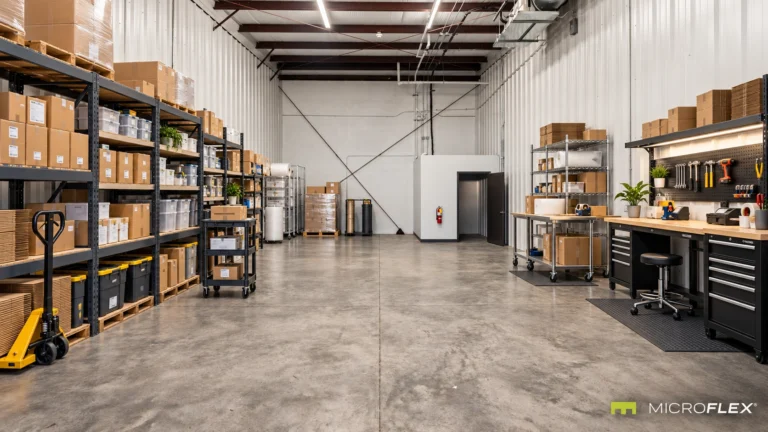
A technical-services business may use the ground floor for equipment preparation, inspection, component organization, charging, testing, and deployment.
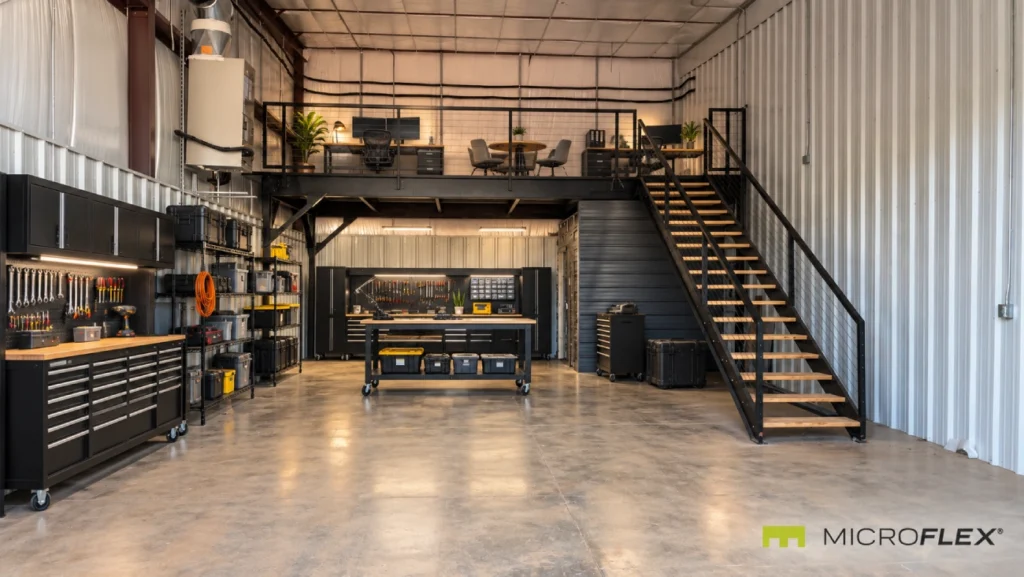
Administrative work can remain separate from the main operational flow when the selected configuration includes an enclosed office or mezzanine.
The important point is not to recreate a laboratory or large engineering facility inside a small unit. The value comes from giving a smaller technical company one consistent place to prepare the equipment and people that move into the field.
Contractors and Installation Businesses
An electrical contractor, HVAC operator, specialty installer, general contractor, or maintenance company may organize the space around frequently used tools, job materials, equipment cases, work surfaces, and daily staging.
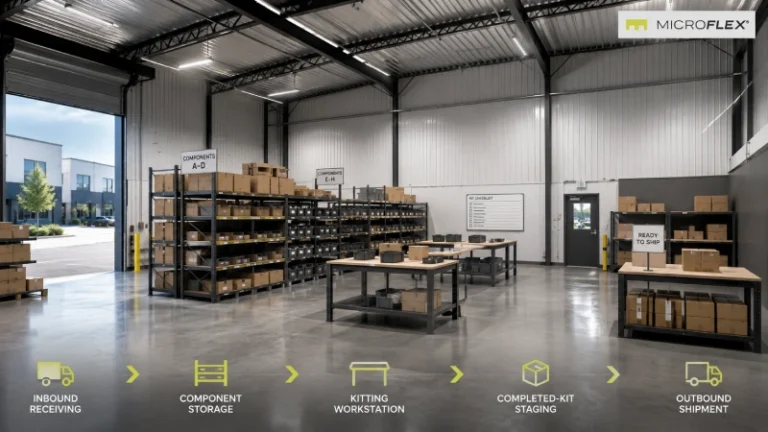
A simple operating sequence might begin with materials arriving near the roll-up door, move through organized storage and preparation, and end with equipment being staged for the next project.
For businesses moving equipment in and out regularly, direct access between the vehicle area and working floor can become more important than simply maximizing storage density.
Related reading:
How Drive-Up Access Supports Daily Operations for Service Businesses
Mobile Detailing and Specialty Vehicle Businesses
Not every field-service operation looks like a traditional contractor.
A mobile detailing or specialty vehicle-care company may spend most of the day working at customer locations while using its unit as the operational center behind the business.
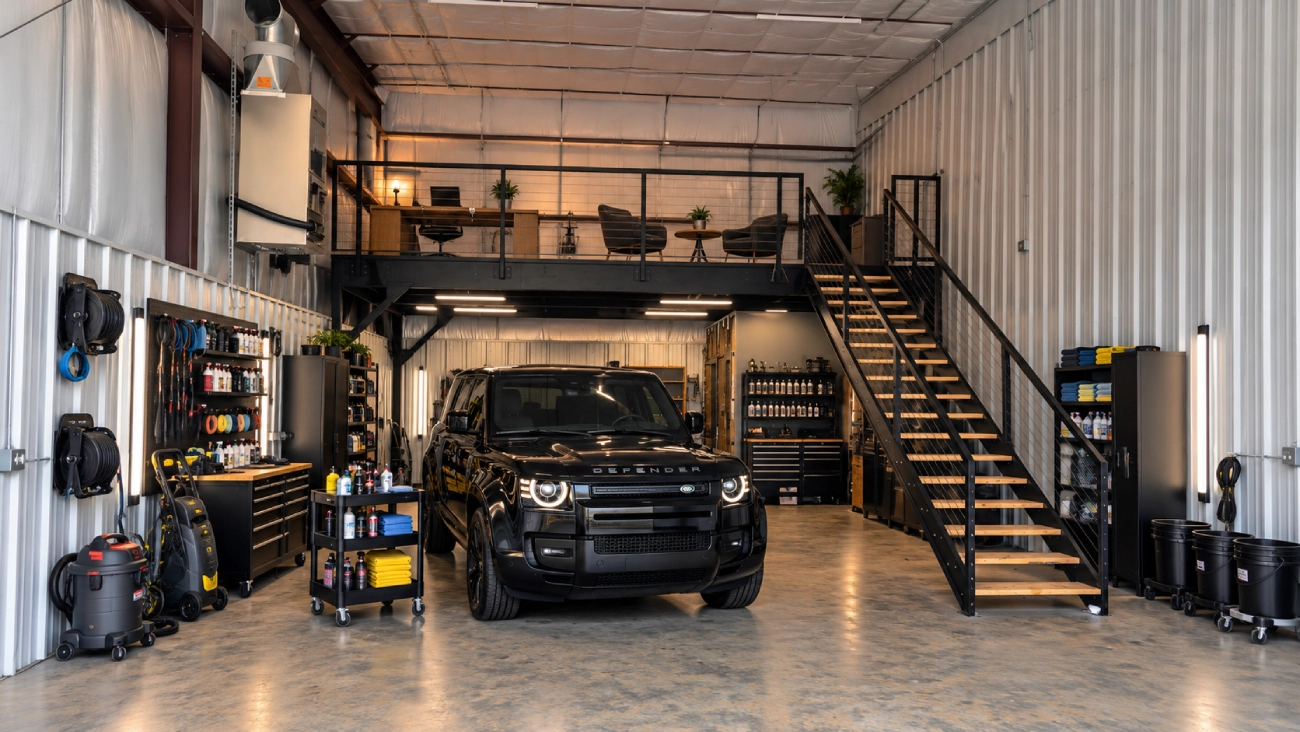
Supplies can be organized in one area, portable equipment in another, and charging or preparation work can happen between appointments.
The vehicle itself may move through the unit depending on the approved use and operating requirements, while the surrounding space supports the equipment and supplies needed for the mobile business.
The operational value is having a consistent base behind a business that otherwise spends most of its time on the road.
Event, AV, and Production Equipment Businesses
Another example is an event-production, audiovisual, photography, videography, or equipment-rental operator.
These businesses often work elsewhere but depend on what happens before and after each project.
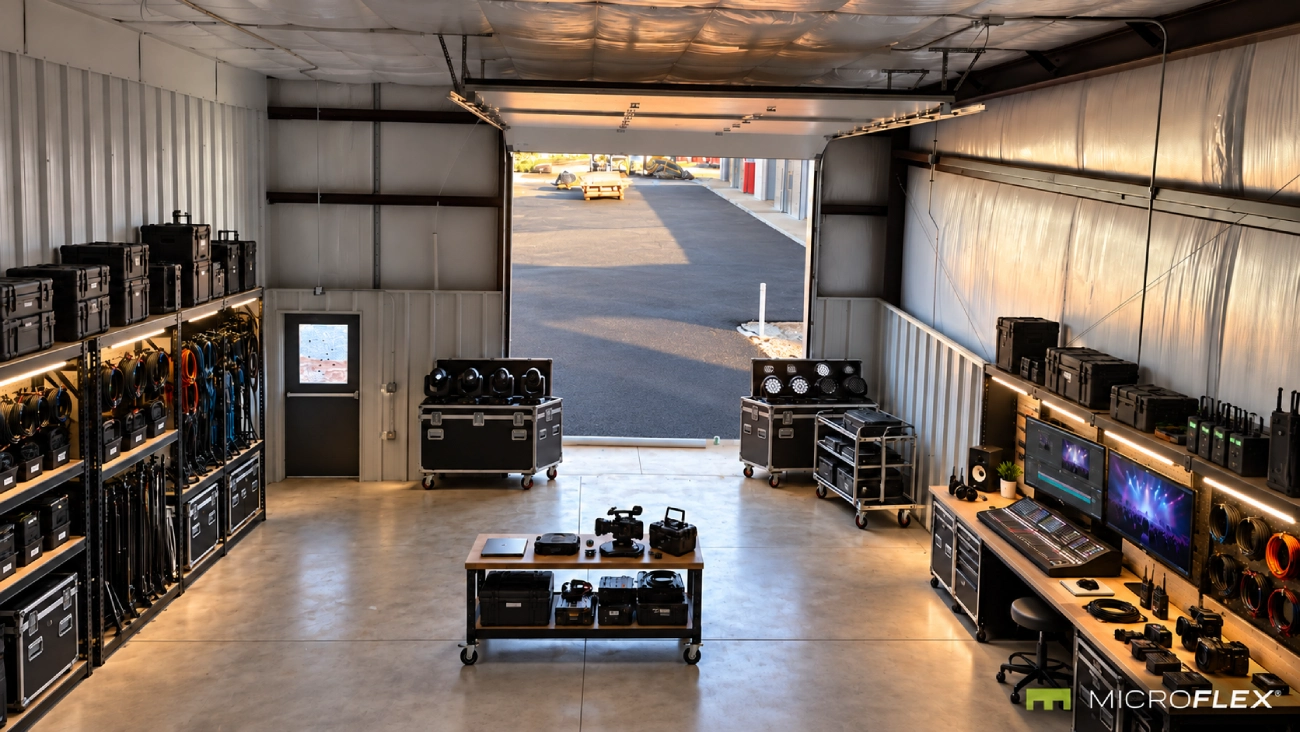
Road cases need to be returned and organized. Batteries need charging. Cameras and production equipment may need preparation or inspection. Cables, stands, lighting equipment, and accessories need a repeatable storage system.
A small operational unit can allow equipment to move through a simple cycle:
return from project → inspection → charging or preparation → organized storage → outbound staging
That is a different use case from a contractor shop, but the underlying workspace problem is similar.
The business needs a private operating base that supports movement, organization, and preparation without requiring a large warehouse.
Right-Sized Space Matters More Than Maximum Space
A growing small business does not automatically need the largest facility it can afford.
For many owner-operators, unnecessary square footage creates more floor to manage without improving the workflow.
A field-service business may need organized shelving, equipment storage, a workbench, an administrative area, and a clear loading path.
A specialty equipment company may need an inspection station, reusable cases, charging space, and staging for outgoing work.
A small production business may need separated receiving, work, and outbound zones.
The more useful question is whether the space supports the sequence of work.
Small-Bay Flex Demand Is Ultimately an Operational Question
Huntsville’s engineering concentration, research institutions, manufacturing employment, contractor ecosystem, and owner-operated business base provide useful market context.
None of those statistics alone proves demand for small-bay flex.
Demand develops inside individual businesses.
A company reaches a point where equipment no longer fits comfortably in a vehicle. Inventory begins interfering with work. Deliveries need a consistent destination. Tools need to be organized. A team needs one reliable place to begin and end the working day.
The operation needs more than passive storage, but it may not need a large conventional industrial facility.
That is the operating gap small-bay flex is designed to address.
Two MicroFlex Locations Serve the Huntsville Market
MicroFlex currently serves the Huntsville market through two purpose-built properties.
Huntsville-Slaughter Rd
MicroFlex Huntsville-Slaughter Rd
is located at 400 Slaughter Rd in Madison and serves businesses operating across the Huntsville market.
The property is positioned near Cummings Research Park and other major employment and business corridors, making it relevant for technical, contractor, service, and equipment-dependent operators.
Huntsville-South Memorial
MicroFlex Huntsville-South Memorial
is located at 4049 Chris Dr SW and provides another purpose-built MicroFlex option within the Huntsville market.
Both locations use the purpose-built MicroFlex product, but configuration, unit availability, and property-specific details vary.
Start With the Workflow
The useful starting point is not simply asking how many square feet a business wants.
Start with what actually happens during a normal working day.
- What arrives at the unit?
- What equipment or inventory stays there?
- What work happens inside?
- What needs to remain accessible every day?
- What needs to leave for jobs or deliveries?
- Which tasks need separation from the main operational floor?
Once the workflow is clear, it becomes easier to determine whether a MicroFlex configuration can support the operation.
Review
Huntsville-Slaughter Rd
and
Huntsville-South Memorial
then contact the leasing team to confirm current configurations, permitted use, and availability.
Sources
- U.S. Bureau of Labor Statistics, Occupational Employment and Wages in Huntsville, AL, May 2025
, published July 2026. - U.S. Bureau of Labor Statistics, Huntsville, AL Economy at a Glance
, August 2026. - U.S. Census Bureau QuickFacts, Madison County, Alabama
. - Cummings Research Park, About CRP
. - U.S. Army Contracting Command-Redstone Arsenal
.
Disclosure
This article is published by Founders Investment Properties, LLC, owner and operator of MicroFlex®. Content is provided for general informational and educational purposes only. Nothing in this article constitutes legal advice, tax advice, financial advice, investment advice, insurance advice, real estate brokerage advice, or any other form of professional advice. Readers should consult their own attorneys, accountants, tax professionals, insurance brokers, and licensed real estate professionals before making decisions based on the topics discussed.
MicroFlex® is a registered trademark of Founders Investment Properties, LLC. Photos may be representative and may not reflect a specific location. Product configurations, features, lease terms, pricing, and availability are subject to change. Current information is available at microflexspace.com or by contacting the leasing team directly.