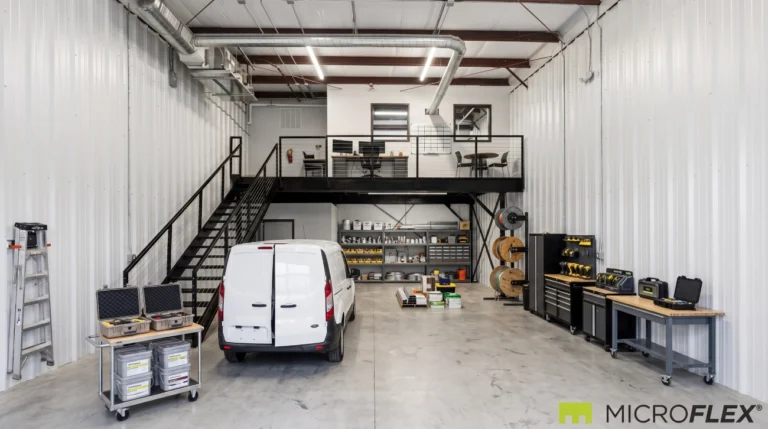
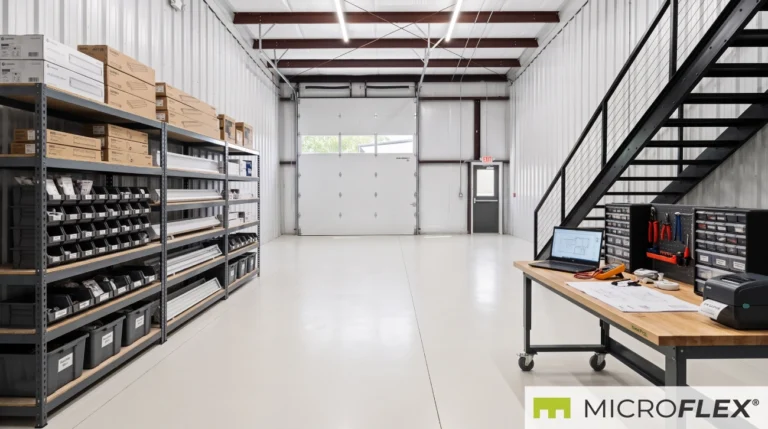
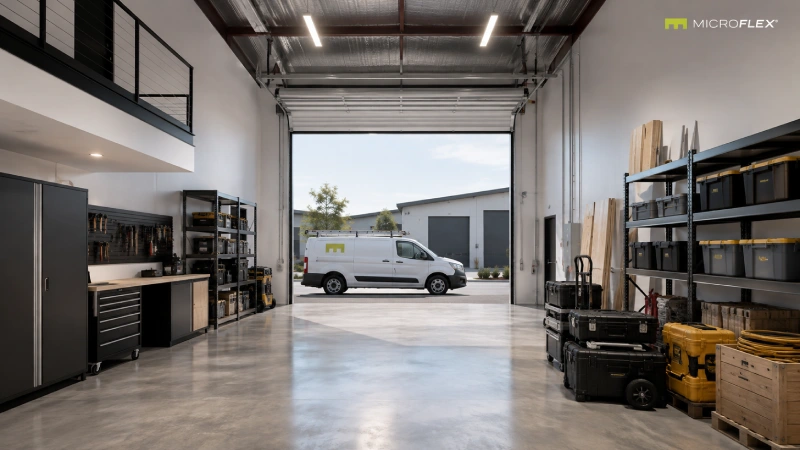
Drive-up access changes the physical relationship between a service vehicle and the workspace behind it. At purpose-built MicroFlex® locations, units include a drive-up roll-up door that allows tools, materials, equipment, and staged items to move between the vehicle-side area and the operational bay.
For a field-service business, that connection can become part of the daily workflow. The location of the roll-up door can influence where receiving happens, where frequently used equipment is stored, where upcoming jobs are staged, and how returned tools re-enter the unit.
Typical purpose-built MicroFlex units are approximately 1,000 to 1,250 square feet, with standard bay dimensions of approximately 25 by 40 or 25 by 50 feet. How that floor area is organized around the drive-up side of the unit can affect how many separate handling steps are built into routine loading and unloading.
Drive-Up Access at a Glance
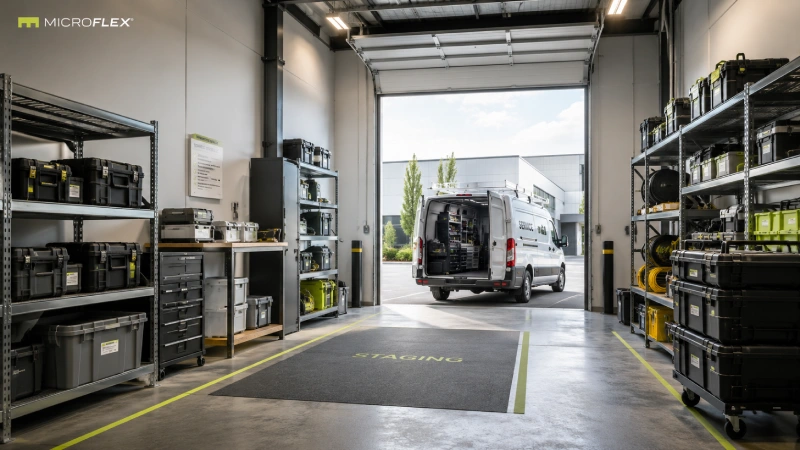
A practical drive-up workflow generally keeps the most movement-intensive parts of the operation connected to the roll-up-door side of the unit.
| Operational Need | How Drive-Up Access Relates to It |
|---|---|
| Vehicle preparation | Job-specific tools and materials can be staged near the vehicle-side movement path. |
| Incoming materials | A receiving zone can sit close to the roll-up door before items move into storage. |
| Frequently used equipment | High-use items can remain closer to the primary loading route. |
| Returned tools | A defined return area can keep incoming equipment from spreading across the bay. |
| Upcoming jobs | Outbound staging can group materials before they move toward the service vehicle. |
In This Article
- Why drive-up access matters to a field-service workflow
- How to organize the area nearest the roll-up door
- How receiving fits into the workflow
- Where frequently used tools and equipment may fit
- How job staging connects to vehicle preparation
- How returned tools and materials re-enter the unit
- How different service businesses may use the same feature
- How the MicroFlex configuration affects the rest of the workflow
- How Auburn-Opelika differs
- Frequently asked questions
Why Does Drive-Up Access Matter to a Service Business?
Many service businesses operate in two places during the same workday: an operating base and a customer or project site.
That creates repeated movement between the unit and service vehicles. Tools may leave in the morning and return later. Replacement parts may arrive at the unit and then move into a vehicle. Materials for an upcoming job may need to be separated from general inventory before loading begins.
A drive-up roll-up door creates a direct transition point between the vehicle-side area and the interior operation.
The usefulness of that connection still depends on the layout behind the door. If frequently used tools sit behind slow-moving inventory, or outbound materials are mixed with incoming deliveries, the workflow can involve unnecessary movement even when the door itself is easy to reach.
The roll-up door therefore works as one component of a larger operating layout that includes receiving, storage, staging, circulation, and return paths.
How Can the Area Nearest the Roll-Up Door Be Organized?
The front portion of the bay tends to see more movement because it connects the interior operation with vehicle-side access.
That does not mean the area needs to become permanent storage.
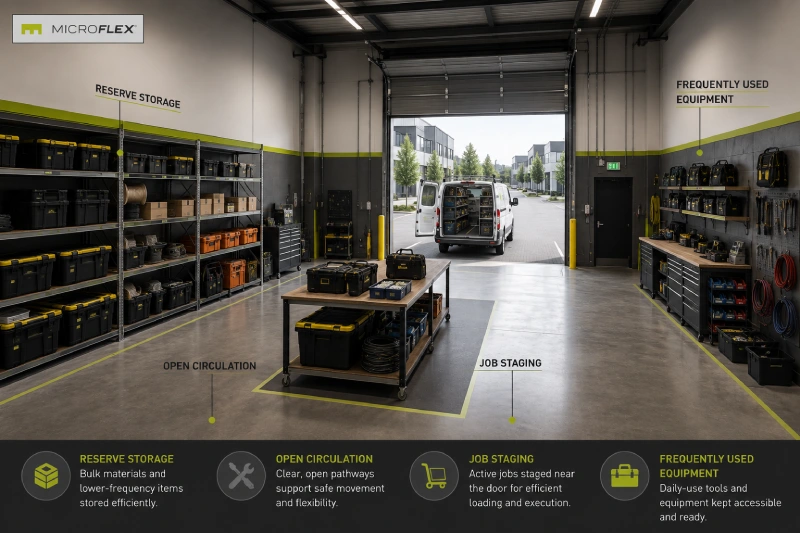
A door-side zone may instead handle short-duration functions such as:
- incoming materials waiting to be sorted
- tools returning from a field job
- equipment being prepared for departure
- job-specific materials assigned to upcoming work
- items moving between shelving and a service vehicle
Keeping a defined circulation path can also make it easier to distinguish active staging from items that belong in longer-term storage.
How Does Receiving Fit Into a Drive-Up Workflow?
Incoming supplies and equipment need somewhere to go before reaching their normal storage position.
A receiving zone near the roll-up door can provide that temporary step.
A basic sequence may look like this:
- Materials enter through the drive-up side.
- Items are checked and sorted.
- Frequently used stock moves to accessible storage.
- Reserve items move farther into the bay.
- Job-specific items can move into an active staging area.
The distinction between receiving and permanent storage matters because cartons, tools, or equipment that remain near the entrance can eventually occupy the same floor area needed for routine movement.
Where Should Frequently Used Tools and Equipment Fit?
Service businesses generally do not use every tool with the same frequency.
An electrical, plumbing, HVAC, installation, maintenance, or repair operation may have equipment that moves between the unit and the field regularly, while specialty tools leave only for certain projects.
The interior organization can reflect that difference.
| Storage Group | Possible Position | Operational Logic |
|---|---|---|
| Daily-use tools | Closer to the primary loading route | They move in and out more regularly. |
| Common consumables | Accessible shelving near active work areas | They may be added frequently during job preparation. |
| Specialty equipment | Defined storage away from daily traffic | Immediate access may not be needed every workday. |
| Reserve materials | Farther from the primary movement zone | They can remain available without occupying higher-movement floor area. |
Connect Job Staging to Vehicle Preparation
Job staging is the point where stored tools and materials become a prepared group for a specific piece of work.
For a field-service operation, that preparation can happen before vehicle loading begins.
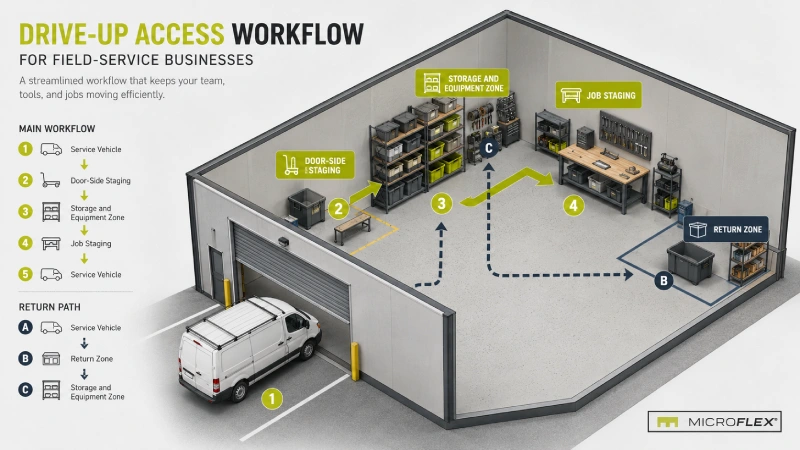
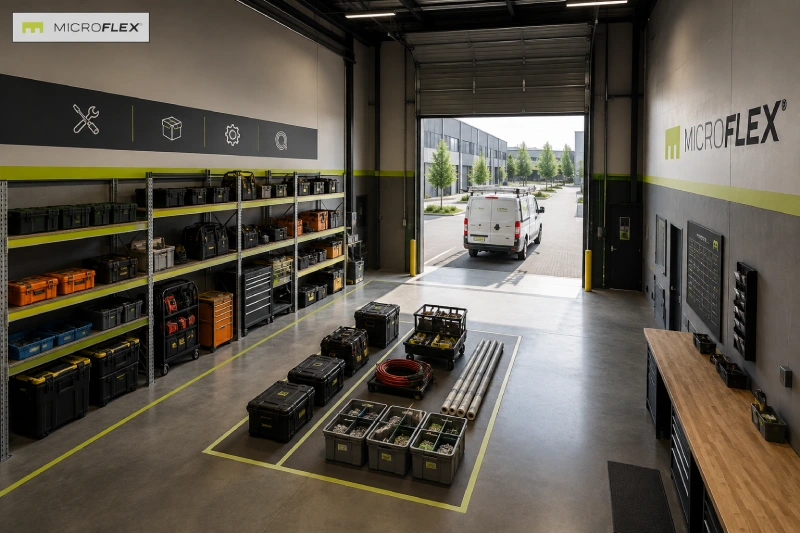
A staging area positioned between primary storage and the roll-up-door path can allow the operator to group equipment and materials first, then move the completed group toward the vehicle.
For example, a residential electrician preparing for an installation might group the required tools, components, and consumables in one staging position instead of gathering individual items during the loading process.
A plumbing or HVAC operation may use the same layout principle with a different mix of parts and equipment.
The specific items change by trade, but the basic movement sequence remains similar:
Storage → Job Staging → Roll-Up Door → Service Vehicle
Plan the Return Path Too
The operating cycle does not end when a service vehicle leaves.
Tools, unused materials, replacement equipment, and other items may return later. Without a defined return process, the area near the roll-up door can gradually become an unsorted holding zone.
A return workflow can separate:
- tools returning to daily-use storage
- unused materials returning to inventory
- equipment that needs review before its next use
- items that belong to another upcoming job
This allows the same drive-up access point to support inbound and outbound movement without turning the entrance into permanent storage.
How Might Different Service Businesses Use Drive-Up Access?
The physical feature remains the same, but the workflow around it can vary by operator.
| Service Business | Typical Movement Through the Unit |
|---|---|
| Electrical contractor | Tools, components, cable, consumables, and prepared job materials moving between shelving, staging, and a service vehicle. |
| Plumbing contractor | Tools, fittings, parts, equipment, and job-specific materials moving through receiving and outbound staging. |
| HVAC contractor | Tools, compatible parts, equipment, and job preparation moving between storage and vehicle-side access. |
| Installation business | Project materials, tools, and equipment grouped before field installation work. |
| Maintenance or repair operator | Frequently used service equipment and replacement items moving in and out as field work changes. |
These are role-based examples. The proposed business activity, equipment, materials, and individual unit use should be confirmed for compatibility with the selected property.
How Does the MicroFlex Configuration Affect the Rest of the Workflow?
Drive-up access is a verified feature at purpose-built MicroFlex locations, but the interior configuration can change how the rest of the bay is organized.
FLEX is the open-bay base configuration. FLEX+ adds an enclosed rear office. FLEX Premium adds a mezzanine. FLEX Ultimate is defined by a full mezzanine plus premium finish.
A service business that regularly performs desk-based scheduling or estimating may examine an available configuration with an enclosed office. An operation that needs the main floor to remain focused on equipment movement may examine whether an available mezzanine configuration serves an appropriate part of the workflow.
Configuration availability varies by property and individual unit.
Inside the Four MicroFlex Configurations
What Else Is Included at Purpose-Built MicroFlex Locations?
In addition to the drive-up roll-up door, purpose-built MicroFlex units include a private restroom, HVAC, LED lighting, and a pre-built configuration.
Typical purpose-built units are approximately 1,000 to 1,250 square feet, with standard bay dimensions of approximately 25 by 40 or 25 by 50 feet.
Individual unit size, configuration, and current availability vary.
For a broader explanation of how the product supports day-to-day operations, see
How Small-Bay Flex Space Supports Daily Business Operations
.
Does Drive-Up Access Apply at Auburn-Opelika?
Yes. Auburn-Opelika units include drive-up roll-up doors and private restrooms.
Auburn-Opelika is a rebranded property rather than a purpose-built MicroFlex location, so the complete purpose-built product description should not automatically be applied there.
At Auburn-Opelika, climate control varies by unit, mezzanine configurations are not available, and units do not begin at 1,000 square feet.
Frequently Asked Questions About Drive-Up Access
What Does Drive-Up Access Mean at MicroFlex?
At purpose-built MicroFlex locations, units include a drive-up roll-up door. This creates a direct movement point between the vehicle-side area and the operational bay.
Does Drive-Up Access Mean a Vehicle Is Intended to Drive Inside the Unit?
No such universal use should be assumed from the term. Drive-up access describes vehicle-side access to the roll-up door. Any proposed vehicle-related activity inside a unit should be confirmed for the specific property, unit, and permitted business use.
What Types of Service Businesses May Use Drive-Up Access?
Role-based examples include electrical, plumbing, HVAC, installation, maintenance, and repair operations that regularly move compatible tools, equipment, parts, or materials between a unit and field-service vehicles.
Should Materials Be Stored Permanently Next to the Roll-Up Door?
Not necessarily. The area nearest the door may be more useful as a receiving, return, or outbound staging zone when the operation needs to preserve a clear movement path.
Do Purpose-Built MicroFlex Units Include Drive-Up Roll-Up Doors?
Yes. Drive-up roll-up doors are a verified feature of purpose-built MicroFlex units.
Does Auburn-Opelika Have Drive-Up Roll-Up Doors?
Yes. Auburn-Opelika units include drive-up roll-up doors, although the property is rebranded and differs from the purpose-built MicroFlex product in other respects.
How Can I Check Current Unit Availability?
Review the current MicroFlex location pages and contact the leasing team to confirm available units, configurations, current property details, and permitted use.
Related MicroFlex Resources
How Small-Bay Flex Space Supports Daily Business Operations
How Residential Contractors Organize a 1,000 to 1,250 SF Flex Unit
Inside the Four MicroFlex Configurations
Explore Current MicroFlex Locations
Drive-up access becomes more useful when the interior workflow reflects the movement that happens each day. Receiving, storage, staging, returns, and vehicle preparation can each have a defined place instead of competing for the same door-side floor area.
View Current MicroFlex Locations
Important Information
This article is published by Founders Investment Properties, LLC, owner and operator of MicroFlex®. Content is provided for general informational and educational purposes only. Nothing in this article constitutes legal advice, tax advice, financial advice, investment advice, insurance advice, real estate brokerage advice, or any other form of professional advice. Readers should consult their own attorneys, accountants, tax professionals, insurance brokers, and licensed real estate professionals before making decisions based on the topics discussed.
MicroFlex® is a registered trademark of Founders Investment Properties, LLC. Photos may be representative and may not reflect a specific location. Product configurations, features, lease terms, pricing, and availability are subject to change. Current information is available at microflexspace.com or by contacting the leasing team directly.