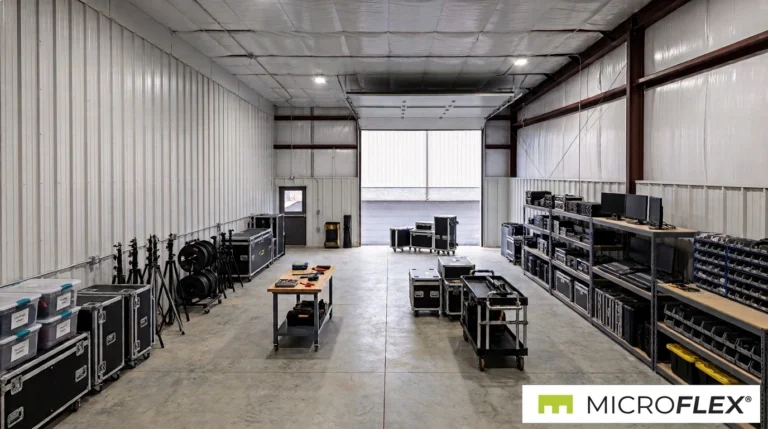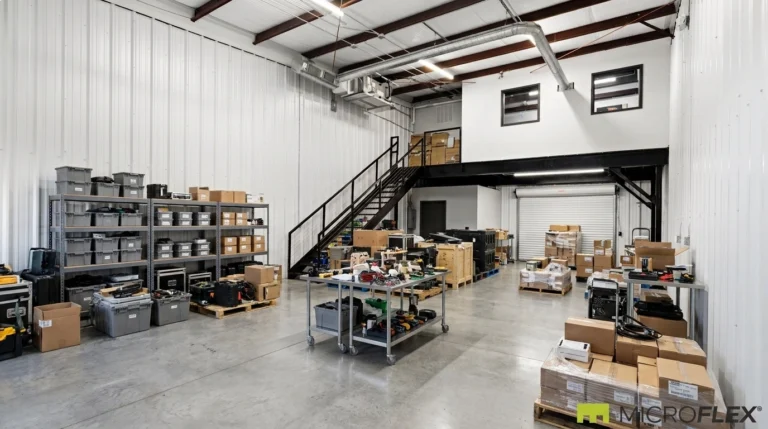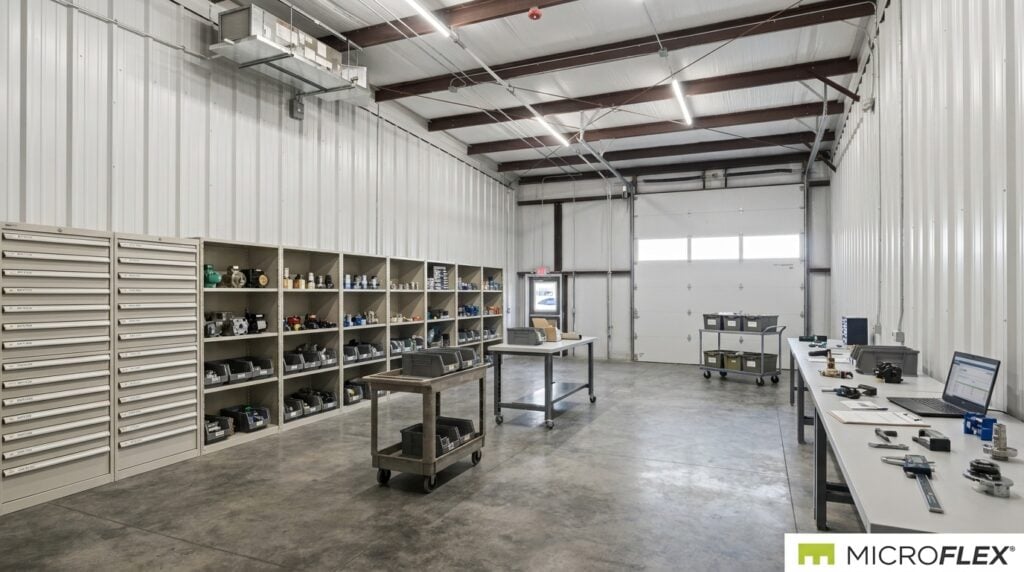
A specialty distributor does not need a massive warehouse to have a complicated inventory problem.
A business may carry hundreds of small components, several product families, replacement parts, technical accessories, compact equipment, and customer-specific orders while operating from a relatively small footprint.
The challenge is rarely just where to place the inventory.
It is keeping the right parts visible, accessible, and moving through the operation without allowing receiving, inspection, order preparation, and outbound staging to compete for the same space.
For a small distributor, a useful operating sequence looks like this:
receive → inspect → store → pick → prepare → stage → dispatch
That sequence can fit inside a small-bay flex unit when each stage has a defined role.
Small Parts Can Create a Large Inventory Problem
A distributor may not handle large pallets or oversized freight.
Its inventory can still be operationally demanding.
A business supplying contractors or technical operators may handle fittings, valves, electrical components, pumps, replacement parts, controls, fasteners, adapters, and specialty accessories.
Each item may occupy very little space.
The challenge comes from quantity and variety.
The business needs to understand where an item is stored, whether it is reserve or active stock, whether it has already been assigned to an order, and whether it is ready to leave.
That makes organization more important than raw warehouse volume.
Receiving Needs a Temporary Landing Point
Incoming inventory should have somewhere to land before it becomes normal available stock.
A receiving area gives newly arrived parts a temporary destination while quantities, product types, and order information are checked.
The key word is temporary.
Receiving should not gradually become permanent storage.
Once incoming inventory has been reviewed, it should move toward inspection, reserve inventory, active stock, or another defined part of the workflow.
At purpose-built MicroFlex® locations, units include drive-up roll-up access, allowing inventory and business supplies to move directly between the vehicle area and operational floor.
Inspection Should Be Separate From Storage
Some specialty distributors handle components that benefit from a visual or dimensional check before they enter usable inventory.
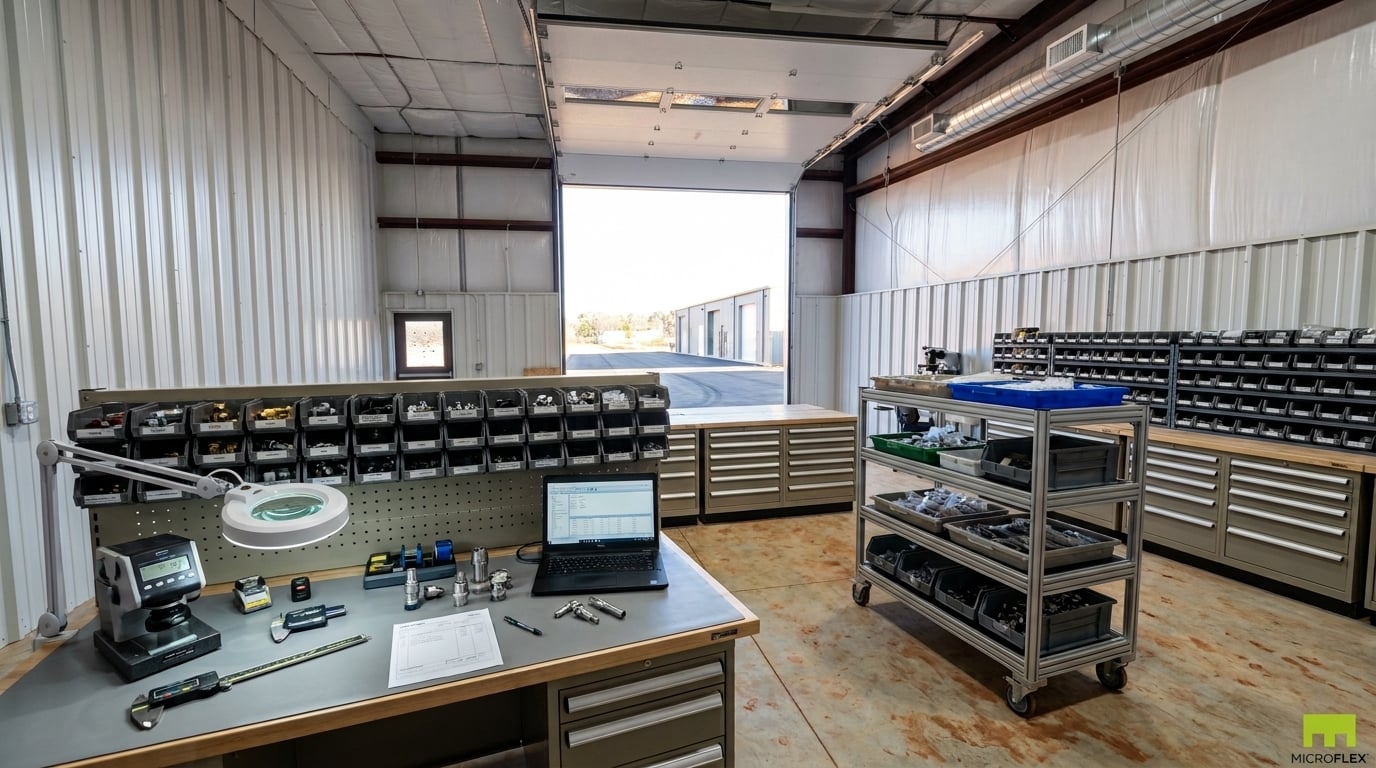
That does not require turning the unit into a laboratory or manufacturing facility.
A compact inspection point can simply provide a consistent place for incoming components to be reviewed before they move into stock.
The workspace might contain a clean table, computer terminal, order documentation, digital measuring tools, and small trays for items awaiting placement.
The operational benefit is status clarity.
Inventory on the inspection table is still moving through receiving.
Inventory placed into its assigned storage position is available stock.
That distinction prevents new items from disappearing into shelving before the receiving process is complete.
Reserve Inventory and Active Inventory Serve Different Roles
A small distributor rarely needs every product equally close to the order-preparation area.
Some parts move frequently.
Others move occasionally.
If all products receive the same prime storage position, the operator can waste the most accessible space on inventory that rarely moves.
A more useful layout separates reserve quantities from active inventory.
Fast-moving items remain closer to picking and preparation.
Reserve quantities can occupy secondary shelving.
Lower-frequency items can remain farther from the main working area without interfering with daily order flow.
The cycle becomes:
reserve inventory → active stock → picked order
Small-Part Storage Needs Precision
Large cartons are easy to see.
Small components are not.
Modular drawers, shallow shelving, labeled bins, and parts cabinets can be more useful than deep general-purpose shelving when an operation manages many compact SKUs.
The layout should allow the operator to identify and retrieve a component without moving several unrelated products first.
Parts with similar shapes or sizes also benefit from clear separation.
This is where specialty distribution differs from passive storage.
The value comes from organized access.
Picking Should Be a Defined Activity
Once a customer order is released, products begin changing status.
A rolling cart can become a simple picking tool.
The operator moves through active inventory, collects the required components, and brings them toward order preparation.
That is different from preparing an order directly inside the storage aisle.
Storage keeps inventory available.
Picking assigns inventory to a specific order.
Separating those functions makes the operation easier to understand visually.
Order Preparation Needs Its Own Surface
A distributor preparing technical or specialty orders benefits from a dedicated work surface.
It does not need to be large.
It does need to remain available.
If the same table is simultaneously receiving new goods, checking components, storing paperwork, and holding completed orders, every new task displaces the previous one.
A dedicated preparation table can support selected components, order documentation, labels, reusable totes, compact packaging materials, and final organization.
Once an order is completed, it should leave that table so the workspace can reset.
Finished Orders Need a Different Destination
Completed orders have a different operational status from active picks.
They should move toward outbound staging rather than accumulating around the preparation area.
That creates a clear visual distinction between available inventory, inventory assigned to an order, and orders ready to leave.
For a business handling several customer orders simultaneously, that separation becomes increasingly useful.
Outbound Staging Should Stay Temporary
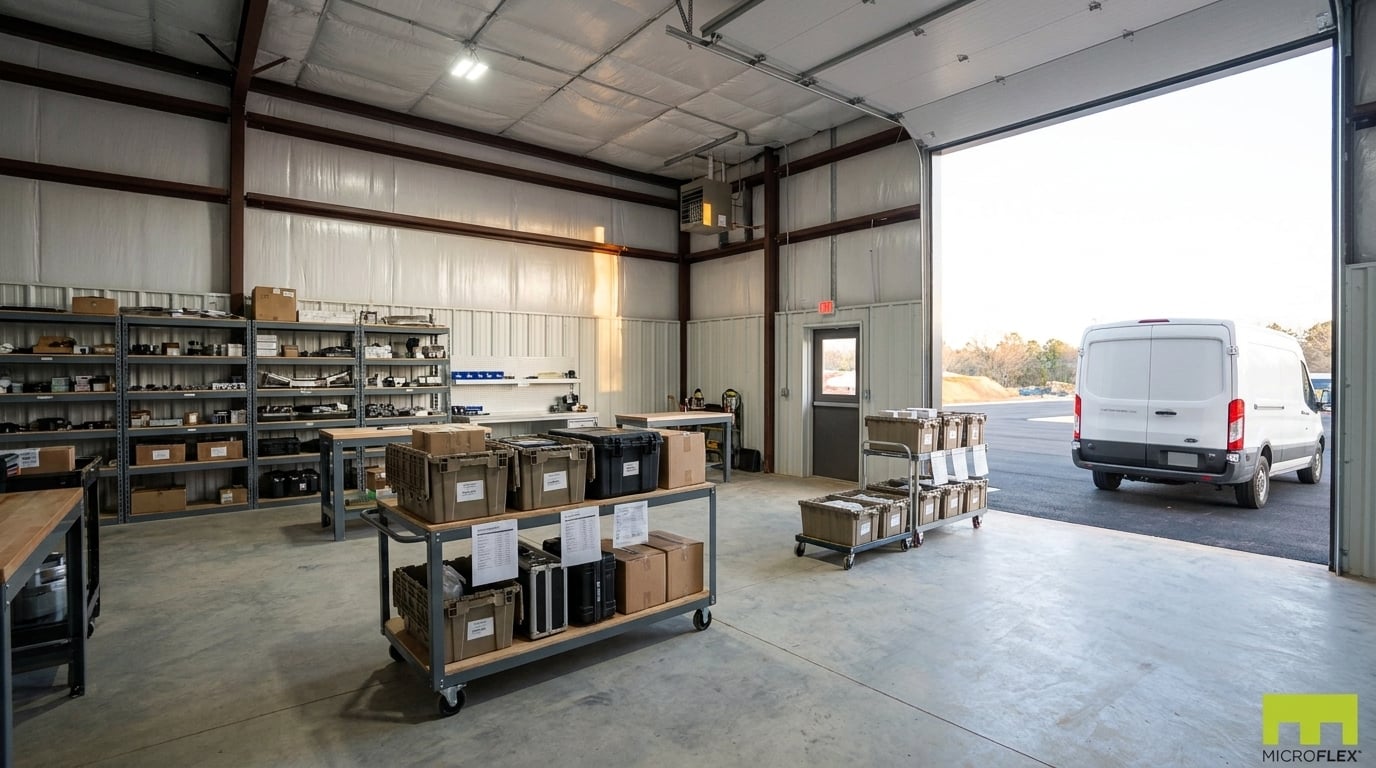
The area near the roll-up door can support outbound movement later in the workflow.
Completed customer orders can move there shortly before pickup or loading.
The benefit comes from keeping that area temporary.
If finished orders remain near the entrance indefinitely, outbound staging becomes permanent storage and begins interfering with receiving and movement.
A useful cycle is:
incoming inventory → storage → picking → preparation → outbound staging → cleared floor
Specialty Distribution Is Not the Same as E-Commerce Fulfillment
Specialty distribution and e-commerce fulfillment both involve inventory and outbound orders, but their operating patterns can differ substantially.
An e-commerce operation may process a larger number of relatively standardized consumer orders.
A specialty distributor may handle fewer orders with more technical components, recurring B2B customers, higher SKU complexity, or products that need careful component matching.
That can make parts organization, product identification, inspection, and order accuracy more important than high-volume packing speed.
The goal is not to create a miniature large-scale fulfillment center.
It is to build a disciplined small distribution workflow.
Product Families Can Shape the Layout
Inventory does not always need to be arranged only by physical size.
A distributor may find it useful to keep related product families together.
One area might contain valves and fittings.
Another might hold controls and accessories.
Compact replacement components may occupy modular drawers.
Larger technical items may remain on shelving.
The physical layout can reflect the logic of the product catalog.
That becomes especially useful when a customer order requires several related components.
Frequently Ordered Sets Can Reduce Repeated Picking
Some distributors repeatedly supply the same combination of components.
When appropriate for the operation, those recurring combinations may be organized as simple prepared sets.
The purpose is not manufacturing.
It is reducing repeated movement through multiple storage locations for frequently repeated orders.
For a broader operational example, see
A Kitting and Light Assembly Workflow in a Small-Bay Unit
.
Administrative Work Is Part of Distribution
Distribution businesses also perform significant desk-based work.
Purchasing, vendor communication, quoting, inventory management, order entry, customer communication, invoicing, and scheduling all exist alongside the physical movement of parts.
MicroFlex offers several pre-built configurations.
FLEX is the open-bay base configuration.
FLEX+ adds an enclosed rear office.
FLEX Premium adds a mezzanine.
FLEX Ultimate includes a full mezzanine with premium finish.
Configuration availability varies by location and unit.
A distributor with substantial administrative work may benefit from separating those functions from the active operational floor.
See
the four MicroFlex configurations
for the full product breakdown.
What a 1,000-to-1,250 SF Distribution Workflow Can Look Like
Purpose-built MicroFlex locations typically offer units of approximately 1,000 to 1,250 square feet, with standard bay dimensions of 25 by 40 or 25 by 50 feet.
Within that footprint, a small specialty distributor can think in connected functions:
receiving → inspection → reserve inventory → active inventory → picking → order preparation → outbound staging
Those functions do not require permanent walls.
Shelving can remain relatively fixed.
Picking carts can move.
The preparation table can remain central.
Receiving and outbound staging may use the same general front area at different times of day.
The layout works when these functions can operate without repeatedly blocking one another.
Open Floor Area Still Matters
Parts-heavy operations are particularly vulnerable to overfilling a unit with shelves and cabinets.
More shelving can appear to mean more capacity.
But every additional storage fixture also consumes circulation space.
A receiving cart needs room to move.
A picking cart needs room to turn.
A completed order needs somewhere to wait.
Incoming and outbound materials need a clear path.
A small distributor does not need the unit to look full in order for the space to be productive.
Some open floor area is performing useful work.
A Practical Daily Distribution Rhythm
A small distributor’s day can follow a repeatable sequence.
Incoming inventory arrives and moves through receiving.
New products are checked and assigned to storage.
Customer orders are released.
Active stock is picked.
Orders move to preparation.
Completed orders move toward outbound staging.
After departure, the preparation and staging zones reset.
The important point is that inventory status changes as it moves through the unit.
That is what turns the space into an operating base rather than passive storage.
When the Problem Becomes Workflow Instead of Storage
A distributor can develop space problems before running out of physical storage capacity.
Orders begin getting prepared on top of inventory.
Incoming products stay near the door because there is nowhere to review them.
Fast-moving components sit behind slow-moving products.
Completed orders remain beside products that have not yet been picked.
Administrative work competes with inspection for the same table.
At that point, the problem is no longer simply how much inventory the business owns.
It is whether the workflow has enough separation between functions.
MicroFlex for Specialty Distribution Operations
Purpose-built MicroFlex units include a drive-up roll-up door, private restroom, HVAC, and LED lighting.
For a compatible specialty-distribution business, the unit can support a clear operational sequence:
receive → inspect → store → pick → prepare → stage → dispatch
The specific business activity, inventory, equipment, customer traffic, and operating requirements should be discussed with the leasing team for the selected property and unit.
A Note About Auburn-Opelika
MicroFlex Auburn-Opelika is a rebranded property rather than a purpose-built MicroFlex development.
Units there do not begin at 1,000 square feet, climate control varies by unit, and mezzanine configurations are not available.
The property includes drive-up roll-up doors and private restrooms.
Current unit size, features, configuration, compatibility, and availability should be confirmed with the leasing team for the specific unit.
Build the Space Around Inventory Movement
A small distributor does not necessarily need the largest possible warehouse.
It needs a workspace where inventory can change status clearly.
Incoming items should not look like ready inventory.
Picked items should not look like available inventory.
Completed orders should not look like unfinished work.
When those stages have defined destinations, the operation becomes easier to manage.
The central idea is simple:
inventory should move forward through the operation rather than circulate around it.
Review the
current MicroFlex locations
and contact the leasing team for current unit availability, configurations, and compatibility with the proposed operation.
Disclosure
This article is published by Founders Investment Properties, LLC, owner and operator of MicroFlex®. Content is provided for general informational and educational purposes only. Nothing in this article constitutes legal advice, tax advice, financial advice, investment advice, insurance advice, real estate brokerage advice, or any other form of professional advice. Readers should consult their own attorneys, accountants, tax professionals, insurance brokers, and licensed real estate professionals before making decisions based on the topics discussed.
MicroFlex® is a registered trademark of Founders Investment Properties, LLC. Photos may be representative and may not reflect a specific location. Product configurations, features, lease terms, pricing, and availability are subject to change. Current information is available at microflexspace.com or by contacting the leasing team directly.