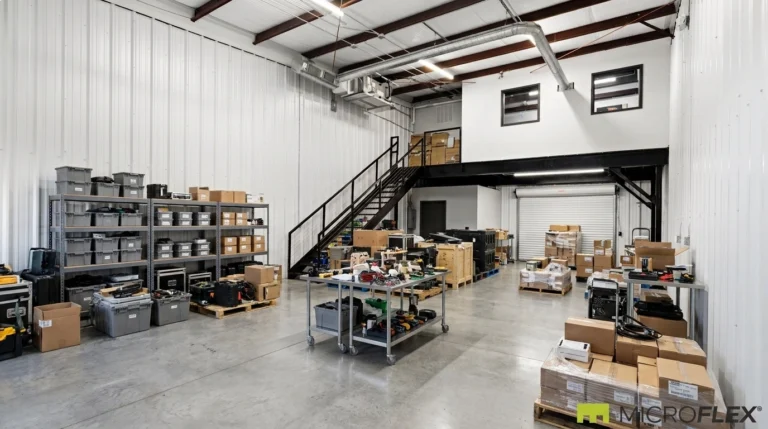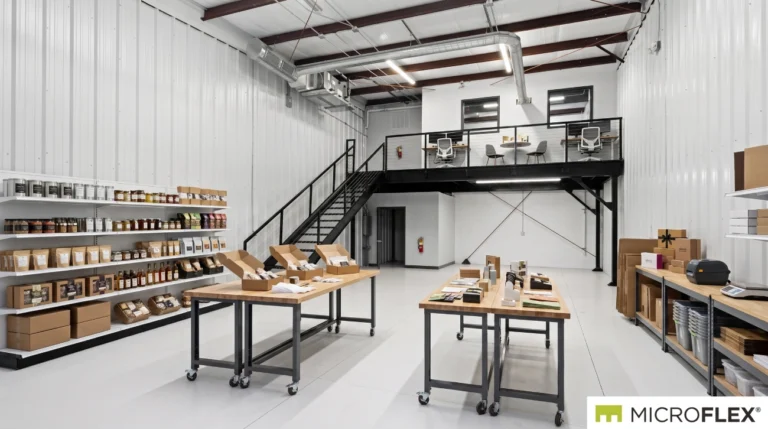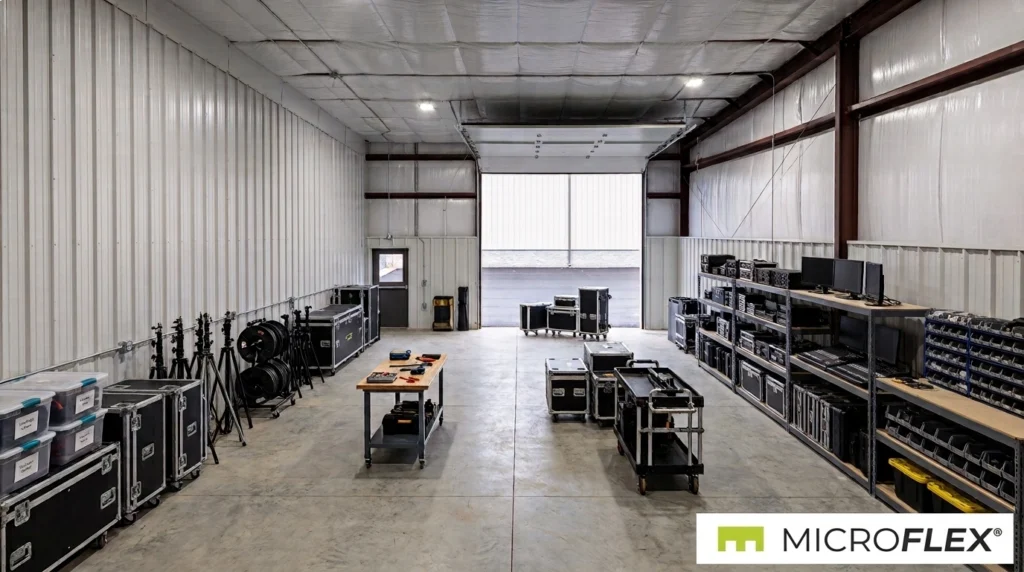
An event-production company does not simply store equipment.
It moves equipment through a cycle.
Road cases return from an event. Cables need to go back to assigned locations. Batteries move to charging. Cameras, lighting, audio equipment, stands, and accessories need to be checked before the next job. The next event may require a completely different loadout from the one that just returned.
That makes the workspace less like passive storage and more like a reset point between jobs.
For a small event, audiovisual, or production business, the usefulness of a flex unit comes from how effectively equipment can move through that cycle:
return → check → reset → store → prepare → stage → load
A well-organized operating base can make that sequence easier to repeat without turning every event day into a search for missing equipment.
Event Equipment Has Different Storage Needs
Event-production inventory rarely behaves like ordinary boxed inventory.
A single business may handle road cases, light stands, tripods, cable reels, speaker stands, cameras, monitors, audio equipment, control surfaces, batteries, adapters, protective cases, small replacement parts, and other production accessories.
Some items stack.
Some roll.
Some need shallow shelving.
Some belong inside cases.
And some need to remain immediately accessible because they move on nearly every job.
Treating all of that equipment as one storage category usually creates unnecessary handling.
A more useful approach is to organize equipment around how frequently it moves and where it goes next.
Fast-Moving Equipment Should Be Easy to Reach
Not every piece of equipment has the same operating rhythm.
A stand or cable kit used several times a week should not sit behind equipment that moves once a month.
Frequently used road cases can remain closer to the active preparation and loadout area.
Less frequently used accessories can occupy secondary shelving.
Small components can have defined bins or drawers.
Long items such as stands can use dedicated wall-side organization without consuming the main working floor.
The goal is not maximum storage density.
It is reducing the number of things that must be moved before the correct equipment can move.
The Return Workflow Matters as Much as Loadout
Most event businesses naturally focus on departure.
The vehicle needs to leave on time.
The correct equipment has to be loaded.
Everything needs to be prepared for the job.
But the quality of the next loadout often depends on what happened after the previous event.
When equipment comes back, it needs a destination.
Road cases that are rolled into the first available space can quickly turn the front of a unit into permanent staging.
Loose cables placed on the nearest table become tomorrow’s sorting problem.
Batteries that never reach the charging area become part of the next job’s preparation problem.
A defined return workflow prevents the unit from resetting itself through clutter.
Returned equipment moves toward checking and reset before going back into ready inventory.
The distinction is simple:
returned equipment is not yet ready equipment.
Build a Dedicated Equipment Reset Zone
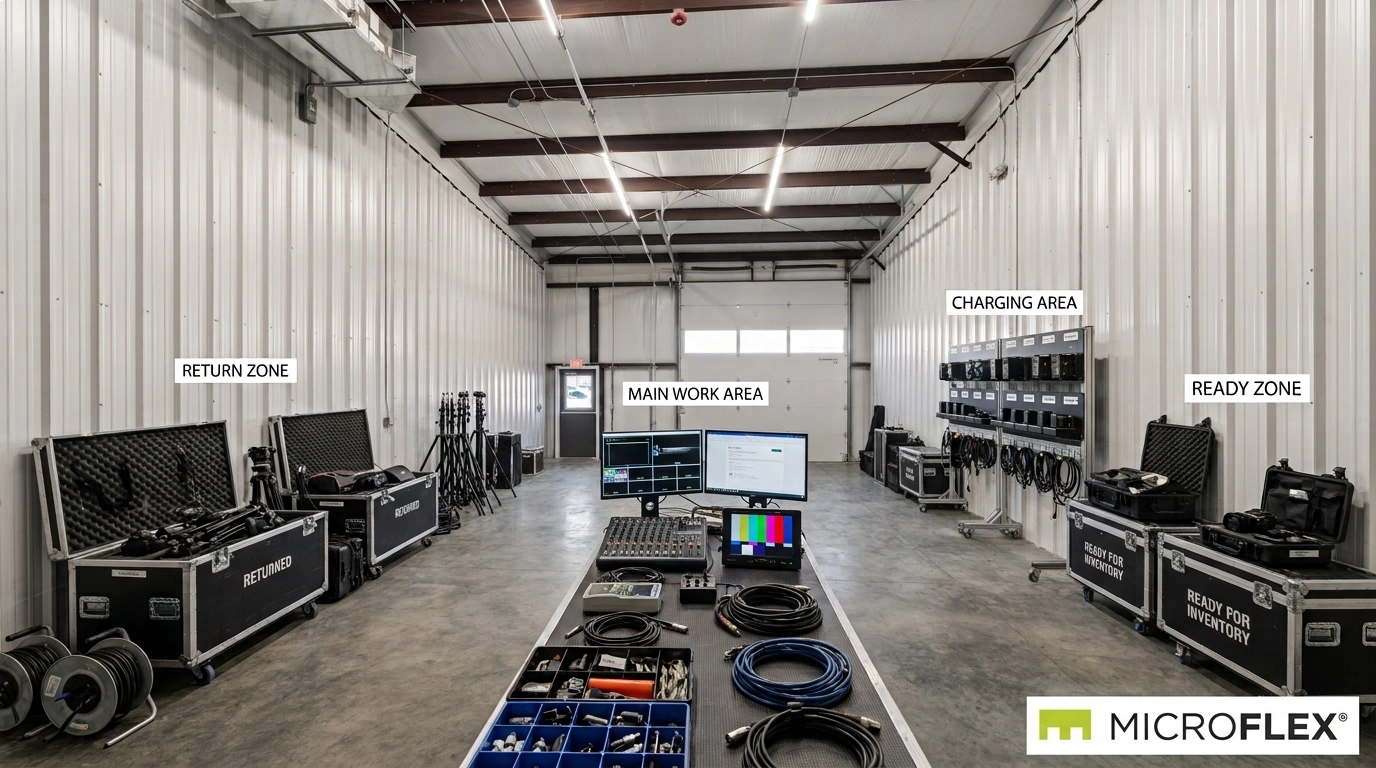
A compact reset area can become one of the highest-value parts of an event-production workspace.
It does not need to resemble a repair facility.
Its purpose is to create a predictable place for checking and organizing equipment between jobs.
A typical setup may include a work surface, computer monitor, cable organization, battery charging, small-component storage, and space for cases waiting to return to inventory.
The important part is separation.
Equipment awaiting review should not be mixed immediately with equipment already prepared for deployment.
That allows the team to understand status visually.
One side is returning.
One side is ready.
Road Cases Change the Floor Plan
Road cases are useful because they allow equipment to travel as a unit.
They also occupy floor space differently from shelving.
Many are mobile.
That can be an advantage when the layout is designed around movement.
Cases arrive.
They move toward reset.
They return to assigned positions.
They later move into event-specific staging.
Then they roll toward loadout.
The floor becomes part of the operating system rather than simply a place to store equipment.
Event-Specific Staging Prevents Last-Minute Searching
The equipment needed for one corporate event may be completely different from what is needed for the next video production or installation.
That is why event businesses can benefit from staging by job rather than only by equipment category.
Inventory storage answers:
Where does this item normally live?
Event staging answers:
Which items leave together next?
Those are different questions.
A job-specific staging area can bring together lighting, audio, camera equipment, cabling, stands, accessories, and cases for one upcoming assignment.
Once staged, the job can be reviewed as a complete set before the equipment reaches the vehicle.
Keep the Loadout Path Open
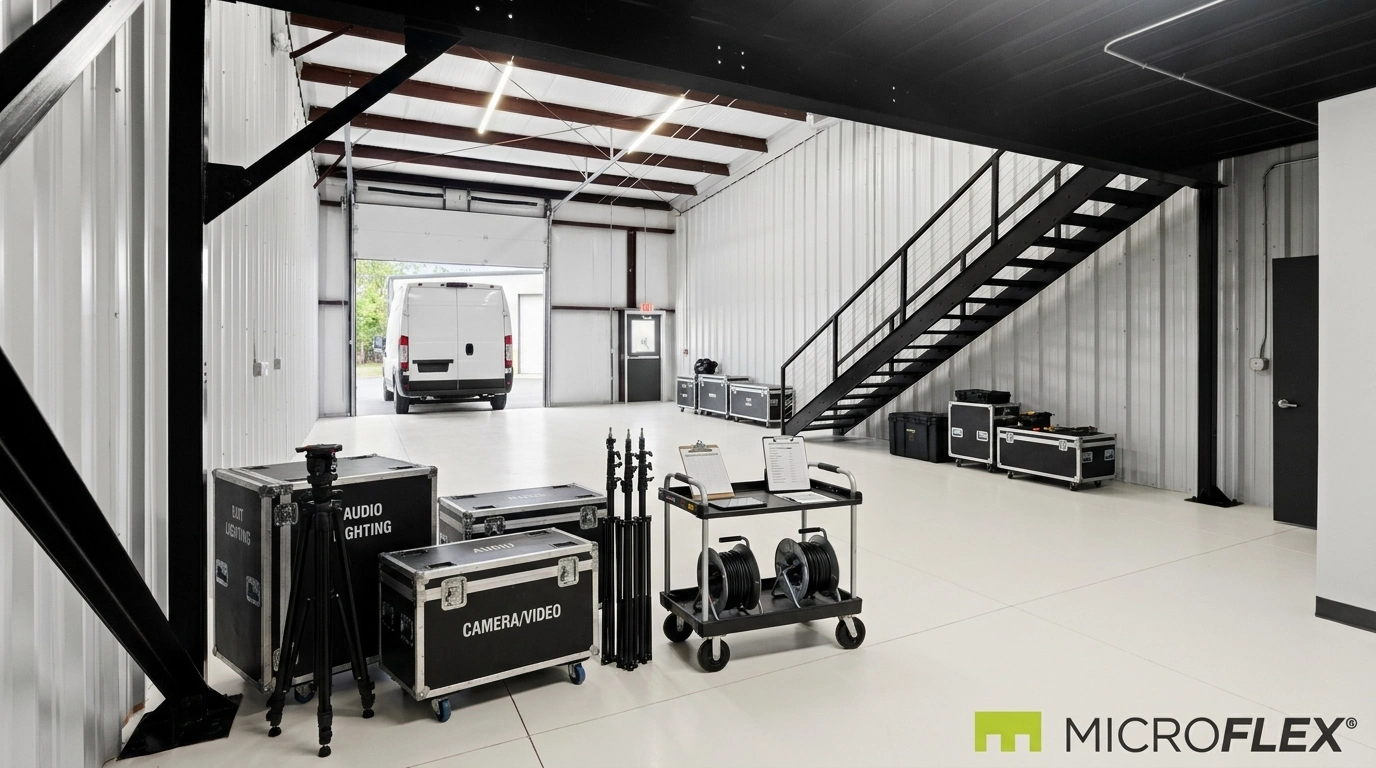
At purpose-built MicroFlex® locations, units include drive-up roll-up access.
For an event-production business, that feature can become part of the operating workflow rather than simply an access point.
Rolling cases, carts, stands, and other equipment can move between the working floor and vehicle area without passing through a separate shared interior loading process.
But that advantage depends on keeping the path usable.
If the area immediately inside the roll-up door becomes permanent case storage, loading activity starts competing with inventory.
A more functional setup keeps the primary loadout route open and uses the area near the door for temporary staging before departure.
Think in Event Loads, Not Just Inventory
A shelf-based inventory system tells the business what it owns.
An event-load system tells the business what is leaving.
For production companies, both are necessary.
Consider a lighting package.
Fixtures may have normal storage locations.
Stands may live elsewhere.
Cables may be organized separately.
Control equipment may occupy another shelf or road case.
Those categories make sense for storage.
But when one event needs all of them, the equipment needs to converge somewhere before departure.
That is why open staging area can be more useful than filling every remaining section of floor with additional shelving.
Small Components Need Their Own System
Large equipment is difficult to lose visually.
Adapters are not.
Neither are small cables, clamps, connectors, batteries, memory cards, mounting accessories, or replacement components.
For many event-production businesses, the smallest items can create the largest preparation delays.
Defined small-parts storage reduces that problem.
Frequently used components can remain close to the preparation area.
Less common accessories can stay organized by equipment family or function.
The exact storage system matters less than consistency.
If each item has a predictable return point, the operating base resets more easily after a job.
Separate Preparation From Reserve Equipment
An event business can have significant equipment inventory without needing all of it active at the same time.
Reserve or less frequently used equipment can remain organized around the perimeter.
The central floor can support temporary preparation.
That allows the active workspace to change based on the next job.
A corporate AV loadout may require several rolling cases and monitors.
A smaller production job may need camera and lighting kits.
A content-production setup may require fewer large cases but more preparation space.
The physical inventory may remain similar.
The active floor changes.
A Mezzanine Can Separate Planning From Equipment Movement
At purpose-built locations where a mezzanine configuration is available, FLEX Premium and FLEX Ultimate can separate some administrative activity from the main operational floor.
FLEX Premium includes a mezzanine.
FLEX Ultimate includes a full mezzanine with premium finish.
Configuration availability varies by location and unit.
For an event-production operator, that separation can support scheduling, quoting, equipment lists, job planning, customer communication, and other desk-based functions.
The ground floor remains focused on physical equipment movement.
The upper level supports planning.
See
the four MicroFlex configurations
for the full product breakdown.
A Practical Daily Rhythm
The same unit may support several workflows during one day.
In the morning, prepared cases may move toward loadout.
Later, returned equipment may enter the reset area.
Throughout the afternoon, equipment can return to assigned storage while another job begins staging.
Administrative work can continue separately.
The unit is not being used for one fixed activity.
It is supporting a recurring operational cycle.
That is the distinction between equipment storage and an equipment operating base.
Open Space Is Not Wasted Space
A nearly full unit can look efficient.
Operationally, it may be the opposite.
Event equipment moves.
Cases roll.
Carts turn.
Stands move in and out of racks.
Several equipment groups may need to come together before a job.
That means some floor area should remain intentionally available.
Open space can become today’s staging area, tomorrow’s return zone, and the next day’s loadout path.
Its value comes from not being permanently occupied.
When an Event Business Starts Needing an Operating Base
The need becomes clearer when storage begins interfering with preparation.
Cases are kept in several places.
The business repeatedly loads and unloads equipment simply to reach what it needs.
Charging happens wherever space is available.
Upcoming jobs are prepared in the same area where returned equipment is waiting.
The vehicle begins functioning as permanent storage rather than transportation.
At that point, the problem is no longer simply where to keep equipment.
It is how to manage equipment between jobs.
A dedicated operating base gives those stages defined places.
MicroFlex for Event and Production Operations
Purpose-built MicroFlex units are typically approximately 1,000 to 1,250 square feet, with standard bay dimensions of 25 by 40 or 25 by 50 feet.
Purpose-built units include a drive-up roll-up door, private restroom, HVAC, and LED lighting.
For a compatible event-production or equipment-based business, the footprint can be organized around a clear cycle:
equipment storage → job staging → preparation → loadout → return → reset
The proposed use, equipment requirements, customer-visit pattern, and other operating requirements should be discussed with the leasing team for the specific unit.
For another example of how direct access shapes small-business workflows, see
How Drive-Up Access Supports Daily Operations for Service Businesses
A Note About Auburn-Opelika
MicroFlex Auburn-Opelika is a rebranded property rather than a purpose-built MicroFlex development.
Climate control varies by unit, mezzanine configurations are not available, and units do not begin at 1,000 square feet.
The property includes drive-up roll-up doors and private restrooms.
Current unit size, features, compatibility, and availability should be confirmed with the leasing team for the specific unit.
Build the Workflow Around the Next Job
An event-production company does not need a warehouse that simply holds road cases.
It needs an operating base where equipment can move from one job into preparation for the next.
The useful sequence is simple:
return → reset → organize → stage → load
When each stage has a defined place, the unit supports more than storage.
It becomes part of the production workflow.
Review the
current MicroFlex locations
and contact the leasing team for current configurations, unit availability, and compatibility with the proposed operation.
Disclosure
This article is published by Founders Investment Properties, LLC, owner and operator of MicroFlex®. Content is provided for general informational and educational purposes only. Nothing in this article constitutes legal advice, tax advice, financial advice, investment advice, insurance advice, real estate brokerage advice, or any other form of professional advice. Readers should consult their own attorneys, accountants, tax professionals, insurance brokers, and licensed real estate professionals before making decisions based on the topics discussed.
MicroFlex® is a registered trademark of Founders Investment Properties, LLC. Photos may be representative and may not reflect a specific location. Product configurations, features, lease terms, pricing, and availability are subject to change. Current information is available at microflexspace.com or by contacting the leasing team directly.