A small food or beverage brand can outgrow a simple packing table long before it needs a large distribution facility.
The challenge is often not square footage by itself.
It is flow.
Finished packaged products arrive in one area. Packaging materials accumulate somewhere else. Gift sets or mixed-product kits are assembled wherever an open surface is available. Labels, inserts, cartons, and shipping supplies compete with saleable inventory for the same shelves.
Completed orders can end up beside incoming products because there is no defined outbound area.
At that point, the business may not need a much larger operation.
It may need a more deliberate one.
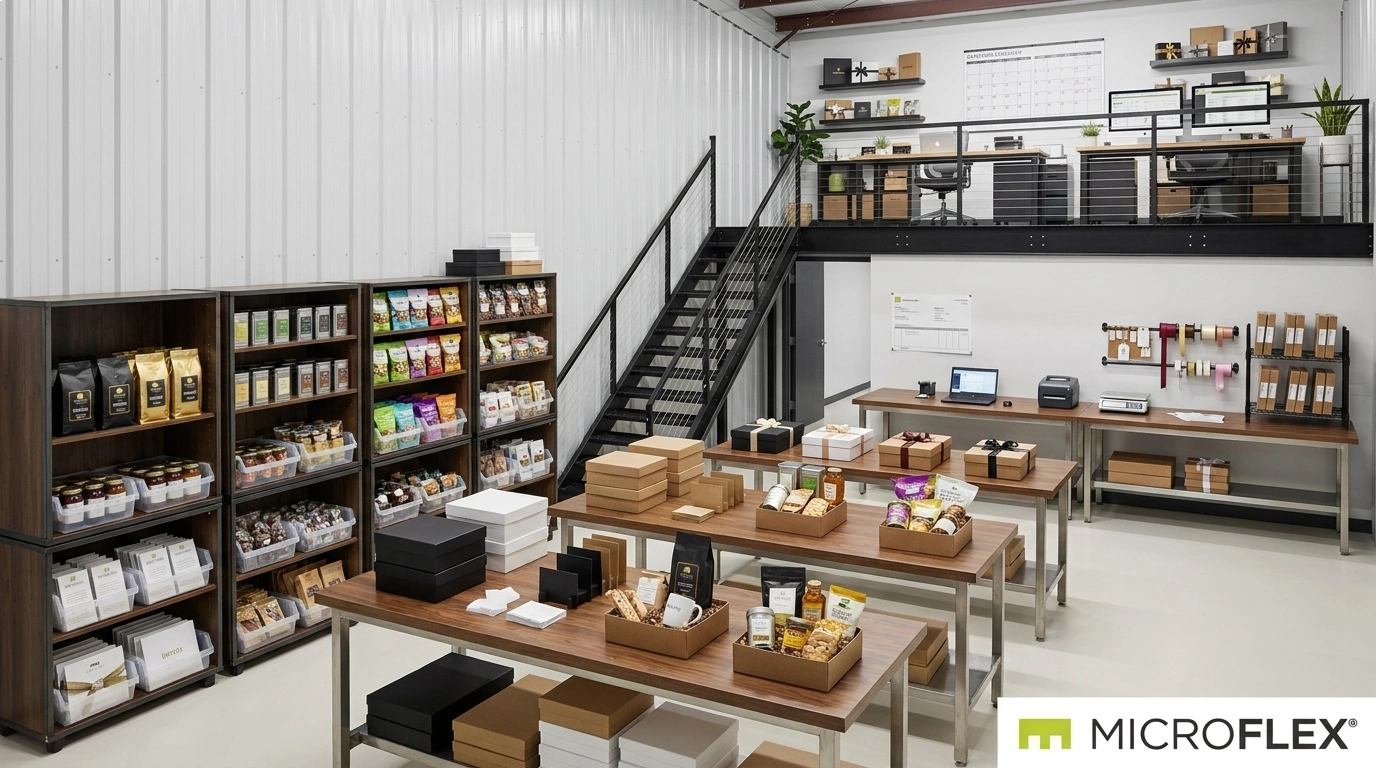
For food and beverage micro-producers handling finished packaged goods, a small-bay flex workspace can be organized around receiving, inventory, secondary packaging, kitting, order preparation, verification, and outbound staging.
This article focuses on those operational workflows. It does not assume that cooking, open-food handling, bottling, manufacturing, processing, or food-service activity is permitted in a MicroFlex unit. The proposed use, product type, equipment, and applicable requirements must be evaluated for the specific operation and unit.
The Workflow Starts Before the Packing Table
Packaging is only one stage of the operation.
A small brand may handle finished packaged products, cartons, bottles, tins, pouches, printed inserts, gift packaging, shipping materials, and completed customer orders during the same working day.
When all of those items occupy the same space without defined roles, the operator begins moving inventory simply to create room for the next task.
A more useful layout follows a sequence:
receiving → reserve inventory → active inventory → packaging or kitting → verification → finished goods → outbound staging
The objective is not to recreate a food factory inside a flex unit.
The objective is to make the movement of packaged goods predictable.
Receiving Should Have a Defined Landing Area
Incoming goods need somewhere to land before they become usable inventory.
Depending on the business, incoming items might include finished sealed products from another facility, packaging components, printed cartons, labels, inserts, shipping materials, or merchandise that will later become part of a kit.
Placing every delivery directly onto any available shelf combines receiving and inventory into one uncontrolled process.
A temporary receiving area creates a transition point.
Items can arrive, be checked, and then move toward reserve inventory, active stock, packaging supplies, or a specific order workflow.
The objective is to keep the entrance from becoming permanent storage.
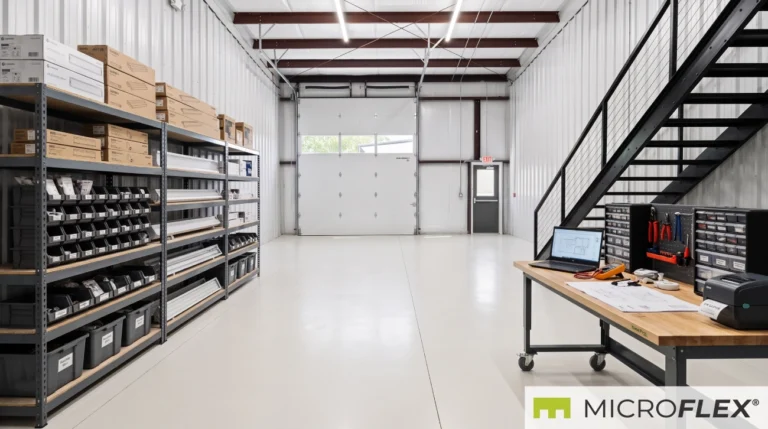
At purpose-built MicroFlex® locations, units include a drive-up roll-up door, allowing inventory and business supplies to move directly between the vehicle area and the operational floor.
Reserve Inventory and Active Inventory Serve Different Roles
A micro-producer rarely needs every case of product immediately beside the packing table.
Keeping all inventory equally accessible can actually make the working area less efficient.
A useful distinction is between reserve inventory and active inventory.
Reserve inventory is product available to the business but not immediately required for current kits or orders.
Active inventory is the smaller quantity currently feeding the packaging or kitting workflow.
For example, a business assembling mixed-product gift sets might store reserve cases along the perimeter while keeping smaller working quantities near the kitting tables.
As active inventory is consumed, it can be replenished from reserve stock.
The cycle becomes:
reserve inventory → active stock → kit or order → finished staging
Frequently handled products remain close to the work without forcing the entire inventory footprint into the center of the operation.
Packaging Materials Need Their Own System
Saleable inventory is only part of the space requirement.
Packaging materials can occupy significant floor and shelf space.
Flat cartons, gift boxes, dividers, labels, printed inserts, sleeves, tissue, tape, protective materials, envelopes, and shipping supplies all need somewhere to go.
If those materials are mixed with product inventory, both categories become harder to manage.
A dedicated packaging-supply zone keeps the working tables supplied without turning the tables themselves into storage.
Frequently used materials can remain close to the active workflow.
Reserve cartons and lower-use supplies can remain farther away.
Printed materials can be separated by product, kit, or campaign.
The work surface should remain a work surface.
A Kitting Station Should Be Designed Around Repetition
Kitting becomes easier to manage when the same physical sequence can repeat without reorganizing the entire table after every order.
Consider a micro-brand assembling a sampler or gift set using several already finished and sealed products.
One component enters the kit.
Then another.
Then an insert or divider.
Then the outer packaging.
The finished kit should then move away from the worktable rather than remain in the same space as the components waiting to be used.
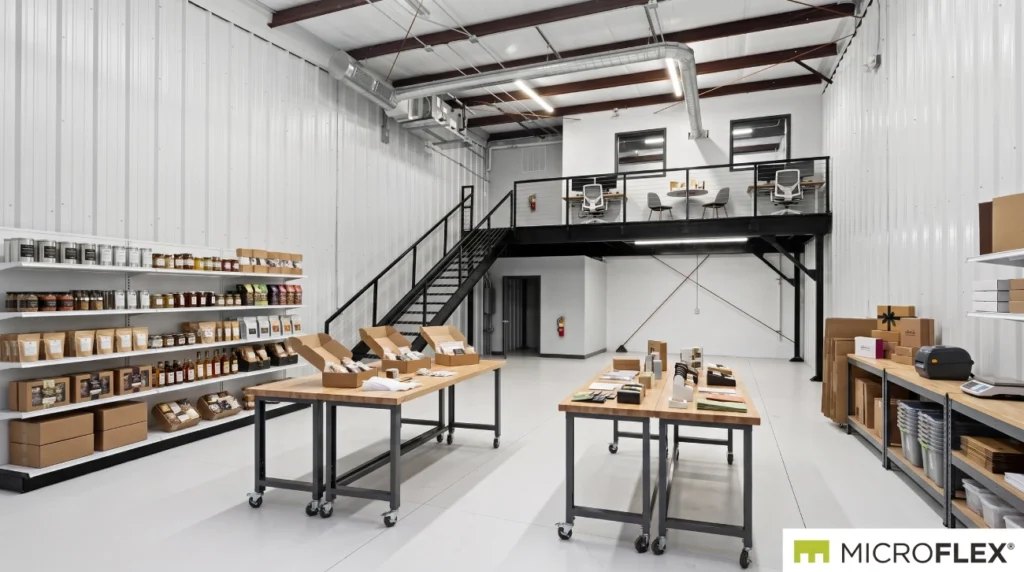
A useful kitting station places active components within a short working radius while providing a clear destination for completed kits.
Rolling tables and movable component bins can also allow one area to support different kit formats at different times.
Subscription Boxes and Corporate Gift Kits Add More Moving Parts
A business preparing subscription boxes or corporate gift sets usually handles more components per finished order than a single-product shipper.
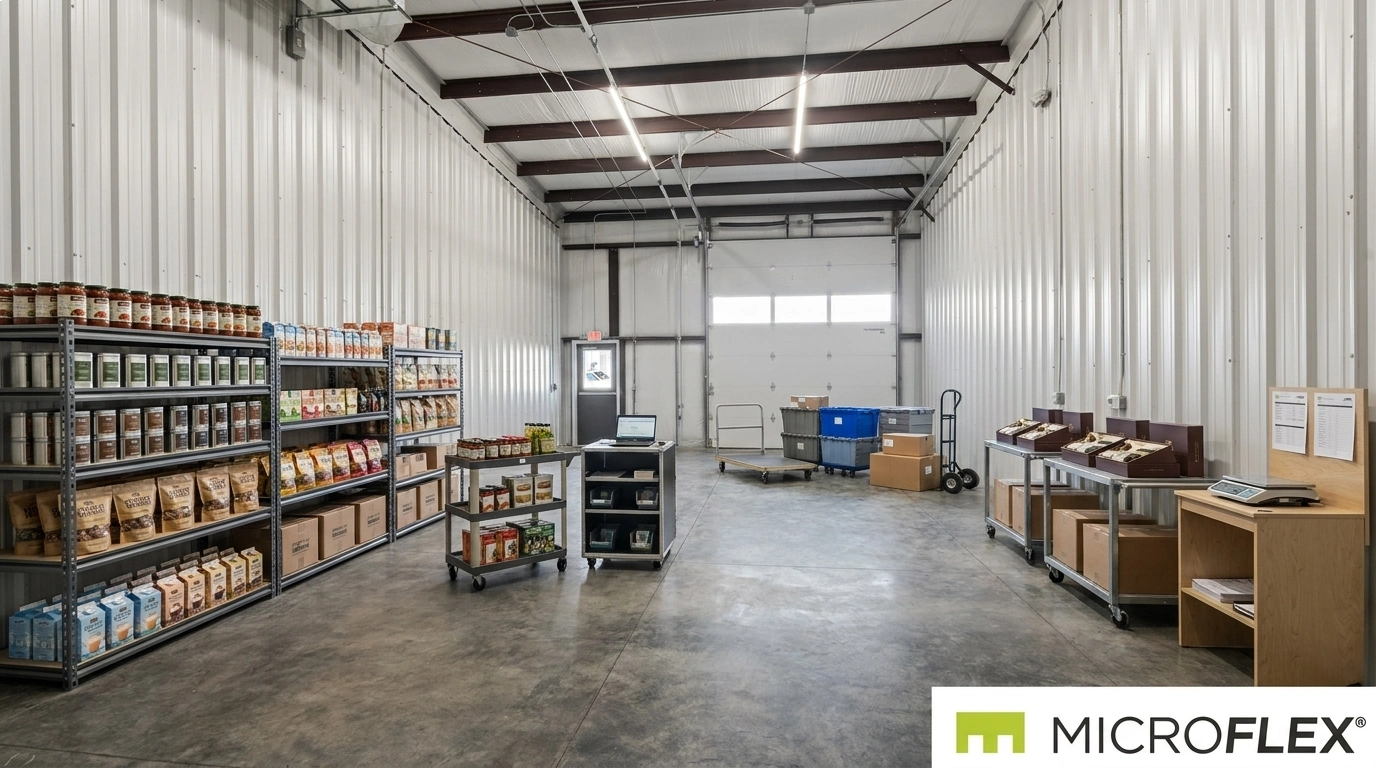
Several SKUs may need to reach the same worktable.
Gift packaging may change by campaign.
Printed inserts may change by customer or season.
The finished kit may occupy more space than the individual components did before assembly.
That makes temporary staging important.
A useful flow might look like:
component picking → kit assembly → verification → finishing → outbound staging
The business does not simply need somewhere to store the products.
It needs room for the products while they are moving from inventory into a finished customer order.
Keep Active Kitting Separate From Reserve Storage
Placing worktables directly inside storage aisles can appear efficient because the inventory is nearby.
In practice, active work can begin blocking access to reserve inventory as order volume increases.
The relationship should be close but separate.
Reserve inventory feeds the kitting station.
The kitting station should not prevent access to reserve inventory.
This is one reason protecting some open floor area can be more useful than maximizing shelf density.
Build a Verification Step Into the Workflow
Once a kit or packaged order has been assembled, it can move through a separate verification point before entering finished-goods staging.
Operationally, this creates a defined moment to confirm that the intended products, quantities, packaging components, and order materials are together.
For food businesses, labeling requirements may also apply depending on the product, activity, and circumstances.
The U.S. Food and Drug Administration provides guidance covering food labeling and major food allergens. The applicable requirements depend on the specific product and business, so the workspace layout itself should not be treated as regulatory guidance.
From a workflow perspective, the key point is to separate items still being assembled from items that have completed the business’s verification process.
Finished Goods Need a Different Destination
Once an order, bundle, gift set, or subscription kit is completed, its operational status has changed.
It should no longer sit among loose components waiting to be used.
Finished goods can move to dedicated shelving, rolling carts, or a temporary staging area.
That separation makes it easier to distinguish what is ready to leave from what still requires work.
A small operation does not necessarily need a large finished-goods zone.
Its size should follow the shipping rhythm.
A brand moving orders daily may keep finished staging relatively small.
A business preparing a larger group of kits for a periodic shipment or pickup may need more temporary floor space.
The important distinction is status, not volume.
Outbound Staging Should Behave Like a Queue
The loading area can support another role later in the workflow.
After receiving has been cleared, completed orders can move toward outbound staging shortly before loading or pickup.
The phrase shortly before is important.
When finished orders remain at the entrance indefinitely, outbound staging becomes another storage zone.
The loading area begins to lose its usefulness for both incoming and outgoing movement.
A better outbound zone functions like a queue:
ready order → outbound staging → vehicle or pickup → cleared floor
Once the order leaves, the space becomes available for the next operating cycle.
One-Way Product Flow Reduces Backtracking
A useful workflow does not need sophisticated automation.
A basic directional layout can already reduce unnecessary movement.
Incoming goods enter near the roll-up door.
Reserve inventory moves toward perimeter storage.
Active inventory feeds packaging or kitting tables.
Completed work moves through verification.
Finished orders move back toward outbound staging.
The product progresses through the unit rather than repeatedly crossing the same floor.
Every time a carton, kit, or case is moved only to make space for something else, the layout is creating work without advancing the order.
Seasonal Campaigns Change the Space Requirement
Food and beverage brands may encounter periods when the packaging workflow changes even though the underlying products remain the same.
Holiday gift sets, corporate gifting, subscription cycles, limited assortments, or other campaigns can temporarily increase the number of components moving through the unit.
A fully fixed floor plan can struggle with those temporary changes.
Mobile tables and open floor area can absorb temporary activity more easily than filling the entire unit with permanent storage.
For one campaign, a business may operate several kitting tables.
Afterward, the same area can return to ordinary order preparation.
That is one reason the unit should not be organized only around peak storage density.
Exceptions Need Their Own Destination
Most inventory follows the normal workflow.
Some does not.
Packaging may arrive damaged.
An order may be returned.
A carton may require review.
A finished item may need to remain separate from available inventory until the business decides what should happen next.
Automatically returning every exception to normal stock can make it difficult to distinguish ready inventory from items still requiring attention.
A small, clearly separated review area can prevent exceptions from becoming general clutter.
Administrative Work Is Still Part of the Operation
Food and beverage micro-producers also have administrative workflows behind the physical operation.
Orders need review.
Packaging supplies need reordering.
Inventory levels need monitoring.
Supplier communication, customer service, shipping documentation, and planning still happen somewhere.
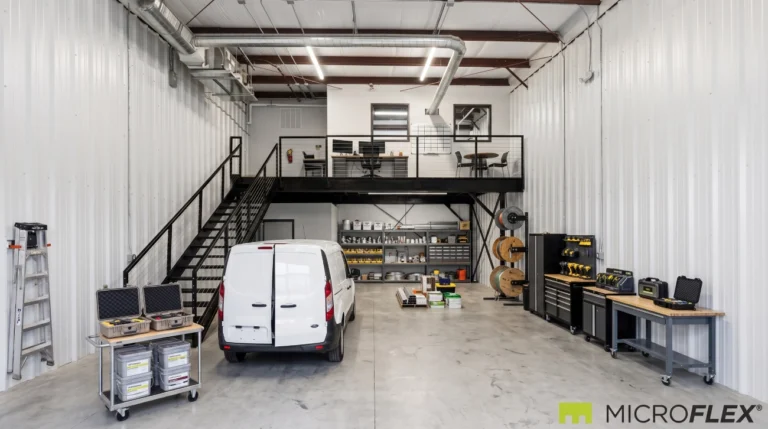
At purpose-built MicroFlex locations, the selected configuration determines how much separation is available between administrative work and the operational floor.
FLEX is the open-bay base configuration.
FLEX+ adds an enclosed rear office.
FLEX Premium adds a mezzanine.
FLEX Ultimate includes a full mezzanine with premium finish.
The configuration should follow the business workflow rather than becoming a feature checklist.
Climate Control Is Not Refrigeration
Purpose-built MicroFlex locations include standard HVAC throughout the unit.
Standard climate control should not be interpreted as refrigeration, frozen storage, specialized humidity control, or another product-specific environmental system.
Businesses handling products that require refrigeration, frozen conditions, narrow temperature ranges, or other specialized environmental controls need to determine whether their requirements and equipment are compatible with the specific unit.
The same principle applies to any activity that may involve product-specific sanitation, ventilation, processing, or equipment requirements.
The workspace does not replace the operator’s regulatory responsibilities.
Food Facility Registration Depends on the Actual Business Activity
The FDA states that facilities engaged in manufacturing, processing, packing, or holding food intended for consumption in the United States generally must register with FDA unless a specific exemption applies.
Examples of exemptions can include certain farms, retail food establishments, restaurants, and private residences where FDA-regulated food is made, depending on the applicable definitions and circumstances.
That means two businesses selling similar products can still have different regulatory situations depending on where and how products are manufactured, packed, held, and sold.
This article does not determine whether a particular business must register with FDA or which federal, state, or local requirements apply.
Those questions should be resolved for the specific business and proposed activity before food-related operations begin.
A Practical Small-Bay Workflow
At purpose-built MicroFlex locations, typical units are approximately 1,000 to 1,250 square feet.
MicroFlex uses one-year modified gross leases.
Within that footprint, a packaged-goods micro-producer can think about the operation as seven connected functions:
- receiving
- reserve inventory
- active inventory
- packaging or kitting
- verification
- finished goods
- outbound staging
Those functions do not all require permanent rooms.
Receiving and outbound staging may use the same general floor area at different times.
A central table can support gift-set kitting during a campaign and standard order preparation during the rest of the month.
Reserve inventory can remain relatively static around the perimeter while active work changes in the center.
The objective is to give each stage a logical destination without overfilling the unit.
Auburn-Opelika Has Different Product Characteristics
MicroFlex Auburn-Opelika is a rebranded property rather than a purpose-built MicroFlex development.
The purpose-built product assumptions above should not automatically be applied there.
At Auburn-Opelika, units include drive-up roll-up doors and private restrooms. Climate control varies by unit, mezzanine configurations are not available, and units do not begin at 1,000 square feet.
Any proposed packaging, kitting, inventory, or food-related use should be evaluated against the actual available unit and confirmed with the leasing team.
Start With Product Movement
The most useful starting point is not the number of shelves that fit inside the unit.
Start with the movement of the product.
- Where does finished inventory enter?
- Where is reserve stock held?
- Which products need to remain beside the kitting table?
- Where do packaging materials live?
- Where is a completed order checked?
- Where does finished inventory wait before leaving?
- How does it reach outbound staging without crossing back through receiving?
When those movements are clear, the floor plan becomes easier to organize.
That is the practical value of a food packaging and kitting workflow.
It turns products, packaging materials, labels, gift sets, and orders into a repeatable operating sequence.
MicroFlex as a Packaging and Kitting Operating Base
MicroFlex® small-bay flex space can be evaluated for non-retail business workflows involving packaged inventory, packaging, kitting, order preparation, and fulfillment.
Suitability depends on the proposed activity, product, equipment, property, unit configuration, applicable requirements, and confirmation of permitted use.
The existence of a MicroFlex unit should not be interpreted as approval for food manufacturing, food processing, preparation, bottling, cooking, or food-service activity.
For a business working with finished packaged products, begin by mapping:
receiving → inventory → active stock → packaging or kitting → verification → finished goods → outbound
Then review
current MicroFlex locations
and contact the leasing team to discuss the proposed use, available configuration, property-specific features, and current availability.
For a broader workflow example, see
A Kitting and Light Assembly Workflow in a Small-Bay Unit
Sources
- U.S. Food and Drug Administration, How to Start a Food Business
. - U.S. Food and Drug Administration, Registration of Food Facilities and Other Submissions
. - U.S. Food and Drug Administration, Food Allergies and Food Labeling Resources
Disclosure
This article is published by Founders Investment Properties, LLC, owner and operator of MicroFlex®. Content is provided for general informational and educational purposes only. Nothing in this article constitutes legal advice, tax advice, financial advice, investment advice, insurance advice, real estate brokerage advice, or any other form of professional advice. Readers should consult their own attorneys, accountants, tax professionals, insurance brokers, and licensed real estate professionals before making decisions based on the topics discussed.
MicroFlex® is a registered trademark of Founders Investment Properties, LLC. Photos may be representative and may not reflect a specific location. Product configurations, features, lease terms, pricing, and availability are subject to change. Current information is available at microflexspace.com or by contacting the leasing team directly.